

The Gospel: Matthew 8:28-34
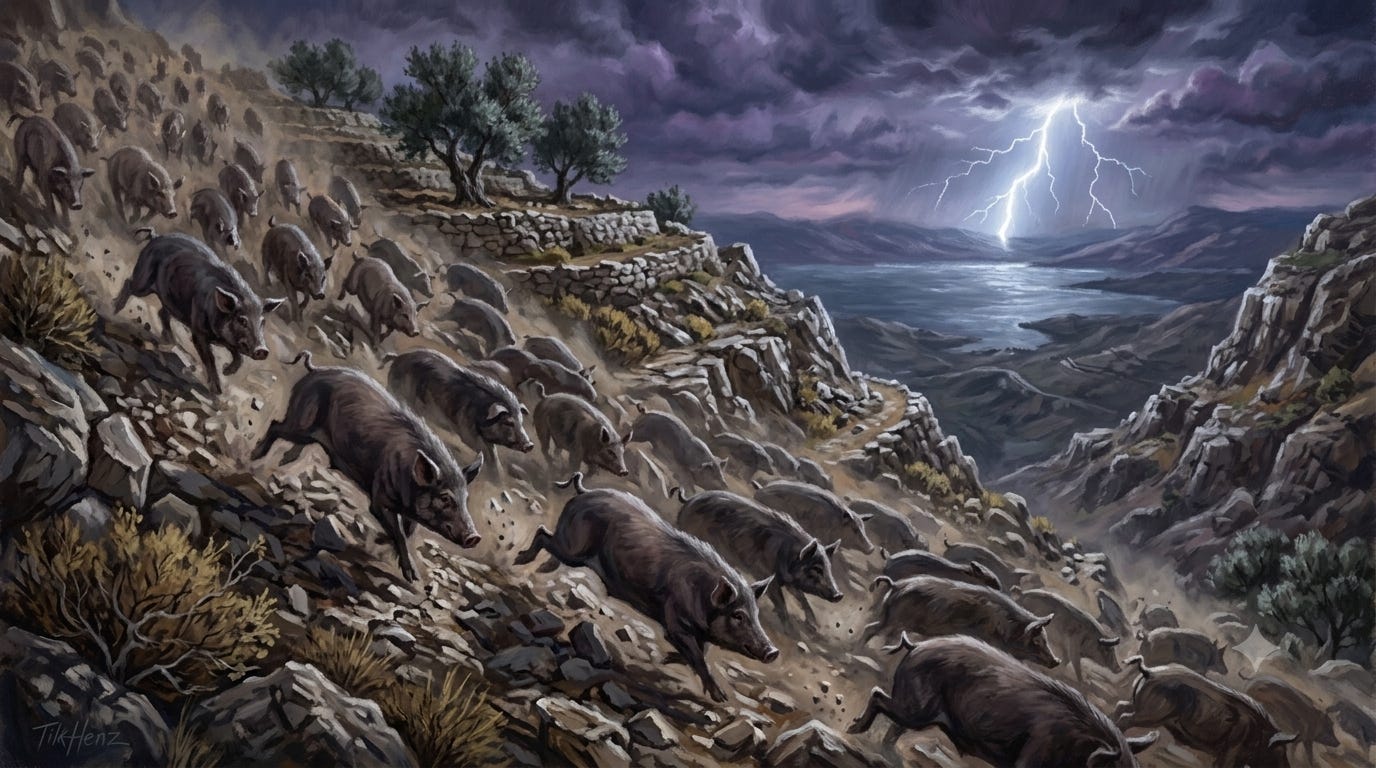
²⁸ When Jesus came to the territory of the Gadarenes, two demoniacs who were coming from the tombs met him. They were so savage that no one could travel by that road. ²⁹ They cried out, "What have you to do with us, Son of God? Have you come here to torment us before the appointed time?" ³⁰ Some distance away a herd of many swine was feeding. ³¹ The demons pleaded with him, "If you drive us out, send us into the herd of swine." ³² And he said to them, "Go then!" They came out and entered the swine, and the whole herd rushed down the steep bank into the sea where they drowned. ³³ The swineherds ran away, and when they came to the town they reported everything, including what had happened to the demoniacs. ³⁴ Thereupon the whole town came out to meet Jesus, and when they saw him they begged him to leave their district.
Today’s Focus
Jesus crosses into Gentile territory and frees two violently possessed men, permitting the loss of an entire herd of swine as the visible cost of an invisible deliverance. The town that witnesses this power responds not with welcome but with a request that Jesus leave, a reminder that real freedom often disrupts more than it comforts.
In the Margins
When Jesus came to the territory of the Gadarenes, two demoniacs who were coming from the tombs met him. They were so savage that no one could travel by that road. The setting itself signals that Jesus has crossed a boundary. Gadara sat in the Decapolis, Gentile territory east of the Jordan, a region where pig farming was a normal part of the economy precisely because the population was not bound by Jewish dietary law. The men living among the tombs occupy a double exile, cast out from human community by the violence of their possession and rendered ritually unclean by their dwelling place under the Law’s own categories. Jesus walks directly into both kinds of uncleanness, Gentile land and the realm of the dead, without hesitation.
What have you to do with us, Son of God? Have you come here to torment us before the appointed time? The demons know exactly who Jesus is and what is coming. Their question reveals an awareness of a final reckoning still ahead, a torment they understand as appointed and certain. They are not confused about reality. They are simply unwilling to submit to it. This is a sobering picture of a knowledge that produces dread rather than repentance, since knowing the truth and yielding to it are not the same thing.
Their request to enter the herd of swine rather than face immediate judgment shows something almost desperate in demonic activity, a preference for embodiment in degraded form over facing what is coming. Jesus says simply, go then. The whole herd rushes down the bank into the sea and drowns. This was a real economic loss for the swineherds and the town, and Jesus does not prevent it. The deliverance of two men cost something visible and material to people who were not even present to ask for it. Freedom, even when it is purely good news for the one receiving it, is not always free of cost to everyone standing nearby.
The swineherds run to report what happened, and the whole town comes out to meet Jesus. After everything that has just occurred, two violently possessed men freed and restored, we might expect gratitude. Instead, when they saw him, they begged him to leave their district. The town’s response is not unlike Israel’s own response at Sinai, where the people asked Moses to be the one who approached God so they would not have to draw near themselves. An encounter with real power that disrupts a settled order, even an order built around something as costly as a ruined herd, can produce fear and a desire for distance rather than welcome.
The two men themselves disappear from Matthew’s account without names and without further mention. Yet their restoration stands on its own as proof that no one, however thoroughly bound and however far outside the visible community of God’s people, is beyond the reach of Christ’s authority over evil. The town that asked Jesus to leave is the part of this story most worth sitting with, because it raises an honest question about what we do when God’s power shows up in a way that disrupts more than it comforts. We say we want freedom. We are not always prepared for what its arrival might cost or disturb.
Reflection Question
Where in your own life have you preferred the familiar disorder to the disruption that real freedom from it would require?