

The Gospel: Matthew 17:1-9
Jesus took Peter, James, and John his brother,
and led them up a high mountain by themselves.
And he was transfigured before them;
his face shone like the sun
and his clothes became white as light.
And behold, Moses and Elijah appeared to them,
conversing with him.
Then Peter said to Jesus in reply,
“Lord, it is good that we are here.
If you wish, I will make three tents here,
one for you, one for Moses, and one for Elijah.”
While he was still speaking, behold,
a bright cloud cast a shadow over them,
then from the cloud came a voice that said,
“This is my beloved Son, with whom I am well pleased;
listen to him.”
When the disciples heard this, they fell prostrate
and were very much afraid.
But Jesus came and touched them, saying,
“Rise, and do not be afraid.”
And when the disciples raised their eyes,
they saw no one else but Jesus alone.
As they were coming down from the mountain,
Jesus charged them,
“Do not tell the vision to anyone
until the Son of Man has been raised from the dead.”
Today’s Focus
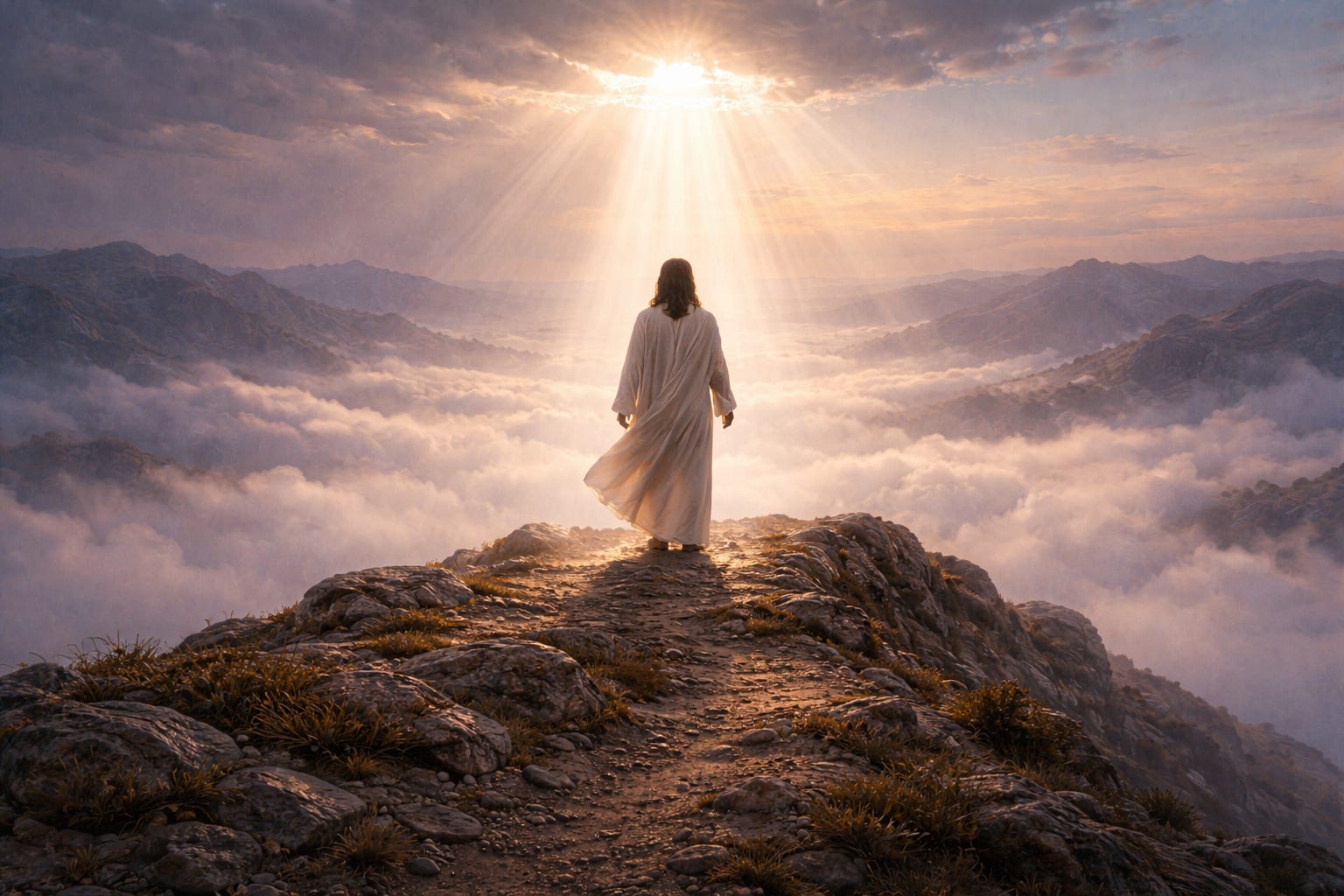
The Transfiguration reveals who Jesus truly is. On a mountain that echoes Sinai and the great moments of Old Testament revelation, Jesus is unveiled in divine glory before Peter, James, and John. His radiant face and dazzling garments signal not reflected glory like Moses, but intrinsic divine identity. Moses and Elijah stand with Him as representatives of the Law and the Prophets, showing that all of Israel’s Scriptures converge in Christ. Yet when the cloud lifts, “Jesus alone” remains.
This moment cannot be separated from the Cross. The glory shown on the mountain prepares the disciples for the suffering to come. The Father’s command — “Listen to Him” — directs all authority and fulfillment to Jesus. The Law and the Prophets point to Him. The question that remains for us is whether Jesus alone is enough.
In the Margins
In scripture, mountains are places of divine revelation. The meaning of the mountain here is theological rather than where it was located. Matthew echoes Sinai imagery. This use of the mountains here are echoes of Exodus 19-24, 1 Kings 18 and 1 Kings 19. The phrase we see, “by themselves,” shows that there was an intimacy to the experience. These disciples are the same three that are taken apart by Jesus in Gethsemane. Here, they are shown something amazing upon the mountain.
The word to describe what happens in Greek is the verb metemorphōthē. This is where we get the modern derivative, “metamorphosis.” It indicates transformation in visible appearance. We see this as the face of Jesus is described as shining “like the sun.” This imagery calls the face of Moses after Sinai in Exodus 34: 29-35. Interestingly, the change in His clothes links to Revelation, where it speaks of the white garments seen. The brightness imagery signals divine identity, not borrowed splendor.
The people who appear with Jesus are significant as well. Moses represents the Law. He is representative of the Covenant. Elijah on the other hand is representative of the Prophets and the expectations of what is to come. Together, these three are the entirety of Israel’s Scriptures in one place at the same time, the Law and the Prophets. This shows continuity, fulfillment, and transition.
Peter’s instinct is to preserve the moment, to remain in glory. He offers to put up tents, a connection to the booths where Israelites lived during the Feast of Tabernacles. The Greek term, skēnai, is translated as tents here, but is the same word for booths in that Feast. The narrative shows that glory is not to be contained. The mission continues downward toward Jerusalem.
The cloud evokes the times we hear of in the Old Testament, specifically Sinai in Exodus 24: 15-18 and the cloud filling the tabernacle in Exodus 40:34-35. The message that is sent ties to Psalm 2:7 and Isaiah 42:1. It also connects us to what John the Baptist heard after the baptism of Jesus. The command to “listen to Him” recalls Deuteronomy 18:15. In a period where these scriptures were often memorized in full, this would have all connected very strongly, revealing an incredible picture of Jesus’ identity and role. Moses and Elijah are there, but the voice directs all authority and attention to Jesus alone.
The disciples fall prostrate, understanding the magnitude of what they are experiencing. Biblically, this is the appropriate response to divine manifestation (Daniel 10, Ezekiel 1). They are in awe, reverent before this divine holiness. When they look up, “they saw no one else but Jesus alone.” This is the theological climax. The Law and the Prophets fade.
Jesus remains.
The Transfiguration cannot be understood apart from the Cross. We understand the whole message today as we live our lives with a risen Jesus. The Passion shows us that the divine Son was the fulfillment of Law and Prophets. Without the Cross, the revealed glory could be misunderstood as political triumph. After the Passion, this vision shows the whole story. As we look at our lives through this lens, we have to ask if Jesus has been enough for us. If the answer is not yes, we need to question what continues to pull us away from Him. Here we have God, on multiple occasions telling us that He is pleased with Jesus, His son. Jesus is enough for God. He is enough to fulfill the Law and the Prophets. Jesus is incredible and we must allow Him to fill us and be enough for us.
Reflection Question
How can you allow more time in your life to reflect on and appreciate the sacrifice of Jesus?
A Small Invitation
If this reflection helped you, consider sharing it with someone who may benefit from hearing this message.