

The Gospel: Matthew 9:1-8
¹ He entered a boat, made the crossing, and came into his own town. ² And there people brought to him a paralytic lying on a stretcher. When Jesus saw their faith, he said to the paralytic, "Courage, child, your sins are forgiven." ³ At that, some of the scribes said to themselves, "This man is blaspheming." ⁴ Jesus knew what they were thinking, and said, "Why do you harbor evil thoughts? ⁵ Which is easier, to say, 'Your sins are forgiven,' or to say, 'Rise and walk'? ⁶ But that you may know that the Son of Man has authority on earth to forgive sins" — he then said to the paralytic, "Rise, pick up your stretcher, and go home." ⁷ He rose and went home. ⁸ When the crowds saw this they were struck with awe and glorified God who had given such authority to human beings.
Today’s Focus
Friends carry a paralyzed man to Jesus, who forgives his sins before healing his body, answering the scribes' silent accusation of blasphemy by performing a visible miracle that serves as proof of an authority no one could see directly.
In the Margins
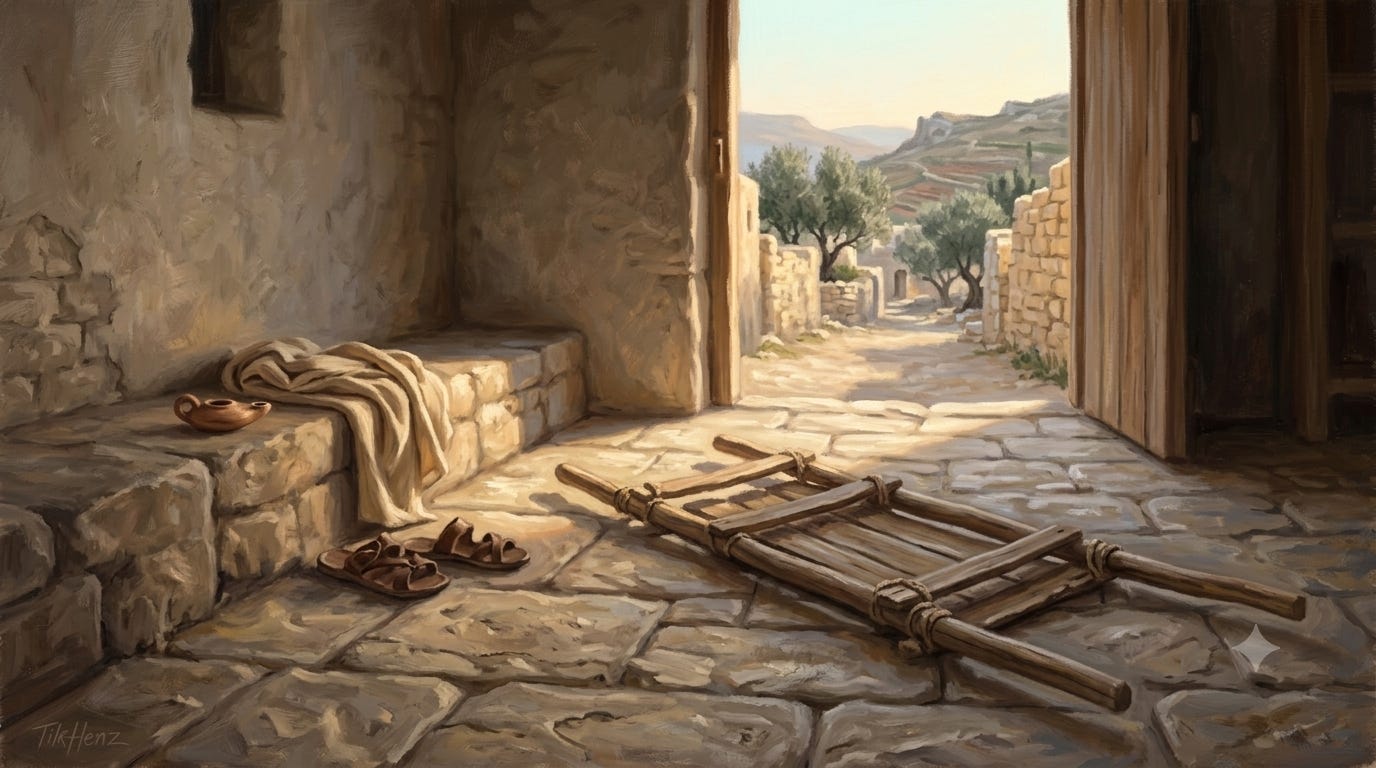
He entered a boat, made the crossing, and came into his own town. And there people brought to him a paralytic lying on a stretcher. Matthew tells us that when Jesus saw their faith, it is the faith of the men carrying the stretcher that moves him to act, not necessarily a profession of faith from the paralyzed man himself. Someone else’s effort and belief carried this man into the presence of Jesus. He could not get there on his own, and Jesus did not require that he could.
Courage, child, your sins are forgiven. This is the first thing Jesus says, before any word about the man’s legs or his ability to walk. The order matters. Whatever has gone wrong in this man’s body, Jesus addresses something underneath it first, the deeper wound of sin that every person carries whether or not it shows up as visibly as paralysis does.
Some of the scribes said to themselves, this man is blaspheming. Their objection was theologically serious, not petty. In the religious understanding of the day, only God could forgive sin in any final sense, since sin is fundamentally an offense against God and no one else has standing to absolve it. The scribes were not wrong about that principle. They were wrong about who was standing in front of them.
Jesus knew what they were thinking and met the accusation directly. Why do you harbor evil thoughts? Which is easier, to say, your sins are forgiven, or to say, rise and walk? The question exposes something important. Forgiving sins is, in one sense, the harder claim, because it cannot be verified by anyone watching. Anybody could say the words. What Jesus does next supplies the proof the words alone could not offer. Rise, pick up your stretcher, and go home. He rose and went home. The visible healing becomes the evidence authenticating the invisible reality that had already happened the moment Jesus spoke forgiveness over him.
When the crowds saw this they were struck with awe and glorified God who had given such authority to human beings. That final phrase is curious and worth noticing. The crowd does not simply marvel at Jesus. They glorify God for giving such authority to human beings, language that looks forward to a future in which this same authority to address sin would be entrusted to others, carried forward beyond Jesus’ own earthly presence.
Most of us are carrying two kinds of paralysis at once, the kind that is visible to the people around us and the kind we have learned to keep hidden. This passage suggests Jesus does not choose between addressing one or the other. He goes to the deeper wound first, and then he makes that deeper healing visible enough that no one watching, including the man himself, has to take it purely on faith. The forgiveness was real before the legs ever moved. The legs moving was the proof for everyone who needed to see it.
Reflection Question
Which is harder for you to actually believe right now, that Jesus can heal something visible in your life, or that he has already forgiven the thing you have never told anyone about?