

The Gospel: Mark 12:13-17
¹³ They sent some Pharisees and Herodians to him to ensnare him in his speech. ¹⁴ They came and said to him, "Teacher, we know that you are a truthful man and that you are not concerned with anyone's opinion. You do not regard a person's status but teach the way of God in accordance with the truth. Is it lawful to pay the census tax to Caesar or not? Should we pay or should we not pay?" ¹⁵ Knowing their hypocrisy he said to them, "Why are you testing me? Bring me a denarius to look at." ¹⁶ They brought one to him and he said to them, "Whose image and inscription is this?" They replied to him, "Caesar's." ¹⁷ So Jesus said to them, "Repay to Caesar what belongs to Caesar and to God what belongs to God." They were utterly amazed at him.
Today’s Focus
Jesus navigates the Pharisees and Herodians' tax trap by calling for a denarius, identifying Caesar's image as the basis of his claim to the coin, and implicitly subordinating Caesar's entire claim by pointing to Genesis 1 and the image of God stamped on human beings.
In the Margins
The Pharisees and Herodians arrive together. The coalition is itself significant. These two groups disagreed on nearly everything. The Pharisees were religious purists who resented Roman occupation and chafed under its cultural pressure. The Herodians supported the Herodian dynasty and by extension the Roman system that sustained it. Their unity in this moment signals that opposing Jesus has become more important than their opposition to each other. It was a clear “enemy of my enemy” situation.
Their opening is flattery designed to close off escape routes. Teacher, you are truthful, you are not concerned with anyone’s opinion, you teach the way of God in accordance with the truth. Every word is calculated to make a deflective answer impossible. Is it lawful to pay the census tax to Caesar or not?
The trap has two jaws. If Jesus says yes, He aligns Himself with Roman taxation and loses credibility among the crowds who resented occupation. If He says no, He can be reported as a rebel against Rome. Either answer appears to damage Him. Mark notes that Jesus knew their hypocrisy. He does not miss the game being played.
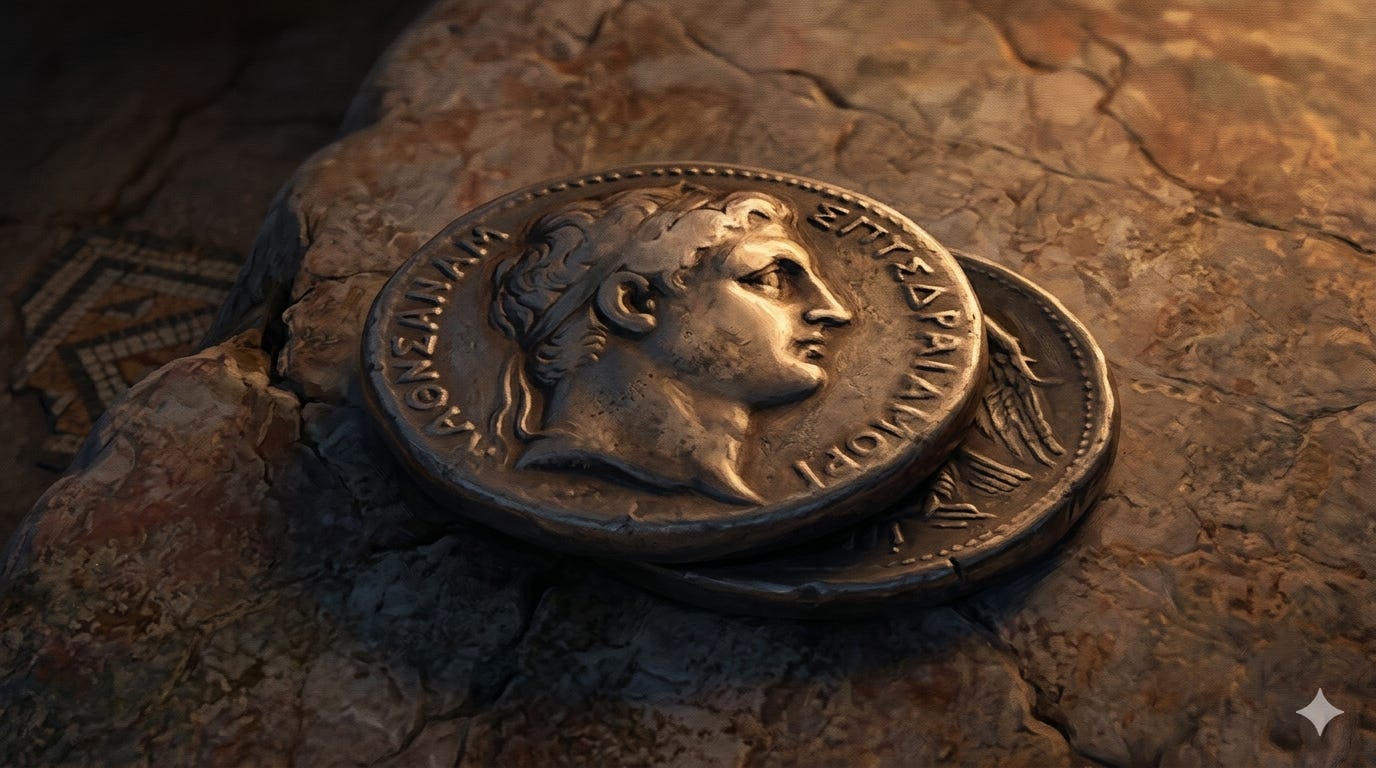
He asks for a denarius, the coin of the Romans. This coin bears the image and inscription of Tiberius, whose coins carried the words Tiberius Caesar, son of the divine Augustus, pontifex maximus. For strict Jews, carrying a coin bearing a graven image was itself a religious compromise. The Herodians carried such coins without concern. The Pharisees priding themselves on purity were in a more awkward position. By producing the coin in the Temple courts, the questioners have already revealed their own practical accommodation with Caesar’s economy.
Repay to Caesar what belongs to Caesar and to God what belongs to God. The Greek word apodote means to give back, to return what is already owed. Jesus is not dividing reality into two separate domains as if Caesar and God are co-equal sovereigns over different territories. He is pointing to image as the principle of belonging. The coin bears Caesar’s image and therefore belongs to his realm. Jesus is calling for them to return to the realm which belongs to the realm, still upholding the real of the Father in doing so.
This is the question underneath the question, the one Jesus leaves hanging in the air, is what bears God’s image. Genesis 1:26-27 answers it. Human beings are made in the image and likeness of God. What bears God’s image belongs to God. Caesar can have the metal stamped with his face. The human life stamped with God’s image belongs to God and cannot be rendered to Caesar as if it were his property.
Every person who has tried to navigate dual loyalties between civic obligation and the claims of God is living inside this passage. The answer Jesus gives does not eliminate the tension. It subordinates Caesar’s claim entirely by revealing the principle of image. The coin is Caesar’s. The person is God’s.
Reflection Question
In the places where civic obligation and the claims of God feel like competing loyalties, what would it mean to remember that the human life bearing God's image cannot ultimately be rendered to Caesar?