

The Gospel: Matthew 28:1-10
¹ After the sabbath, as the first day of the week was dawning, Mary Magdalene and the other Mary came to see the tomb. ² And behold, there was a great earthquake; for an angel of the Lord descended from heaven, approached, rolled back the stone, and sat upon it. ³ His appearance was like lightning and his clothing was white as snow. ⁴ The guards were shaken with fear of him and became like dead men. ⁵ Then the angel said to the women in reply, "Do not be afraid! I know that you are seeking Jesus the crucified. ⁶ He is not here, for he has been raised just as he said. Come and see the place where he lay. ⁷ Then go quickly and tell his disciples, 'He has been raised from the dead, and he is going before you to Galilee; there you will see him.' Behold, I have told you." ⁸ Then they went away quickly from the tomb, fearful yet overjoyed, and ran to announce this to his disciples. ⁹ And behold, Jesus met them on their way and greeted them. They approached, embraced his feet, and did him homage. ¹⁰ Then Jesus said to them, "Do not be afraid. Go tell my brothers to go to Galilee, and there they will see me."
Today’s Focus
The Sabbath ended and two women came to the tomb because they could not stay away. What they found was an empty tomb, an angel, and an earthquake. The stone was not rolled back to let Jesus out. He was already gone. It was rolled back so the witnesses could see. The angel called him the crucified one, present tense in its effect, because the resurrection does not erase the cross, it vindicates it. He was raised by the Father, not by his own effort. And then on the road, walking toward his disciples, Jesus called them his brothers. That is the shape of this love. It gathers back the ones who ran, names them brothers, and sends them to Galilee to begin again.
In the Margins
The Sabbath has ended and two women come to the tomb, not with spices or a task, but simply because they cannot stay away. Mary Magdalene has been the continuous thread of faithful witness through everything that preceded this moment. She was at the cross, the burial, and now she is here. What greets them is an earthquake.
The Gospel of Matthew has already recorded one earthquake in the passion narrative, at the moment Jesus died, when the earth shook, rocks split, and tombs opened. This is the second. In Exodus 19, the mountain shook when God descended at Sinai. In Psalm 68, the earth quakes at the presence of God. This is not describing a geological event, it is signaling that what is happening here belongs to the same category as the direct interventions of God in Israel’s history, the kind that reshape everything that comes after.
The angel’s appearance is connects with what we see in the book of Daniel. In Daniel 7 and 10, the Ancient of Days and the heavenly messenger are described with faces like lightning and garments white as snow. The resurrection is not only a personal miracle, it’s a cosmic, eschatological event, the kind Daniel’s visions were pointing toward.
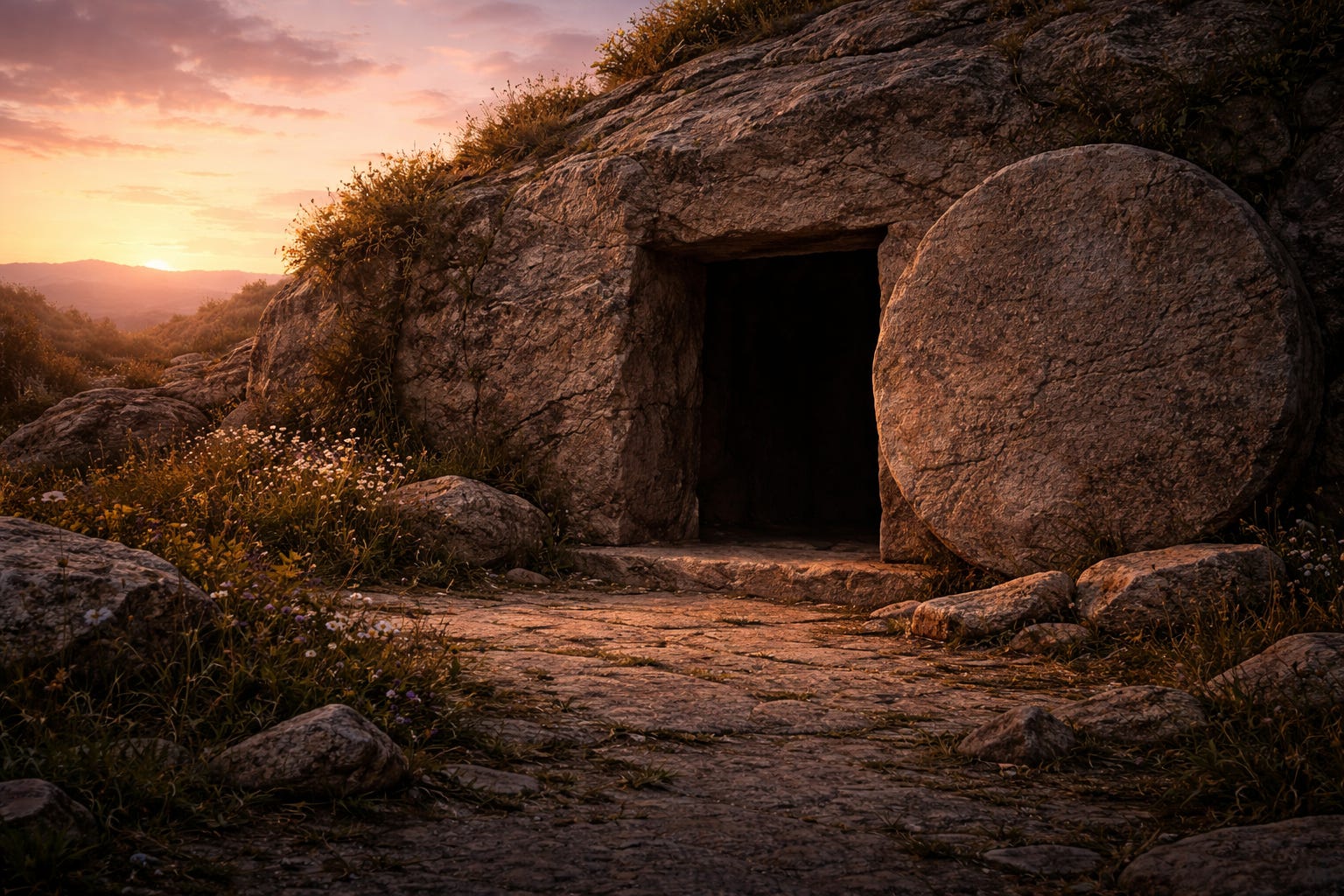
The stone is rolled back, but not to let Jesus out, He is already gone. The stone is moved so the women can see the empty tomb. That distinction matters more than it might seem. The resurrection does not require the stone. The witnesses do. The angel rolls it back and sits on it, stationed there to announce what has already occurred. The angel’s message carries two moments worth diving deeper into.
The first is the word the angel uses for Jesus. The crucified one. In Greek, ton estauromenon, a perfect passive participle describing a completed action with ongoing effects. The risen Jesus is still identified by the cross. The resurrection does not erase what happened on that Friday, rather, it vindicates it. The second is the construction used for the resurrection itself. He has been raised. Egerthē in Greek is a divine passive, meaning God raised Him. This is not self-resuscitation, but an act of the Father, locating the resurrection inside the life of the Trinity rather than presenting it as something Jesus accomplished for Himself.
The women leave the tomb carrying fear and great joy simultaneously. Jesus meets them on the road, not at the tomb. He appears while they are going to tell the others. They take hold of His feet and worship Him. The physical contact is not incidental. This is a bodily resurrection. He can be touched. The Gospel is not describing a vision or an impression, this is describing a person.
The message Jesus sends to the disciples carries the most unexpected word in the passage. He calls them His brothers. These people fled, denied Him, and not one of them is at the tomb. Yet, the first thing the risen Jesus calls them is brothers. Psalm 22 is the anchor here. It is the psalm Jesus quoted from the cross, the one that begins with My God, my God, why have you forsaken me. That same psalm ends with the vindicated sufferer proclaiming God’s name to his brothers in the great assembly. The desolation of the cross gives way to the brotherhood of the resurrection, and this Gospel signals that the arc has been completed.
He sends them to Galilee where He called the first disciples by the sea. The Gospel ends where it began, in the region the religious establishment had long dismissed, with the people who failed Him being gathered back and sent forward. The circle the Gospel of Matthew has been drawing since chapter 4 closes in the same place it opened, with the same unlikely people, now carrying news that changes everything.
We are blessed at what we have been invited into. It is clear that our perfection is impossible, just as it was impossible for those who followed Jesus the closest. What we know for certain is that He loves us. Deeply. He loves us despite our imperfections. He loves us despite the fact that we will fail to live up to the standard. He loves us so much that He became the Passover lamb to atone for all of our sins and imperfections, and still invites us to be near Him.
Reflection Question
Where can you let Jesus love you, despite the imperfections, and allow Him the opportunity to help heal you there?
A Small Invitation
If this reflection helped you, consider sharing it with someone who may benefit from hearing this message.