

Today’s Takeaway
The Epiphany narrative reveals Christ as the universal King whose manifestation extends beyond Israel to the Gentiles, fulfilling Old Testament prophecy, demonstrating divine sovereignty over history and creation, and exposing the opposition between authentic worship and political fear.
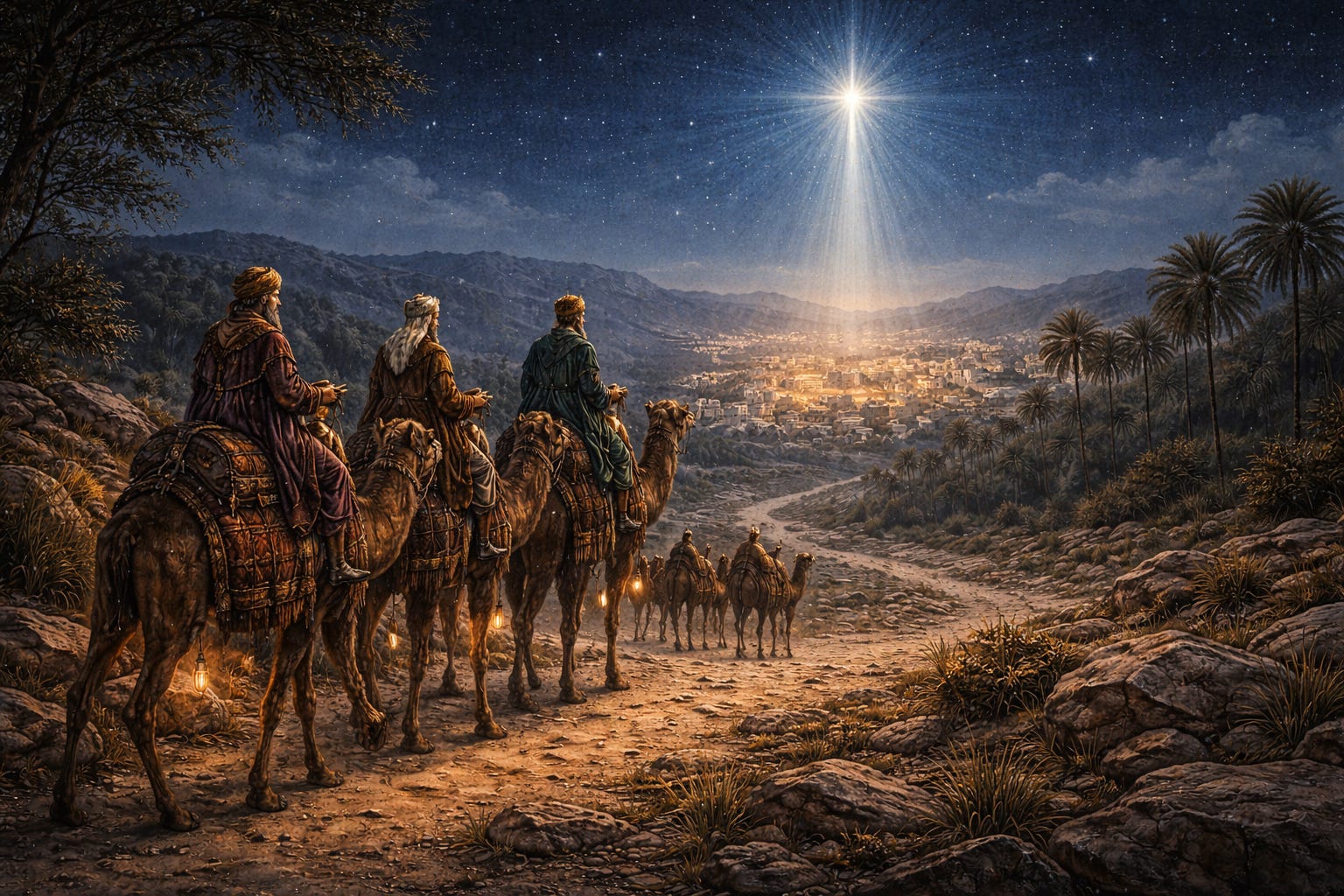
The Gospel
When Jesus was born in Bethlehem of Judea, in the days of King Herod, behold, magi from the east arrived in Jerusalem, saying, “Where is the newborn king of the Jews? We saw his star at its rising and have come to do him homage.”
When King Herod heard this, he was greatly troubled, and all Jerusalem with him. Assembling all the chief priests and the scribes of the people, He inquired of them where the Christ was to be born.
They said to him, “In Bethlehem of Judea, or thus it has been written through the prophet:
And you, Bethlehem, land of Judah, are by no means least among the rulers of Judah; since from you shall come a ruler, who is to shepherd my people Israel.”
Then Herod called the magi secretly and ascertained from them the time of the star’s appearance. He sent them to Bethlehem and said, “Go and search diligently for the child. When you have found him, bring me word, that I too may go and do him homage.”
After their audience with the king they set out. And behold, the star that they had seen at its rising preceded them, until it came and stopped over the place where the child was.
They were overjoyed at seeing the star, and on entering the house they saw the child with Mary his mother. They prostrated themselves and did him homage.
Then they opened their treasures and offered him gifts of gold, frankincense, and myrrh. And having been warned in a dream not to return to Herod, they departed for their country by another way.
Reflection
In this passage we are presented early with King Herod, who ruled from 37-4 BC. We know historically that Herod was extremely paranoid and was known for his brutality. He would have been extremely guarded against anything that could bring about a rival king.
The Magi that are being discussed were likely astrologers. Magi commonly served as astrologers, dream interpreters and/or scholarly priests in the East (Persia/Babylon). I grew up knowing them as three Kings, but this is actually something that is inferred from Psalm 72:10–11 – “The kings of Tarshish and the isles shall offer gifts…” and Isaiah 60:3, 6 – “Nations and kings come bearing gold and frankincense…”, but there is no indication that they were actual Kings.
The reason they show up at King Herod’s door is because the star. Traditions generally held that when a new star appeared it was symbolic of the birth of a King. It would make sense for them to head to the King they knew, expecting to find a son. Remember, they have not received any divine signs or revelations – they are basing this off of what had traditionally happened.
So King Herod is clearly upset by this, and anyone that is hearing would also understand that it is going to cause an issue. Herod calls what would essentially be an emergency cabinet meeting to figure out what has happened and where it has happened. They recall Micah chapter 5 with their response which now tells King Herod that if this is true, it has happened in Bethlehem. He is concealing his intentions and likely working to not cause a Messianic uprising when he calls the Magi in secret.
What is interesting is that the gifts they present indicate that the Magi recognized the authority of the child before their arrival. Even after meeting with Herod, they are not swayed and choose very deliberate gifts. Gold would have been for royal kingship, frankincense for divine worship and priesthood, and myrrh for mortality and suffering. In their own way they anticipate Christ’s place as King, Priest, and sacrifice. It is a direct parallel also with Isaiah 60:1-6 that talks about the bringing of gold and frankincense.
When the Magi depart, after the encounter with Christ, there is something significant that could get missed. They would have been accustomed to operating within royal courts. When it says they departed another way, this likely alludes to their lives being completely changed in a way, not just their direction of travel. The dream, likely a divine revelation, would have meant that they were no longer able to return to their previous life. If they had returned to the court or people knew they were back, they would have placed themselves in serious danger, risking interrogation or retaliation from Herod. They left to find the Christ, and upon finding him, their way of life was changed forever.
This is the case for a lot of people after receiving Christ in their life. In fact, later in Matthew he uses the word metanoeō in the verse “Repent, for the kingdom of heaven is at hand.” This word doesn’t mean to simply confess your sins, but to change and reorient one’s life. This means Matthew is really calling on us to change our ways and live a different life. Having heard the word of Jesus, we are meant to leave by a different way than the one we came. This concept of changing and living for God is repeated throughout the New Testament, such as: Matthew, Luke, John, Acts, Romans, Ephesians, and Corinthians.
It brings up the question we generally have to reflect on. Are we leaving encounters with Christ in a way that will change us? Are we continuing to sin or do the things that bring us pain and expect it to get better just through the encounter? I believe we are receiving grace and strength from God, but he calls on us to take the action to change. We live in a world that is very judgmental and this can cause us a lot of fear. If we keep going back to that world without the change, we are sure to be bound by the rules and stresses of that world. When we pause, and reflect on the example set by the Magi, we have a chance to change. We must approach Christ and recognize his divine authority.
The authority over our lives and the actions. When we are called back to the things in life that bring us to sin, it is there that we must pray and look for a different path. Spoiler alert – we are going to fail in walking a perfect path. The good news is that it was expected we would fail, and through prayer and genuine faith – we can keep trying to improve every day.
Reflection Question
How do we leave our encounters with Christ and do we reflect on how our lives should be changing to live more Holy?