

06 Aug 26 | The Transfiguration
Six days after telling them He would be killed, He took three of them up a mountain and let them see what was underneath.
The Gospel: Matthew 17:1-9
¹ After six days Jesus took Peter, James, and John his brother, and led them up a high mountain by themselves. ² And he was transfigured before them; his face shone like the sun and his clothes became white as light. ³ And behold, Moses and Elijah appeared to them, conversing with him. ⁴ Then Peter said to Jesus in reply, "Lord, it is good that we are here. If you wish, I will make three tents here, one for you, one for Moses, and one for Elijah." ⁵ While he was still speaking, behold, a bright cloud cast a shadow over them, then from the cloud came a voice that said, "This is my beloved Son, with whom I am well pleased; listen to him." ⁶ When the disciples heard this, they fell prostrate and were very much afraid. ⁷ But Jesus came and touched them, saying, "Rise, and do not be afraid." ⁸ And when the disciples raised their eyes, they saw no one else but Jesus alone.
⁹ As they were coming down from the mountain, Jesus charged them, "Do not tell the vision to anyone until the Son of Man has been raised from the dead."
Today’s Focus
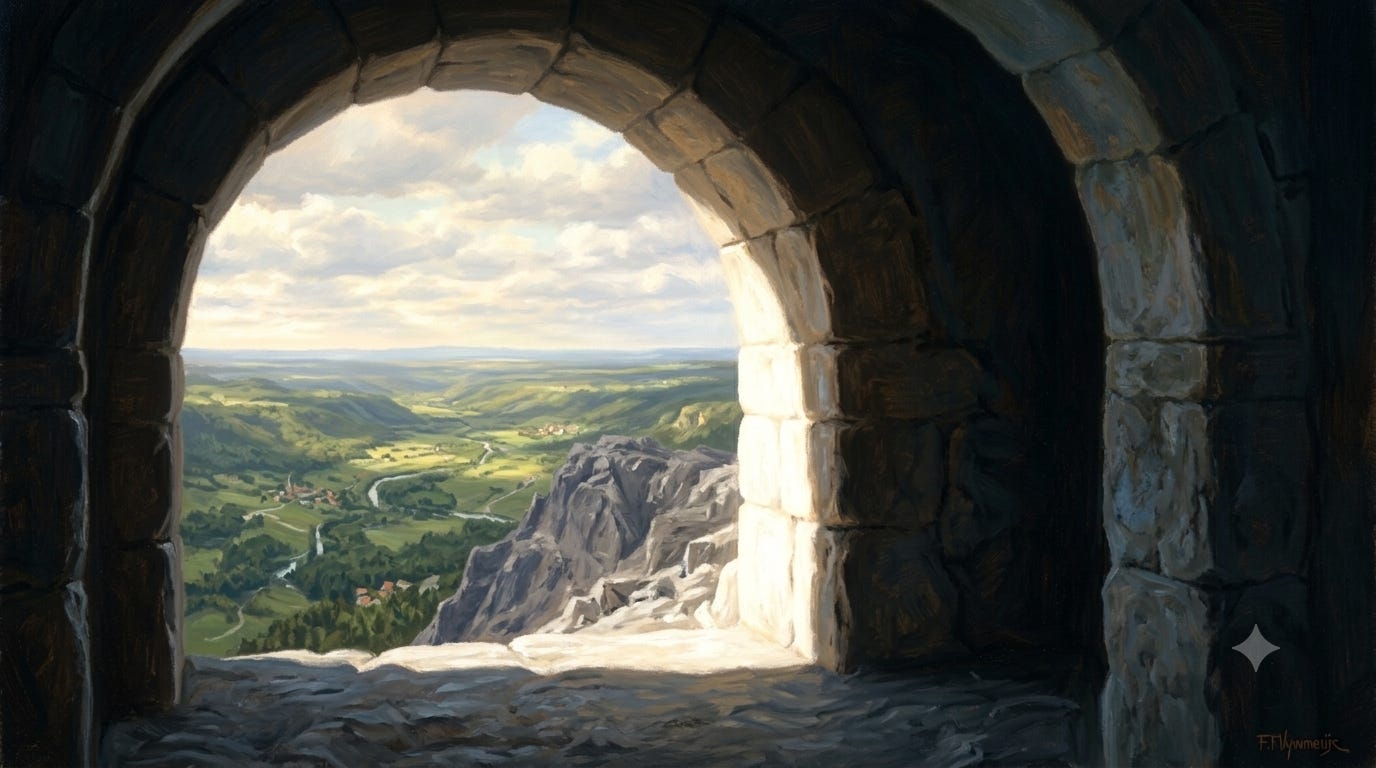
On a high mountain, Jesus was transfigured in front of Peter, James, and John. Moses and Elijah appeared with Him, a cloud covered them, and the Father's voice named Him Son and told them to listen to Him. This glory was not given for its own sake. It was given six days after the cross was announced and shortly before it arrived.
In the Margins
Matthew begins with a time marker, and it is doing real work. After six days. Six days after what? After Peter confessed that Jesus is the Messiah, and after Jesus told them plainly for the first time that He would go to Jerusalem, suffer, and be killed, and after Peter tried to talk Him out of it and was rebuked for it. The Transfiguration does not float free. It sits directly on top of the worst news the disciples had ever received.
There is also an older six days behind this one. In Exodus 24, the cloud covered Sinai for six days, and on the seventh God called to Moses out of the cloud. Everything about this scene is built on that mountain.
The Greek word Matthew uses is metamorphothe, transfigured, transformed. This is not light falling on Jesus from outside. It comes from within Him. When Moses came down from Sinai his face shone, but it shone with borrowed light, reflected from a glory he had stood near. Here the glory is His own, and Matthew reaches for the plainest comparison available. His face shone like the sun.
Moses and Elijah appear and speak with Him. Between them they represent the Law and the Prophets, and both had their own mountain encounters with God, Moses at Sinai and Elijah at Horeb. Both also left the world in ways Scripture treats as unusual.
Peter’s response is the one people tend to smile at, but it deserves more respect than that. He offers to build three tents, using the word for the booths of the Feast of Tabernacles. He is not being foolish. He is trying to make a good moment last, which is a deeply human instinct, especially six days after being told that his teacher is going to die.
While he is still speaking, the cloud arrives. This is the cloud of the Exodus, the presence that filled the tabernacle and later the Temple, and the voice from inside it repeats what was said at the Jordan and adds one command. This is my beloved Son, with whom I am well pleased. Listen to Him. That last phrase reaches back to Deuteronomy 18, where God promises a prophet like Moses and tells Israel that they must heed him.
The disciples fall on their faces in terror, which is the standard human response to the presence of God throughout Scripture. And then comes the detail that is easy to read past. Jesus came and touched them. The glory did not stay at a distance. He crossed the space and put a hand on them and told them to rise and stop being afraid, using the same verb that will later describe His own rising.
When they looked up, Moses and Elijah were gone and they saw no one but Jesus alone. The Law and the Prophets had pointed at Him and then stepped out of the frame.
Then He tells them not to speak of it until after the resurrection. This vision was not given to be published. It was given to three men who would need it, because two of them would be in Gethsemane watching Him sweat, and all of them would need something to hold when the glory was entirely invisible.
Most of us have been given something like this, some moment when God was unmistakably near, and most of us are living now at some distance from it. That is not failure. It is the pattern. The mountain was never meant to be permanent. It was meant to be remembered.
Reflection Question
What has God shown you in the past that you were meant to carry into a harder season, and have you been letting yourself remember it?