

The Gospel: Matthew 9:18-26
¹⁸ While he was saying these things to them, an official came forward, knelt down before him, and said, "My daughter has just died. But come, lay your hand on her, and she will live." ¹⁹ Jesus rose and followed him, and so did his disciples. ²⁰ A woman suffering hemorrhages for twelve years came up behind him and touched the tassel on his cloak. ²¹ She said to herself, "If only I can touch his cloak, I shall be cured." ²² Jesus turned around and saw her, and said, "Courage, daughter! Your faith has saved you." And from that hour the woman was cured.²³ When Jesus arrived at the official's house and saw the flute players and the crowd who were making a commotion, ²⁴ he said, "Go away! The girl is not dead but sleeping." And they ridiculed him. ²⁵ When the crowd was put out, he came and took her by the hand, and the little girl arose. ²⁶ And news of this spread throughout all that land.
Today’s Focus
Jesus is interrupted on his way to a dead girl by a woman who has suffered hemorrhages for twelve years, and in both cases his response reverses the expected direction of ritual contamination, transmitting life and wholeness rather than absorbing uncleanness, showing that neither prolonged suffering nor death itself places anyone beyond his reach. Jesus does not ration His attention. The woman who interrupted the journey to the dying girl was not a delay. She was received with the same urgency as the official's request.
In the Margins
While he was saying these things to them, an official came forward, knelt down before him, and said, my daughter has just died. But come, lay your hand on her, and she will live. The request is not tentative. The man’s daughter is already dead, and he kneels before Jesus and states a confidence: come and lay your hand on her, and she will live. Jesus rose and followed him. No discussion, no condition, no delay.
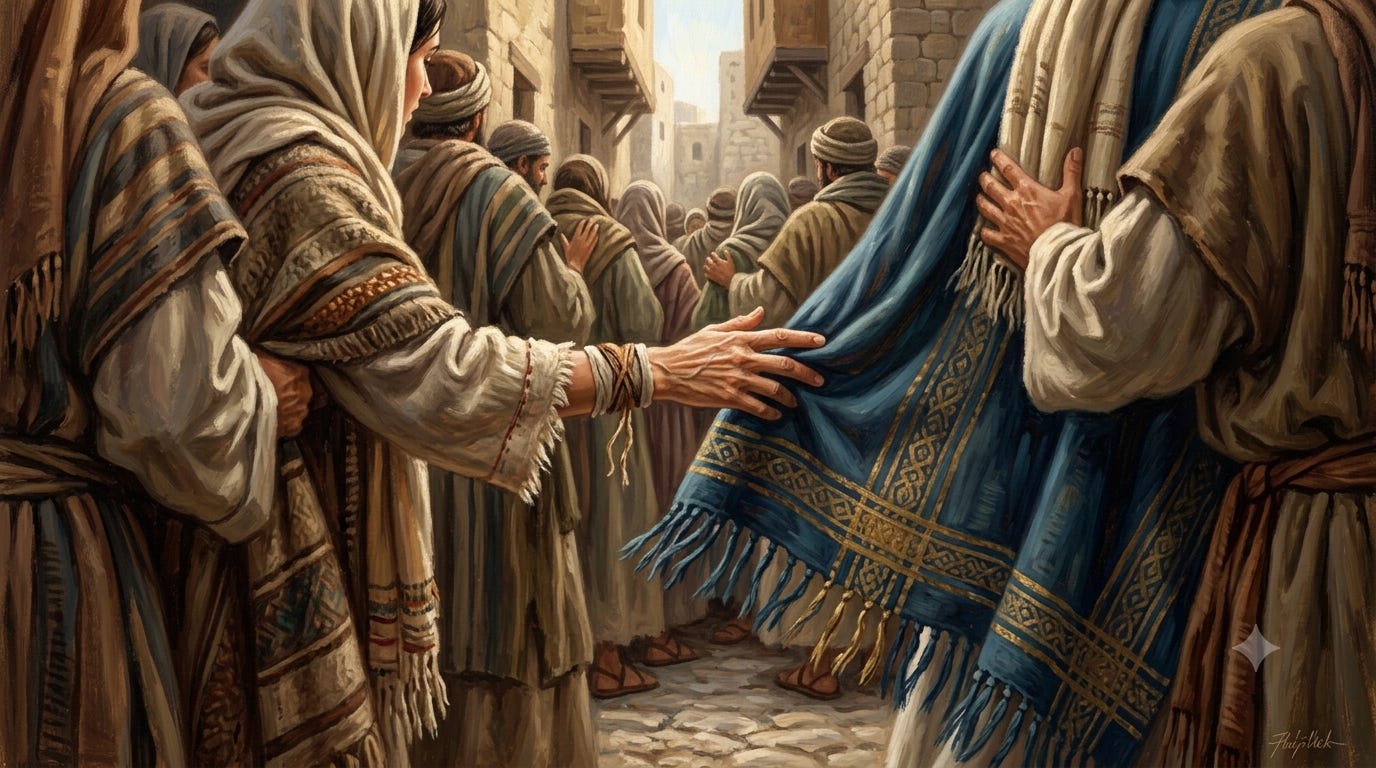
On the way, something happens that does not fit the urgency of where Jesus is going. A woman suffering hemorrhages for twelve years came up behind him and touched the tassel on his cloak. Under the purity code of Leviticus 15, her condition had rendered her continuously ritually unclean for over a decade, unable to touch others without transferring that uncleanness, excluded from normal worship and social contact. Her reaching for the tassel of Jesus’ cloak, the tzitzit worn in fulfillment of Numbers 15:38-40, was an act of hope crossing a boundary that the Law said should not be crossed. If she touched him, he became unclean.
The reverse happened. Jesus turned around and saw her, and said, courage, daughter, your faith has saved you. And from that hour the woman was cured. What should have flowed from her to him, impurity, flowed the other direction. What flowed from him to her, wholeness, was not something the purity system had any category for. The encounter shows something fundamental about who Jesus is: contact with him does not absorb the brokenness of the person who comes. It transforms it.
When Jesus arrived at the official’s house and saw the flute players and the crowd who were making a commotion, he said, go away, the girl is not dead but sleeping. And they ridiculed him. The mourners are not villains. They have just watched a child die and they know what death looks like. Their ridicule is the response of people whose experience tells them exactly what is possible. When the crowd was put out, he came and took her by the hand, and the little girl arose.
Taking the hand of a corpse was another category of ritual defilement under Numbers 19. Jesus reaches directly into it. The expected contamination does not work in his direction. Life moves the other way.
Matthew places these two stories inside each other deliberately, the woman’s healing bracketed inside the journey to the dead girl, and the structure itself carries meaning. The interruption is not a delay in the real story. It is part of the real story. The woman who reached out from the crowd’s edge and the girl who had already stopped breathing are received with the same word: courage. The outcome in both cases is the same: restoration. Neither prolonged suffering nor completed death places a person beyond what Jesus can do with a word and a hand.
This passage is not primarily about the mechanics of two miracles. It is about the kind of power Jesus carries and the direction it moves when it meets human brokenness. It moves toward healing, not away from it. It does not protect itself from defilement. It transmits life through contact with the most desolate places it can reach.
Reflection Question
Is there a part of your life you have assumed has gone on too long or too far to be touched by Jesus, the way this woman had suffered for twelve years before reaching for Him?