

The Gospel: Mark 12:38-44
³⁸ In the course of his teaching he said, "Beware of the scribes, who like to go around in long robes and accept greetings in the marketplaces, ³⁹ seats of honor in synagogues, and places of honor at banquets. ⁴⁰ They devour the houses of widows and, as a pretext, recite lengthy prayers. They will receive a very severe condemnation."
⁴¹ He sat down opposite the treasury and observed how the crowd put money into the treasury. Many rich people put in large sums. ⁴² A poor widow also came and put in two small coins worth a few cents. ⁴³ Calling his disciples to himself, he said to them, "Amen, I say to you, this poor widow put in more than all the other contributors to the treasury. ⁴⁴ For they have all contributed from their surplus wealth, but she, from her poverty, has contributed all she had, her whole livelihood."
Today’s Focus
Jesus contrasts the religious performance and hidden exploitation of the scribes with the total self-giving of a poor widow whose two coins represent her entire livelihood, redefining generosity by the ratio of sacrifice to security rather than the size of the gift.
In the Margins
Two scenes are placed side by side and the contrast is the sermon.
First the scribes. Jesus warns against those who like to walk around in long robes, receive greetings in the marketplace, take seats of honor in synagogues and banquets, and devour widows’ houses while making lengthy prayers for show. The religiosity is elaborate. The exploitation is real. The same people whose prayers are longest and whose robes are most distinguished are consuming the resources of the most vulnerable members of the community. Mark does not soften the condemnation. They will receive a very severe judgment.
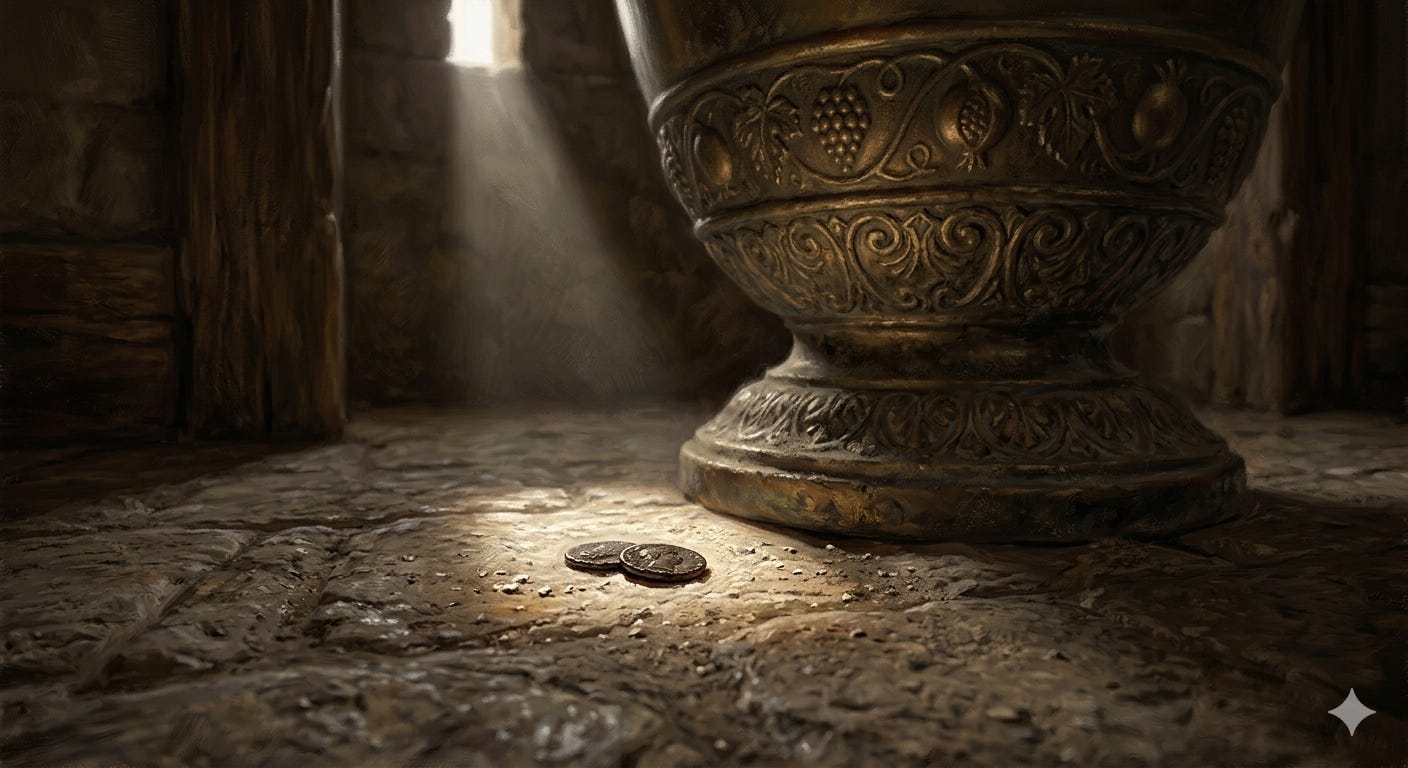
Then Jesus sits down opposite the Temple treasury and watches. The treasury in the Temple complex consisted of thirteen horn-shaped collection boxes designated for different offerings. Many wealthy people put in large amounts. Then a poor widow comes and puts in two lepta, the smallest coins in circulation, together worth less than a penny. A lepton was one sixty-fourth of a daily wage. Two of them would not buy a meal.
Jesus calls His disciples over. Amen, I say to you, this poor widow put in more than all the others. They gave from their surplus. She gave from her poverty. She gave her whole livelihood.
The Greek word for livelihood, bios, means life. She did not give a portion of her life. She gave her life. The wealthy donors gave from what was left over after their needs were secured. Their gifts cost them nothing in terms of security or provision. Her gift cost her everything she had to live on.
The placement of this scene immediately after the warning about the scribes is deliberate and painful. The scribes devour widows’ houses. A widow is putting her last two coins into the Temple the scribes administer. The system that was supposed to protect her is consuming her and she is still giving everything to God within it. Whether Jesus is commending her faith or also lamenting the structure that has brought her to this point, or both, the text holds without resolving. The faithfulness is real. The injustice is real.
What the passage redefines is the measure of generosity. The world measures giving by the size of the gift. Jesus measures it by the ratio of gift to security, by what the giving actually costs the giver in terms of what they were holding onto. The widow’s two coins are worth more than all the large gifts combined not by any arithmetic of coins but by the arithmetic of trust. Her gift is an act of reliance on God rather than on anything she can hold in her hand.
Most of us have never given from that place. Most of us give from surplus and call it generosity. This woman gave her life and Jesus made sure His disciples saw it.
Reflection Question
What would it look like to give in a way that actually costs you your sense of security rather than simply distributing what is left over?