

The Gospel: Matthew 10:1-7
¹ Then he summoned his twelve disciples and gave them authority over unclean spirits to drive them out and to cure every disease and every illness. ² The names of the twelve apostles are these: first, Simon called Peter, and his brother Andrew; James, the son of Zebedee, and his brother John; ³ Philip and Bartholomew, Thomas and Matthew the tax collector; James, the son of Alphaeus, and Thaddeus; ⁴ Simon the Cananean, and Judas Iscariot who betrayed him.
⁵ Jesus sent out these twelve after instructing them thus, "Do not go into pagan territory or enter a Samaritan town. ⁶ Go rather to the lost sheep of the house of Israel. ⁷ As you go, make this proclamation: 'The kingdom of heaven is at hand.'"
Today’s Focus
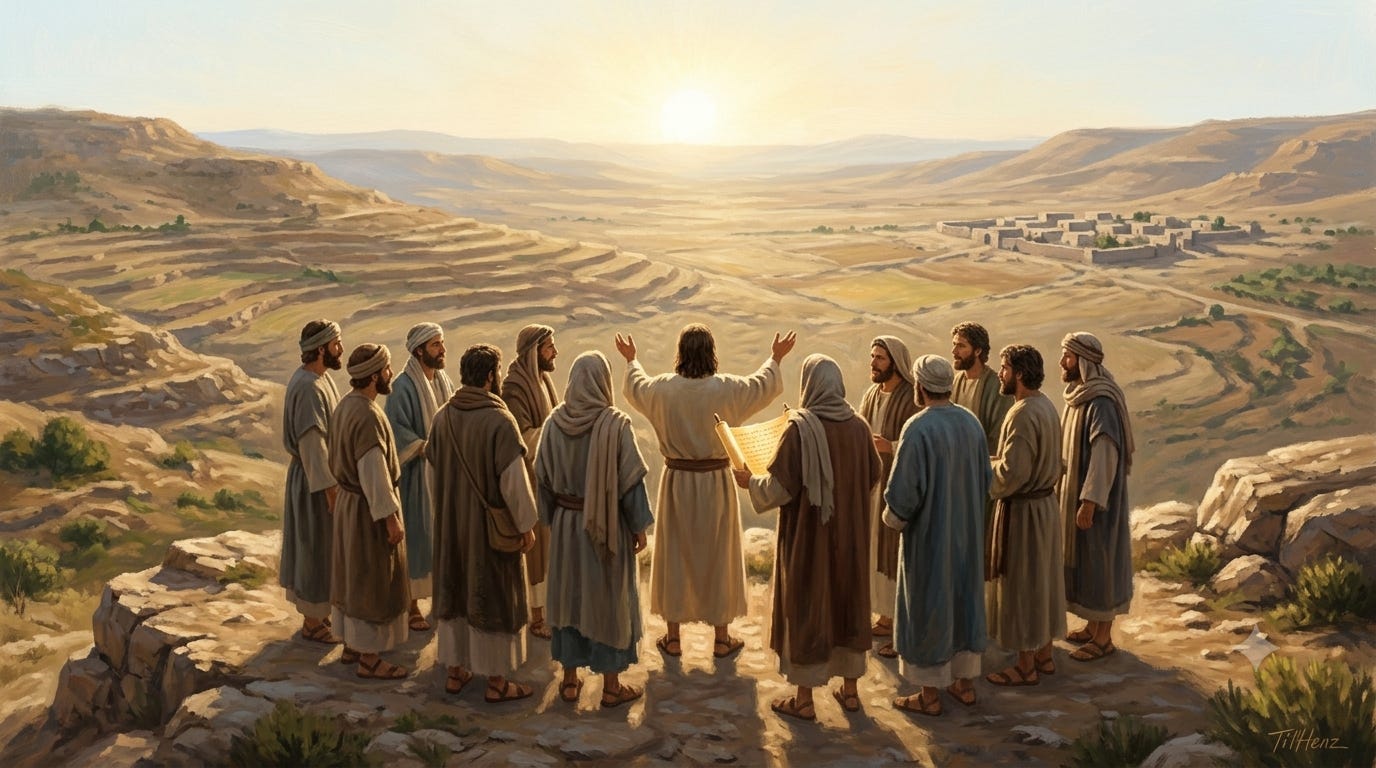
Jesus commissions the Twelve with authority drawn from his own, names them including Judas without softening, restricts the initial mission to Israel in fulfillment of the covenant sequence, and sends them with a proclamation that is not complex but total: the kingdom of heaven is at hand.
In the Margins
Then he summoned his twelve disciples and gave them authority over unclean spirits to drive them out and to cure every disease and every illness. The mission does not begin with training or credentials or a period of supervised trial. It begins with authority given. The Greek word is exousia, the same word Matthew uses throughout the Gospel for Jesus’ own authority, the authority that astonished the crowd in the Sermon on the Mount, the authority he claimed over sin in the healing of the paralytic, the authority he will declare over all of heaven and earth at the Great Commission. He does not give the Twelve a lesser version of this. He gives them the same thing.
The names follow, and Matthew does not spare the list its most difficult detail. Simon called Peter, and his brother Andrew. James and John. Philip and Bartholomew. Thomas and Matthew the tax collector. James, the son of Alphaeus, and Thaddeus. Simon the Cananean, and Judas Iscariot who betrayed him. Judas is named inside the commissioning without ambiguity, without a footnote, without softening. He is part of the original twelve. He receives the same authority. Whatever the betrayal was, it was not something God failed to see coming, and it did not disqualify the office or the mission. The Church has always held this truth carefully: the validity of what is entrusted through an office does not depend on the worthiness of the one holding it. What God sends through a person is not canceled by what that person later does.
Do not go into pagan territory or enter a Samaritan town. Go rather to the lost sheep of the house of Israel. The restriction is real and it matters. The mission at this stage is specifically to Israel, the covenant people who are described as lost sheep. This is not exclusion. It is sequence. The Gospel goes first to Israel, fulfilling God’s covenant promises before the scope widens. Paul will describe the same pattern in Romans: for Jew first and then Greek. The widening will come, fully and explicitly, in the Great Commission after the resurrection. For now, the disciples are sent to begin where God’s work in history began.
As you go, make this proclamation: the kingdom of heaven is at hand. The message is brief and total. Not a complex theological system requiring extensive explanation before anything can be done with it. Not a conditional offer available only under specific circumstances. The kingdom of heaven is at hand, pressing up against the present moment, breaking into history through these twelve ordinary people being sent out with authority they did not earn and a message they did not invent.
The Twelve were fishermen, a tax collector, a zealot, men with no formal rabbinical training, no credentials, no independent standing in the religious hierarchy of their day. What Jesus entrusted to them was real authority over real evil and real sickness, not a symbolic gesture to be fulfilled at some later, more qualified moment. Most of them went to their deaths exercising it. None of them had become impressive before they were sent. Being sent was part of how they became who they were.
Reflection Question
What has Jesus entrusted to you that you keep waiting to feel qualified for, and what would it mean to accept that being sent is itself part of how you become who he is making you?