

The Gospel: John 4:5-42
Jesus came to a town of Samaria called Sychar,
near the plot of land that Jacob had given to his son Joseph.
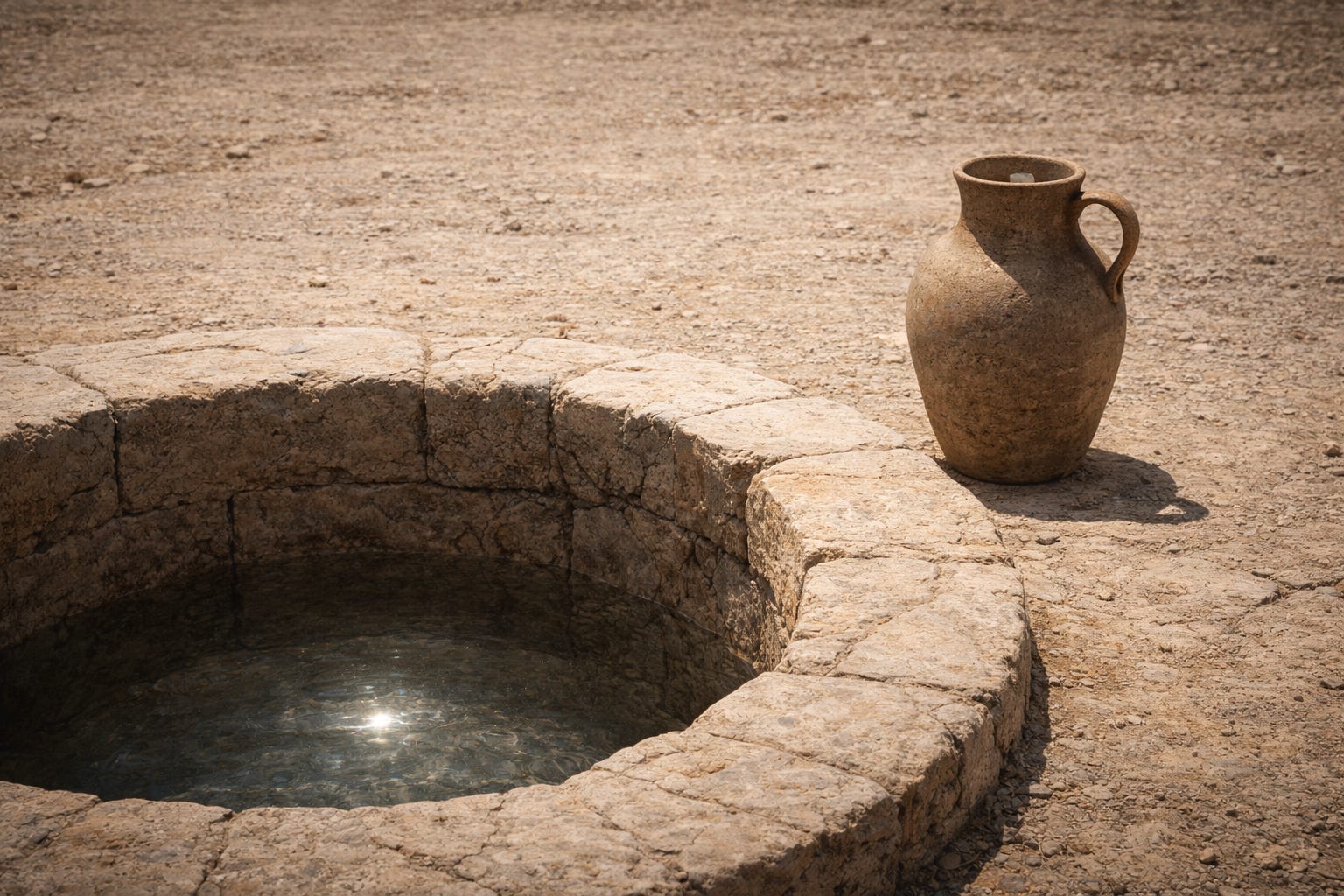
Jacob’s well was there.
Jesus, tired from his journey, sat down there at the well.
It was about noon.
A woman of Samaria came to draw water.
Jesus said to her,
“Give me a drink.”
His disciples had gone into the town to buy food.
The Samaritan woman said to him,
“How can you, a Jew, ask me, a Samaritan woman, for a drink?”
—For Jews use nothing in common with Samaritans.—
Jesus answered and said to her,
“If you knew the gift of God
and who is saying to you, ‘Give me a drink, ‘
you would have asked him
and he would have given you living water.”
The woman said to him,
“Sir, you do not even have a bucket and the cistern is deep;
where then can you get this living water?
Are you greater than our father Jacob,
who gave us this cistern and drank from it himself
with his children and his flocks?”
Jesus answered and said to her,
“Everyone who drinks this water will be thirsty again;
but whoever drinks the water I shall give will never thirst;
the water I shall give will become in him
a spring of water welling up to eternal life.”
The woman said to him,
“Sir, give me this water, so that I may not be thirsty
or have to keep coming here to draw water.”
Jesus said to her,
“Go call your husband and come back.”
The woman answered and said to him,
“I do not have a husband.”
Jesus answered her,
“You are right in saying, ‘I do not have a husband.’
For you have had five husbands,
and the one you have now is not your husband.
What you have said is true.”
The woman said to him,
“Sir, I can see that you are a prophet.
Our ancestors worshiped on this mountain;
but you people say that the place to worship is in Jerusalem.”
Jesus said to her,
“Believe me, woman, the hour is coming
when you will worship the Father
neither on this mountain nor in Jerusalem.
You people worship what you do not understand;
we worship what we understand,
because salvation is from the Jews.
But the hour is coming, and is now here,
when true worshipers will worship the Father in Spirit and truth;
and indeed the Father seeks such people to worship him.
God is Spirit, and those who worship him
must worship in Spirit and truth.”
The woman said to him,
“I know that the Messiah is coming, the one called the Christ;
when he comes, he will tell us everything.”
Jesus said to her,
“I am he, the one speaking with you.”
At that moment his disciples returned,
and were amazed that he was talking with a woman,
but still no one said, “What are you looking for?”
or “Why are you talking with her?”
The woman left her water jar
and went into the town and said to the people,
“Come see a man who told me everything I have done.
Could he possibly be the Christ?”
They went out of the town and came to him.
Meanwhile, the disciples urged him, “Rabbi, eat.”
But he said to them,
“I have food to eat of which you do not know.”
So the disciples said to one another,
“Could someone have brought him something to eat?”
Jesus said to them,
“My food is to do the will of the one who sent me
and to finish his work.
Do you not say, ‘In four months the harvest will be here’?
I tell you, look up and see the fields ripe for the harvest.
The reaper is already receiving payment
and gathering crops for eternal life,
so that the sower and reaper can rejoice together.
For here the saying is verified that ‘One sows and another reaps.’
I sent you to reap what you have not worked for;
others have done the work,
and you are sharing the fruits of their work.”
Many of the Samaritans of that town began to believe in him
because of the word of the woman who testified,
“He told me everything I have done.”
When the Samaritans came to him,
they invited him to stay with them;
and he stayed there two days.
Many more began to believe in him because of his word,
and they said to the woman,
“We no longer believe because of your word;
for we have heard for ourselves,
and we know that this is truly the savior of the world.”
Today’s Focus
At Jacob’s well, centuries of division meet divine initiative. Jesus crosses ethnic, theological, and moral boundaries to reveal Himself not first to Jerusalem’s elite, but to a Samaritan woman at noon. What begins as a request for water becomes a revelation of identity: He is the giver of living water, the fulfillment of covenant hope, the One in whom worship is no longer confined to mountain or temple. The woman’s gradual recognition, from “Jew” to “Savior of the world,” mirrors the journey every disciple must take. The living water He offers is not information, but participation in His life. Encounter becomes transformation. Transformation becomes mission.
In the Margins
The encounter takes place in Sychar, near land associated with Jacob and Joseph (Genesis 33:19; Joshua 24:32). The setting is Samaria. After the Assyrian conquest (722 BC), the northern kingdom experienced population mixing (2 Kings 17). Samaritans developed a form of Yahwistic worship centered on Mount Gerizim and accepted only the Pentateuch as Scripture. This is the first five books of the Old Testament as we know it today, though they used a Samaritan version, which differed slightly in wording from the Jewish text. Because of this, the Samaritans would have expected a Taheb (restorer), a prophet like Moses. They didn’t have the same Davidic Messiah that the Jews expected.
By the first century, relations between Jews and Samaritans were strained, marked by mutual suspicion and theological disputes. The meeting occurs “about noon.” In Johannine symbolism, light and revelation are rarely accidental. Noon suggests exposure, there was nothing hidden. This strained relations status had extended so far that to drink water drawn by a vessel handled by a Samaritan woman would have been forbidden. Samaritan women were seen as ritually unclean. On top of this, we can deduce that the woman was socially ostracized. Coming for water at noon would have been very uncharacteristic. Her marital history, the five husbands and a current non-marital relationship, has generated much speculation. Some Church Fathers interpreted this allegorically (five husbands = five false gods of Samaria, cf. 2 Kings 17). While intriguing, the plain narrative indicates relational brokenness.
In the Old Testament, wells are often places of betrothal encounters (Genesis 24; 29; Exodus 2). This Gospel is saturated with symbolic layering. Jesus, the Bridegroom (John 3:29), meets a woman at a well. The scene subtly evokes covenant renewal, not in romantic terms, rather it signals restoration of a people. The Greek phrase hydōr zōn can mean “running water,” but Jesus deepens its meaning calling it living water, a covenant of life from God. Jesus is offering Himself as the source of life, a new covenant.
The dispute over Mount versus Jerusalem reflects a central Samaritan-Jewish division. Jesus affirms covenant continuity by declaring that salvation is from the Jews. He points out that the hour is coming and is here. In John, this refers to the revelation through death and glorification. Jesus is making the point that worship will extend beyond Jerusalem, but that it will start there. Worship will be centered in Spirit and truth. In John’s theology, this is inseparable from Christ Himself.
The woman speaks of a messiah and there is a progression throughout showing her new understanding of Jesus. She started from “a Jew” to “sir”, “prophet”, and finally “messiah”. The recognition is gradual, but she leaves as a witness. Jesus affirms this, claiming “I am.” This is an Old Testament self-designation of Yahweh, echoing Exodus 3:14. Jesus reveals in one of the most direct acknowledgements of who He is to a Samaritan woman with whom talking to would have normally been seen as having religious and social restrictions.
She leaves her water jar to proclaim as a witness that invited others to see for themselves if He was the Christ. She leaves behind her old source of water, carrying forth the word she knows is true. With this, the people of Samaria are concluding that Jesus is indeed the expected Messiah of Israel, confessing, “this is truly the Savior of the world.” “Savior” was a title used in the Greco-Roman world for emperors, making this confession striking when spoken by marginalized Samaritans.
This story shows that understanding who Jesus is drives mission. Mission is participation in ongoing divine work. We as Christians know who Jesus is. We have a choice to participate in the mission of spreading the word. There are various Christian branches, but most if not all have evangelization and spreading of the word as a core function. We have a choice every day. We can practice our faith quietly or be willing to live a life that openly displays our love for Jesus. It is not for everyone, some are introverts by nature and others simply don’t feel comfortable being so outgoing with strangers. This does not require public preaching; it may simply mean embodying the Gospel in daily life. How we show up every day. When people see you, do they know you are a follower of Christ because of how you are?
Reflection Question
Where am I still drawing from shallow wells (reputation, comfort, success, control) instead of allowing Christ to become my true source of life?
A Small Invitation
If this reflection helped you, consider sharing it with someone who may benefit from hearing this message.