

09 Aug 26 | Peter Walks on Water
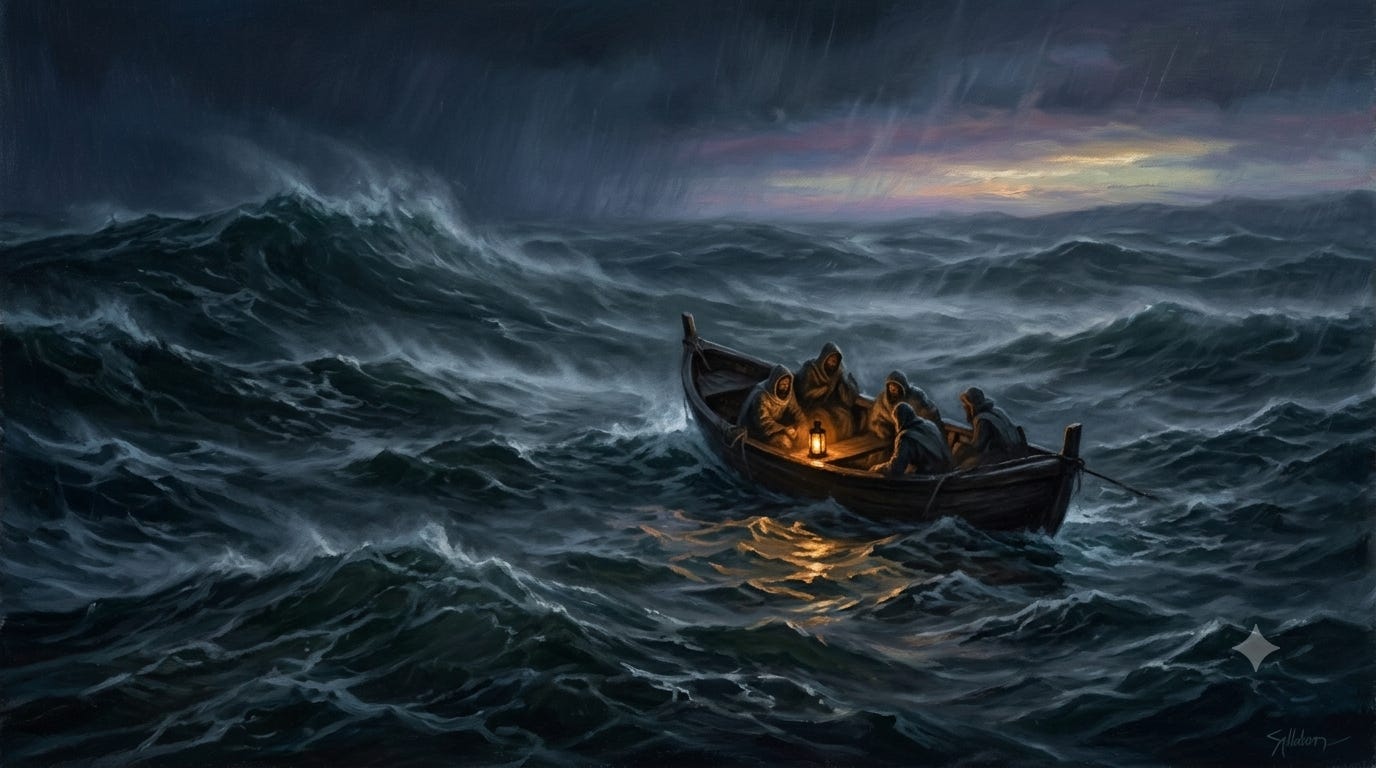
Eleven men stayed in the boat. Only one of them got called out for having little faith.
The Gospel: Matthew 14:22-33
²² Then he made the disciples get into the boat and precede him to the other side, while he dismissed the crowds. ²³ After doing so, he went up on the mountain by himself to pray. When it was evening he was there alone. ²⁴ Meanwhile the boat, already a few miles offshore, was being tossed about by the waves, for the wind was against it. ²⁵ During the fourth watch of the night, he came toward them, walking on the sea. ²⁶ When the disciples saw him walking on the sea they were terrified. "It is a ghost," they said, and they cried out in fear. ²⁷ At once Jesus spoke to them, "Take courage, it is I; do not be afraid." ²⁸ Peter said to him in reply, "Lord, if it is you, command me to come to you on the water." ²⁹ He said, "Come." Peter got out of the boat and began to walk on the water toward Jesus. ³⁰ But when he saw how strong the wind was he became frightened; and, beginning to sink, he cried out, "Lord, save me!" ³¹ Immediately Jesus stretched out his hand and caught him, and said to him, "O you of little faith, why did you doubt?" ³² After they got into the boat, the wind died down. ³³ Those who were in the boat did him homage, saying, "Truly, you are the Son of God."
Today’s Focus
Peter asked to walk on the water and did, until he looked at the wind. Jesus caught him immediately and called him a man of little faith. It is worth noticing that the only person in that boat who received a correction was the only person who had gotten out of it.
In the Margins
This account is usually remembered as the story of Peter sinking. It is worth reading it as the story of Peter walking.
The disciples had been fighting a headwind for most of the night. The fourth watch, in Roman reckoning, ran from roughly three in the morning to dawn, which means these men had been at the oars for something like nine hours with no progress. When they finally see something moving toward them across the water, they conclude it is a ghost and cry out in fear. That is not cowardice. A figure walking on the sea in the dark is not a thing that happens.
Jesus answers with a phrase that would have carried the weight of Sinai. Take courage, it is I, do not be afraid. The middle phrase in Greek is ego eimi, I am, the name God gave Moses from the burning bush. And He is speaking it while doing something Scripture reserves for God alone. Job says that God trampled the waves of the sea. Psalm 77 says His path was through the great waters and His footprints were unseen.
Then Peter does something no other disciple in the Gospels does. He does not ask Jesus to prove Himself. He asks for permission to come out there with Him. Lord, if it is you, command me to come to you on the water.
Jesus says one word. Come.
And Peter got out of the boat and walked on the water toward Jesus. That sentence deserves to be sat with before we rush to the sinking. A fisherman who had spent his working life on that lake, who knew exactly what water does and does not support, climbed over the side in the dark during a storm because Jesus said one word. Whatever Peter’s faith was, it was not small in that moment.
Matthew tells us precisely what changed. When he saw how strong the wind was he became frightened. The wind had been strong the entire time. Nothing about the conditions shifted. What shifted was Peter’s attention. He had been looking at a person, and then he was looking at his circumstances, and the circumstances were genuinely alarming. They always had been.
Beginning to sink, he cried out three words. Lord, save me. It is the shortest prayer in the Gospels, and it is answered before it finishes leaving his mouth. Matthew says immediately Jesus stretched out His hand and caught him. The verb means to take firm hold of something. There is no lesson taught while Peter treads water, no pause to let the point land. He is caught first.
Then the correction, and the wording matters. O you of little faith, why did you doubt. The Greek is oligopistos, small faith, not no faith. Jesus is not saying Peter had none. He is saying Peter had some and it ran out partway across.
The men who received no correction that night were the ones who never left the boat. That is worth thinking about. Whatever Peter did wrong, he did it further from the boat than anyone else was willing to go.
Most of us have a version of this. We are more comfortable being safely faithful than riskily faithful, because staying in the boat produces no visible failures. Nobody sinks in the boat. But the confession that closes this scene, truly you are the Son of God, comes from men who had just watched Jesus reach into the water and pull their friend out. They learned who He was because one of them was foolish enough to need saving.
Reflection Question
Where has the fear of failing publicly kept you sitting in the boat, and what would it look like to ask Him for permission to come?