

Today’s Takeaway
This Gospel reveals that Jesus does not merely cure disease—He crosses boundaries of ritual impurity to restore communion, showing that holiness in God’s Kingdom is contagious outward, not threatened by human brokenness.
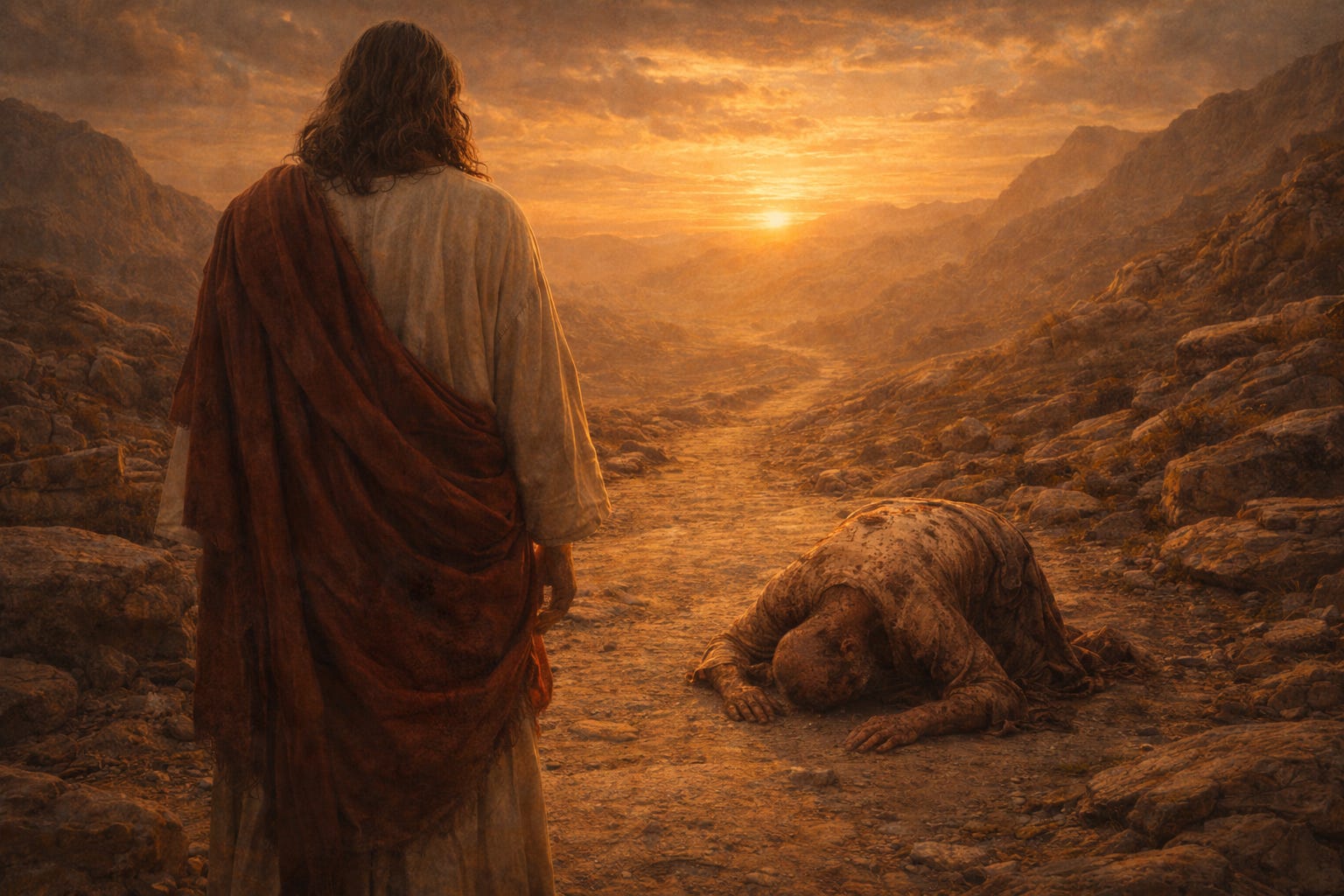
The Gospel
It happened that there was a man full of leprosy in one of the towns where Jesus was;
and when he saw Jesus,
he fell prostrate, pleaded with him, and said,
“Lord, if you wish, you can make me clean.”
Jesus stretched out his hand, touched him, and said,
“I do will it. Be made clean.”
And the leprosy left him immediately.
Then he ordered him not to tell anyone, but
“Go, show yourself to the priest and offer for your cleansing
what Moses prescribed; that will be proof for them.”
The report about him spread all the more,
and great crowds assembled to listen to him
and to be cured of their ailments,
but he would withdraw to deserted places to pray.
In the Margins
In the Bible, we hear a lot about “Leprosy,” but this actually refers to many ailments like psoriasis, eczema, or even mold on fabrics, not just Hansen’s disease. The significance is that in the Book of Leviticus, the people of Israel were told how to handle this situation as Leprosy symbolized a death-like exclusion from the community. Lepers were declared unclean, required to live outside the community, barred from worship, and could only be reintroduced through priestly verification. Essentially, it separated them from God in many ways.
Here we have a leper who falls prostrate at the sight of Jesus and declares Him as “Lord.” He doesn’t ask Jesus to prove Himself or demand anything. He submits to the power and will of Him and begs. During this time, no one would have dared to come near the leper. They should not have been in contact at all, it was the Law. This will come up numerous times in miracle Jesus performs, they are not done on demand or command, rather mainly for those that throw themselves at Him in humility.
Jesus says that He wills it, and acts in a manner that would have been seen consistent with the power of God. Jesus touches the untouchable, but is not made unclean through this action, rather from Him cleanliness flows. He washes away the unclean of the leper and then tells the leper to continue to abide by the Law and present himself. In another part of the Gospel we hear Jesus say that He did not come to abolish the Law but to fulfill it. Here He is showing that He satisfies the Law through his will.
Jesus, after this, retreats to pray. He instructs the cleansed leper not to tell anyone, just to finish fulfilling the Law. In the world we live in today, there are so many things we seek gratification from. The number of views, likes, follows, subscribers, or whatever! It is easy to get wrapped up in a world of seeking things to give us that feeling of acceptance or fulfillment. Jesus shows us that it is possible to perform good without receiving that. I haven’t cleansed any lepers in my life – nothing close to anything that amazing. If Jesus can walk away from that without seeking glory, we can probably do the same. What is interesting is what this does internally do us as well.
If you are doing good deeds to fill something, are you doing those deeds for others or are you doing them for yourself? Jesus does this miracle purely for the sake of the leper. He knows who He is already and it does not tell of there being a massive crowd around. Jesus has come across this person in transit – someone that everyone else would have rejected and fled from. Let’s use this example of purely selfless act to help shape how we show up. We could all stand to do good in the world with a focus on who we help and not how it makes us feel at the end of it. Funny enough, we will probably feel better when we focus on how we impact others and not how that impacts us. It is about our access to God and ensuring the praise and worship is placed on Him, not us.
Reflection Question
Where in my life do I long for God’s healing, yet hesitate to fully place myself before Him in humility—trusting not my own timing, merit, or image, but His will alone?