

The Gospel: Matthew 5:1-12
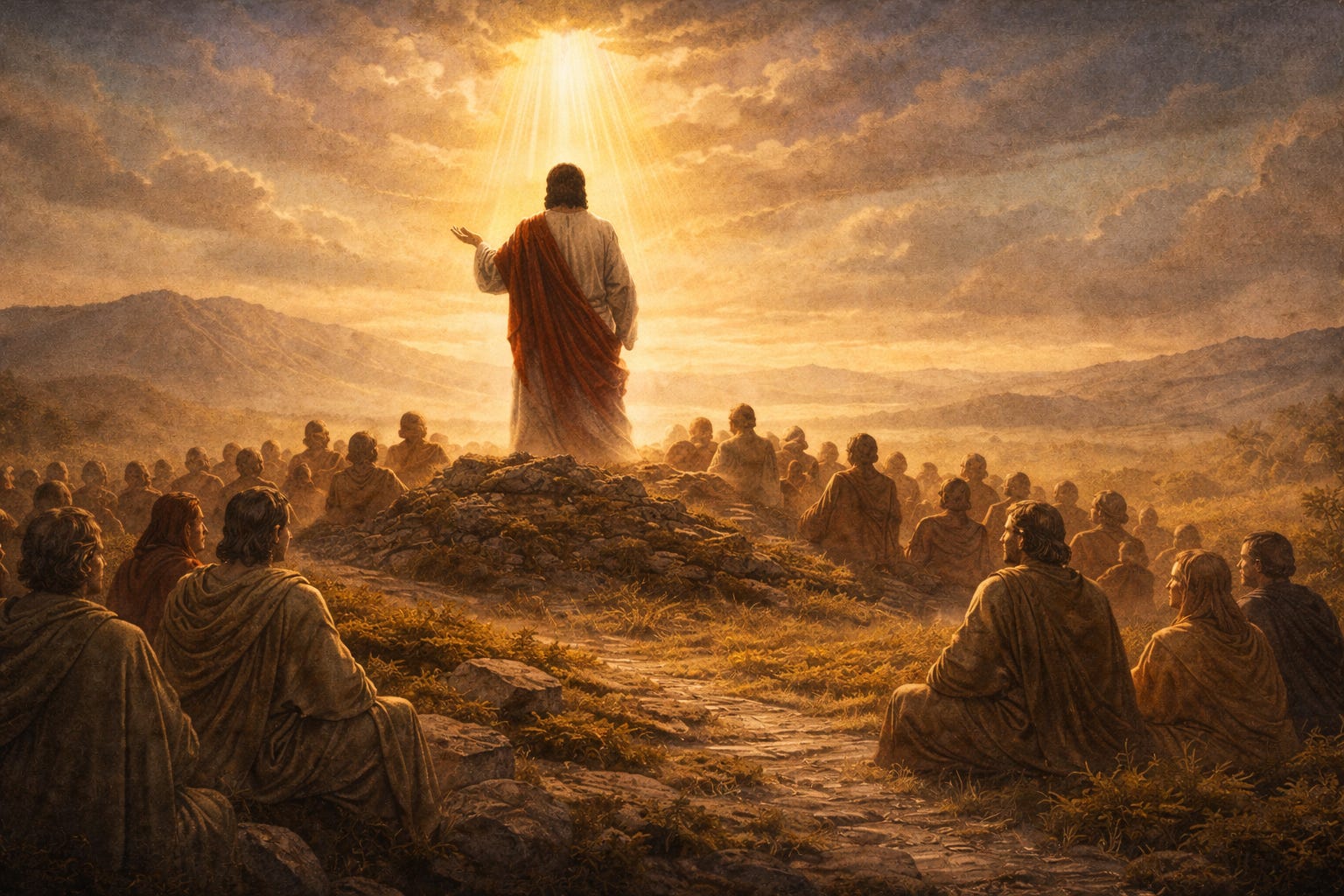
When Jesus saw the crowds, he went up the mountain,
and after he had sat down, his disciples came to him.
He began to teach them, saying:
"Blessed are the poor in spirit,
for theirs is the kingdom of heaven.
Blessed are they who mourn,
for they will be comforted.
Blessed are the meek,
for they will inherit the land.
Blessed are they who hunger and thirst for righteousness,
for they will be satisfied.
Blessed are the merciful,
for they will be shown mercy.
Blessed are the clean of heart,
for they will see God.
Blessed are the peacemakers,
for they will be called children of God.
Blessed are they who are persecuted for the sake of righteousness,
for theirs is the kingdom of heaven.
Blessed are you when they insult you and persecute you
and utter every kind of evil against you falsely because of me.
Rejoice and be glad,
for your reward will be great in heaven."
Today’s Focus
In the Beatitudes, Jesus reveals not a list of virtues to achieve, but a vision of life lived under God’s reign. Spoken from the mountain in deliberate echo of Sinai, these blessings declare who already stands within God’s favor, even when circumstances suggest weakness, grief, or rejection. The key word “blessed” (makarios) functions as a divine verdict, not a feeling, naming those whose lives are aligned with God’s saving purpose rather than worldly success. The Beatitudes culminate in a decisive turn toward Christ Himself, where suffering becomes blessed not in itself, but when it flows from fidelity to Him. Together, they form a mission statement for the Kingdom, defining a people shaped by dependence on God, mercy, integrity, peacemaking, and faithfulness that endures even when it costs comfort or approval.
In the Margins
This Gospel opens with Jesus’ sermon on the mount. The mountain evokes Sinai, pulling from Exodus 19-20. These teachings are known as the Beatitudes, and they set a tone for a lot of theological foundations. While not commandments, I personally feel they run as a core foundation that we should all grow out of. This is a mission and values statement for Jesus’ ministry.
When Jesus uses the word “blessed” – it is originally written as makarios. This word does not just mean “happy” or “spiritually accomplished” which is how we often use the term today. It goes much deeper. It describes a state of life that is objectively favored by God, regardless of outward circumstances or emotional condition.
In the biblical context, makarios functions as a divine verdict, not a subjective feeling. It names those who stand within God’s saving purpose, even when their present condition appears weak, sorrowful, or marginalized. It is frequently used in wisdom and prophetic traditions to mark those whose lives are aligned with God’s will and future, rather than with immediate success.
Crucially, makarios does not deny suffering. Instead, it asserts that suffering does not disqualify a person from God’s favor.
The final point I want to make is the shift that Jesus makes. He moves from third person to second person. He calls those that suffer due to their allegiance to Him blessed. The earlier Beatitudes speak of righteousness, mercy, and peacemaking. This one is grounded in persecution due to a relationship with Jesus Himself.
It leaves us to reflect even today as to whether we are living up to this mission statement. A modern mission statement for us could be: We exist to live under God’s reign by trusting Him above ourselves, seeking justice with humility, extending mercy without calculation, and working for reconciliation in a fractured world. We commit to integrity of heart, compassion toward the suffering, and faithfulness to Christ even when it costs us comfort, status, or approval. We measure success not by power or recognition, but by belonging to God and bearing witness to His Kingdom in how we live.
Now we just have to ask ourselves if that is how we are truly showing up every day. Please read more on the each of the Beatitudes below!
Reflection Question
Which beatitude currently feels most “costly” for you to live, and what would it look like to choose it anyway as an act of trust in Jesus’ promise?
A Small Invitation
If this reflection helped you, consider sharing it with someone who may be carrying more than they were meant to.
Going Deep in Beatitudes
Here is a reflection that I recently read on the beatitudes. It does such a great job, I don’t think I can really compete with much more than what it says.
“Blessed are the poor in spirit, for theirs is the kingdom of heaven.” By poverty in spirit Jesus does not mean lacking in intelligence, faith or joy. Instead, to be poor in spirit is to know that our true strength is not relative to our accomplishment and our true worth does not come from our possessions, rather these are rooted in our relationship with God, the source of all that is.
“Blessed are those who mourn, for they shall be comforted.” Mourning is more than sadness. It is an expression of true empathy and compassion. As we grieve with others, we participate in God’s healing work, offering comfort and hope amid life’s losses. Our ability to mourn is a sign of deep and gratuitous love.
“Blessed are the meek, for they shall inherit the earth.” Meekness is not weakness. Trusting in God, the meek discover deep peace, something the world cannot give. The meek need not assert themselves aggressively. Their strength comes from the quiet confidence in God’s power rather than their own.
“Blessed are those who hunger and thirst for righteousness, for they shall be filled.” To hunger and thirst for righteousness is to make it our life’s purpose to seek God’s will and to help realize God’s vision and hope for our world. It means to be passionate about truth, goodness and justice.
“Blessed are the merciful, for they shall obtain mercy.” Mercy is at the heart of God, and it must be at the heart of every Christian. When we forgive, when we show compassion, when we reach out to those in need, our reflects God’s love.
“Blessed are the pure in heart, for they shall see God.” Purity is not just about avoiding sin. Purity is about having undivided loyalty to God. A pure heart is one that seeks God above all else, unclouded by selfish motives or distractions.
“Blessed are the peacemakers, for they shall be called children of God.” In a world torn by lies and division, hatred and violence, we are called to be agents of reconciliation and healing. Peacemaking requires deep listening, respectful dialogue, and a willingness to forgive. This is not an easy task, but it is essential to our Christian mission.
Finally, “Blessed are those who are persecuted for righteousness’ sake, for theirs is the kingdom of heaven.” Commitment to God’s truth may bring opposition or suffering, but Jesus reminds us that such trials are not defeats. On the contrary, they are signs that we are on the path to salvation.
The Beatitudes do not promise an easy life, but they do promise a life of deep meaning, purpose, and eternal reward. They guide us to live not for the fleeting approval of the world, but for the lasting joy found in God. When we follow this path, we are truly blessed, maybe not in the eyes of the world, but much more importantly, in the eyes of God.
As we ponder our Christian mission during this Jubilee Year of Hope, let us take to heart these eight beatitudes which Jesus laid out as the path to salvation. In a world driven by competition, pride, and material success, the Beatitudes challenge us to embrace a life rooted in humility, compassion, and a relentless pursuit of righteousness. The Beatitudes offer a powerful antidote to the tempting, yet false paths offered by our world. The beatitudes offer us much needed hope for our world.