

Today’s Takeaway
The coming of God’s Kingdom is not abstract or distant—it demands a concrete response: repentance, trust, and the willingness to leave behind old securities to follow Christ.
The Gospel
After John had been arrested,
Jesus came to Galilee proclaiming the Gospel of God:
“This is the time of fulfillment.
The Kingdom of God is at hand.
Repent, and believe in the Gospel.”
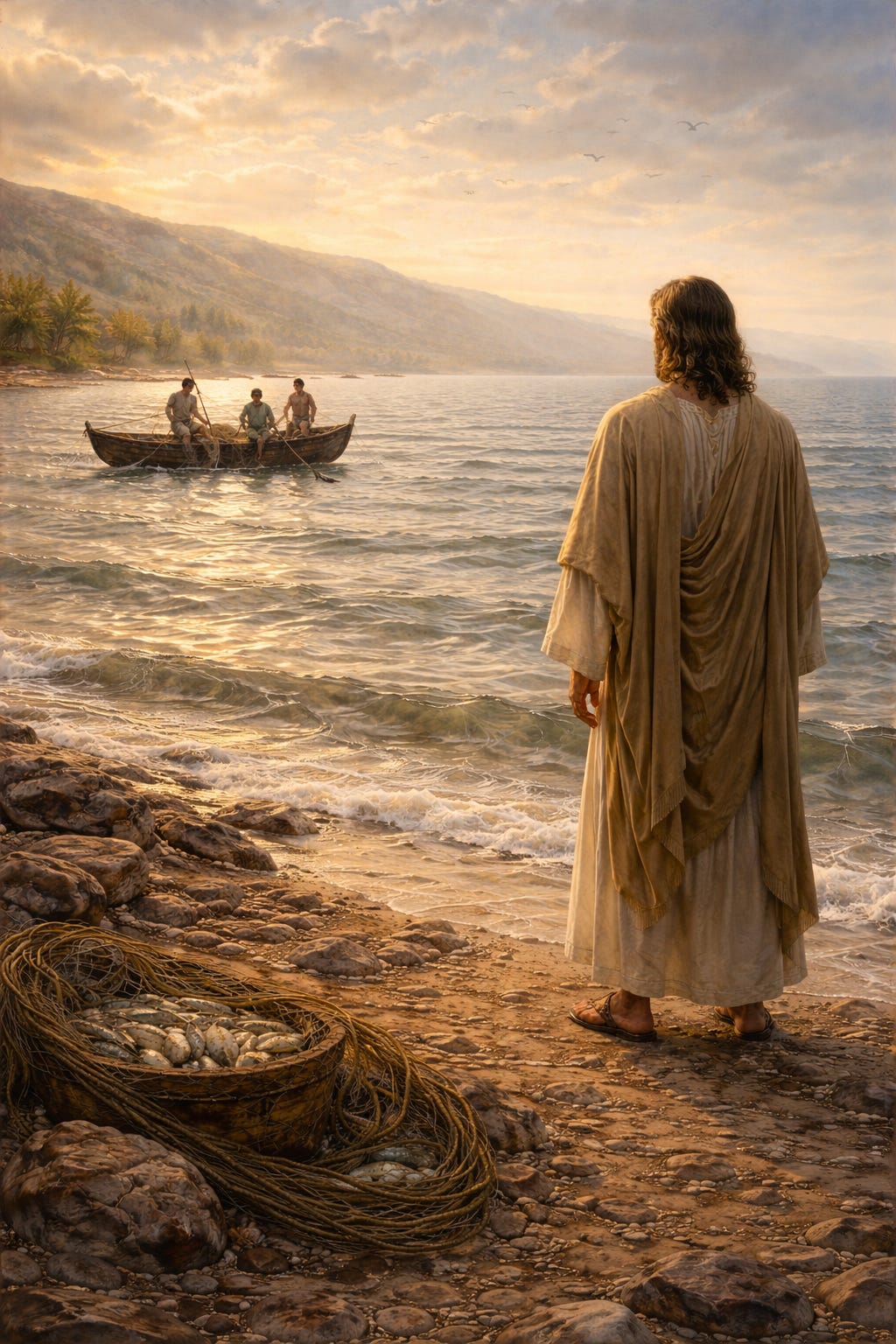
As he passed by the Sea of Galilee,
he saw Simon and his brother Andrew casting their nets into the sea;
they were fishermen.
Jesus said to them,
“Come after me, and I will make you fishers of men.”
Then they left their nets and followed him.
He walked along a little farther
and saw James, the son of Zebedee, and his brother John.
They too were in a boat mending their nets.
Then he called them.
So they left their father Zebedee in the boat
along with the hired men and followed him.
In the Margins
This Gospel message is set at a major turning point in the story of Jesus; John has been arrested. Scripturally this fulfills John’s own testimony when he said that he had to decrease. In addition to this, John was said to be preparing the way for Jesus. With his arrest, there was no more public preparation that could have been done. This would have been an indicator that it was time for Jesus to step out into His fully public ministry. While it looks like defeat for John to be arrested, it is just the beginning of Jesus’ mission.
The first place Jesus heads is to Galilee. It was a culturally mixed area and religiously marginal, but it is actually tied to scriptural prophecy. In Isaiah 9, it speaks of light dawning in a region seen as insignificant. Galilee matches this, especially as it would have been viewed in the eyes of Judean elites.
When Jesus arrives, his message is clear; the time of waiting is over. He declares the time is now. The next part of his message is that the Kingdom of God is breaking into history now through Himself. Wherever Jesus is, God’s reign is operative. The final part is for people to turn away from sin and believe the good news He is declaring. Jesus didn’t come and give a big explanation. He comes and announces that it is happening, His explanation comes later in His ministry.
His next action is to call disciples to follow him. He does not draw his disciples from within synagogues or the temple. He does not look for people who were the most studied, holy, or politically significant. Instead, Jesus finds people doing ordinary work. Jesus is not looking for lukewarm followers, even here. He calls them for a full-time gig, “come after me.” He called on them to change their life completely – something we see often – coming in contact with Christ is a life-changing event.
Jesus turns fishing into a metaphor for gathering people for the Kingdom of God. Their skills are transformed. It is telling that becoming a follower is not about abandoning who we are as people, rather how we can use the skills we have to worship God. Jesus is showing us early in His message that God has endowed us with gifts and we are able to use these gifts to glorify God and expand His message.
The disciples show us the cost of following Jesus with all of our heart. At the very least, this offers a clear example of what it means to follow with all of one’s heart. All of those called drop what they are doing, leave their belongings, and go with Jesus. There is no account that they were hesitant and there is nothing that tells us they hemmed and hawed. It is interesting that they had such faith, because we have to remember that they still were not seeing Jesus perform miracles. They are responding to His authority, but their overall faith is not fully formed.
This is something we see all the time in society today. We are quick to wear a jersey for our favorite team. We don’t care if the other fans judge us for our jersey, we stand strong for that favorite team. We might even be giving up something to be part of that fandom. Depending on where you live, you might not visit a certain restaurant, or only go to a specific spot to catch a game. It might even shape who your friends are! When we apply this same standard to Jesus, are we keeping the same dedication that we show to a sports team? Do we publicly profess our fandom of the Kingdom of God? Do we only go to certain places on Sunday to worship or not go to certain establishments because of our faith? We have the luxury of knowing the miracles and knowing the resurrection.
I believe we require less blind faith to follow Jesus than the early disciples, but should be ready to do the equally as hard part, giving up things that would take us away from Christ. We are all witness to a world shaped by competing allegiances. One to God’s Kingdom and another to forces opposed to it. Our lives will ultimately reflect whether we were aligned with the Kingdom of God or worked against it. The risen Christ will later say “because you are lukewarm, neither hot nor cold, I will spit you out of my mouth.” Just as people become diehard fans of a team, we need to make sure we are giving the same fandom to the Kingdom of God.
Reflection Question
Where in my life can I give more of my heart to Jesus and leave behind something I am doing in order to draw closer to Him?