

The Gospel: Matthew 13:1-23
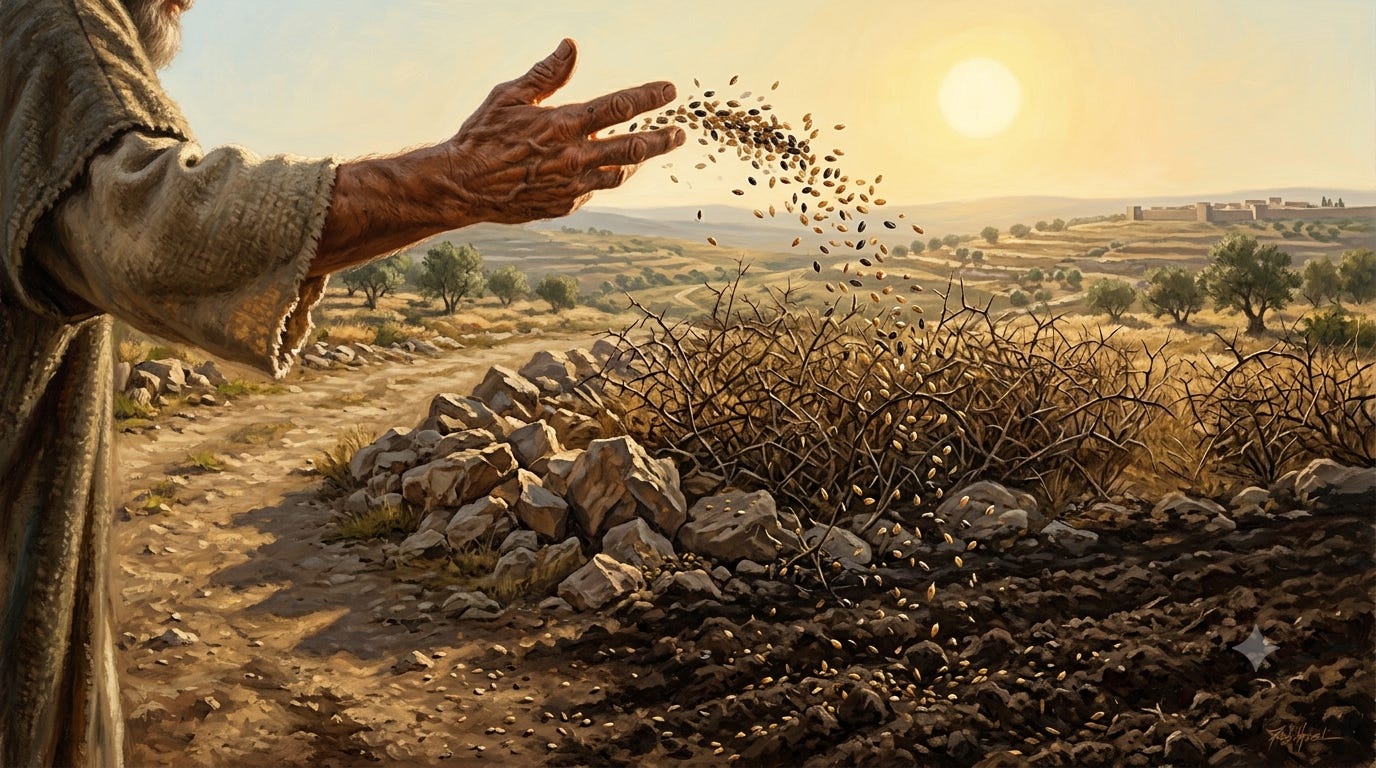
¹ On that day, Jesus went out of the house and sat down by the sea. ² Such large crowds gathered around him that he got into a boat and sat down, and the whole crowd stood along the shore. ³ And he spoke to them at length in parables, saying: "A sower went out to sow. ⁴ And as he sowed, some seed fell on the path, and birds came and ate it up. ⁵ Some fell on rocky ground, where it had little soil. It sprang up at once because the soil was not deep, ⁶ and when the sun rose it was scorched, and it withered for lack of roots. ⁷ Some seed fell among thorns, and the thorns grew up and choked it. ⁸ But some seed fell on rich soil, and produced fruit, a hundred or sixty or thirtyfold. ⁹ Whoever has ears ought to hear."
¹⁰ The disciples approached him and said, "Why do you speak to them in parables?" ¹¹ He said to them in reply, "Because knowledge of the mysteries of the kingdom of heaven has been granted to you, but to them it has not been granted. ¹² To anyone who has, more will be given and he will grow rich; from anyone who has not, even what he has will be taken away. ¹³ This is why I speak to them in parables, because 'they look but do not see and hear but do not listen or understand.' ¹⁴ Isaiah's prophecy is fulfilled in them, which says:
'You shall indeed hear but not understand,
you shall indeed look but never see.
¹⁵ Gross is the heart of this people,
they will hardly hear with their ears, they have closed their eyes,
lest they see with their eyes
and hear with their ears
and understand with their heart and be converted,
and I heal them.'
¹⁶ "But blessed are your eyes, because they see, and your ears, because they hear. ¹⁷ Amen, I say to you, many prophets and righteous people longed to see what you see but did not see it, and to hear what you hear but did not hear it.
¹⁸ "Hear then the parable of the sower. ¹⁹ The seed sown on the path is the one who hears the word of the kingdom without understanding it, and the evil one comes and steals away what was sown in his heart. ²⁰ The seed sown on rocky ground is the one who hears the word and receives it at once with joy. ²¹ But he has no root and lasts only for a time. When some tribulation or persecution comes because of the word, he immediately falls away. ²² The seed sown among thorns is the one who hears the word, but then worldly anxiety and the lure of riches choke the word and it bears no fruit. ²³ But the seed sown on rich soil is the one who hears the word and understands it, who indeed bears fruit and yields a hundred or sixty or thirtyfold."
Today’s Focus
Jesus tells the parable of the sower from a boat pushed out from shore by the crowd, then privately interprets each soil as a condition of the human heart, showing that the word of God is sown generously and indiscriminately while the outcome depends entirely on the disposition of whoever receives it.
In the Margins
Before Jesus gives the parable, the situation itself says something. The crowd has grown so large that he has been pushed off the land into a boat. He sits on water and the people stand on shore, and from that distance he tells them a story about why some people will understand what he is saying and others will not. The irony is quiet and deliberate. The parable about receptivity is being told to a crowd with wildly varying degrees of it.
The parable itself is simple enough on the surface. A sower scatters seed. Different soils produce different results. What makes it worth the close attention Jesus clearly expects is not the story but the principle underneath it. The seed never changes. The sower never changes. What changes is the ground, and the ground is not the field. It is the person hearing.
When the disciples ask why Jesus uses parables at all, his answer challenges any assumption that the purpose is to make things clearer. Parables are not illustrations of points that could be made plainly. They are a form of speech that does something different: they reveal to those disposed to receive and remain opaque to those who are not. This is not God withholding understanding from some people arbitrarily. It is the same dynamic the parable itself describes. The condition of the ground at the moment of hearing determines what happens to the seed. Isaiah’s prophecy fills in the background: the people who look but do not see, who hear but do not understand, have arrived at that condition not because God has closed them off but because they themselves have closed their eyes.
Jesus then walks through each soil, and what is striking is how recognizable each one is. The path hearer loses the word before it has a chance to do anything, stolen before it takes root. The rocky ground hearer receives it with immediate and genuine joy, then falls away when the word costs something, because joy in the word and roots in the word are not the same thing. The thorny ground hearer is not opposed to the word. She is distracted from it, the particular distractions being anxiety about the circumstances of life and the pull of material accumulation, two things that do not announce themselves as enemies of faith and therefore do a great deal of damage quietly over a long time.
The good soil is not described in terms of effort or achievement. It hears and understands. It receives. The fruit is not the soil’s production. It is what happens when the word finds ground that does not close against it.
None of these soils are permanent assignments. The same person can be rocky ground through one decade of their life and good soil in another. The same person can be genuinely receiving in one area while being slowly choked in a different one. What the parable does not permit is the comfortable assumption that receiving the word once, long ago, with joy, is the same as remaining ground that produces fruit now.
Reflection Question
Which of the four soils most honestly describes the condition of your heart toward God's word right now, not the condition you wish described you, and what is specifically hardening, choking, or opening that ground?