

The Gospel: Matthew 11:25-30
²⁵ At that time Jesus said in reply, "I give praise to you, Father, Lord of heaven and earth, for although you have hidden these things from the wise and the learned you have revealed them to the childlike. ²⁶ Yes, Father, such has been your gracious will. ²⁷ All things have been handed over to me by my Father. No one knows the Son except the Father, and no one knows the Father except the Son and anyone to whom the Son wishes to reveal him.
²⁸ "Come to me, all you who labor and are burdened, and I will give you rest. ²⁹ Take my yoke upon you and learn from me, for I am meek and humble of heart; and you will find rest for yourselves. ³⁰ For my yoke is easy, and my burden light."
Today’s Focus
Jesus praises the Father for revealing truth to the childlike rather than the wise, establishes that all authority has been given to Him by the Father, and invites the weary and burdened to exchange their ill-fitting religious obligations for His well-fitted yoke, promising the deep sabbath rest that comes from relationship with a meek and humble teacher.
In the Margins
This passage arrives in Matthew after a sequence of rejection and opposition. Jesus has condemned the cities where His miracles were performed because they did not repent. John the Baptist is in prison and uncertain. The religious establishment has been consistently hostile. The context is not triumph. It is resistance and weariness. Into that context Jesus prays.
I praise you, Father, Lord of heaven and earth, because you have hidden these things from the wise and the learned and revealed them to the childlike. This is not a general thanksgiving. It is a specific acknowledgment that the pattern Jesus has been witnessing is exactly what the Father intended. The scholars and the powerful have not received it. The little ones have. The hiddenness is not arbitrary caprice. Those whose learning has become armor against surprise, whose expertise has made them too settled in their categories to receive something arriving outside those categories, are precisely the ones who miss it. The childlike have no such defense, and their receptivity is their qualification.
All things have been handed over to me by my Father. This is the same claim that closes the Gospel at the Great Commission. Here it appears quietly, almost parenthetically, before the most pastoral invitation in Matthew’s Gospel. The authority claim and the pastoral invitation are not separate. The one who invites is the one who has received everything from the Father and can therefore give what He offers.
Come to me, all you who labor and are burdened, and I will give you rest. The Greek word anapausis, rest, is the word of sabbath rest, the deep rest of the seventh day, not the absence of activity but the presence of shalom. The burden Jesus is addressing was specific in its first century context. The yoke was a rabbinic metaphor for the obligations of the Torah as interpreted and applied by the teachers. Under the Pharisaic system the Torah had accumulated layers of interpretive obligation that the ordinary person could not navigate fully. The burden was religious and moral. The system had become crushing in the very place it was supposed to bring life.
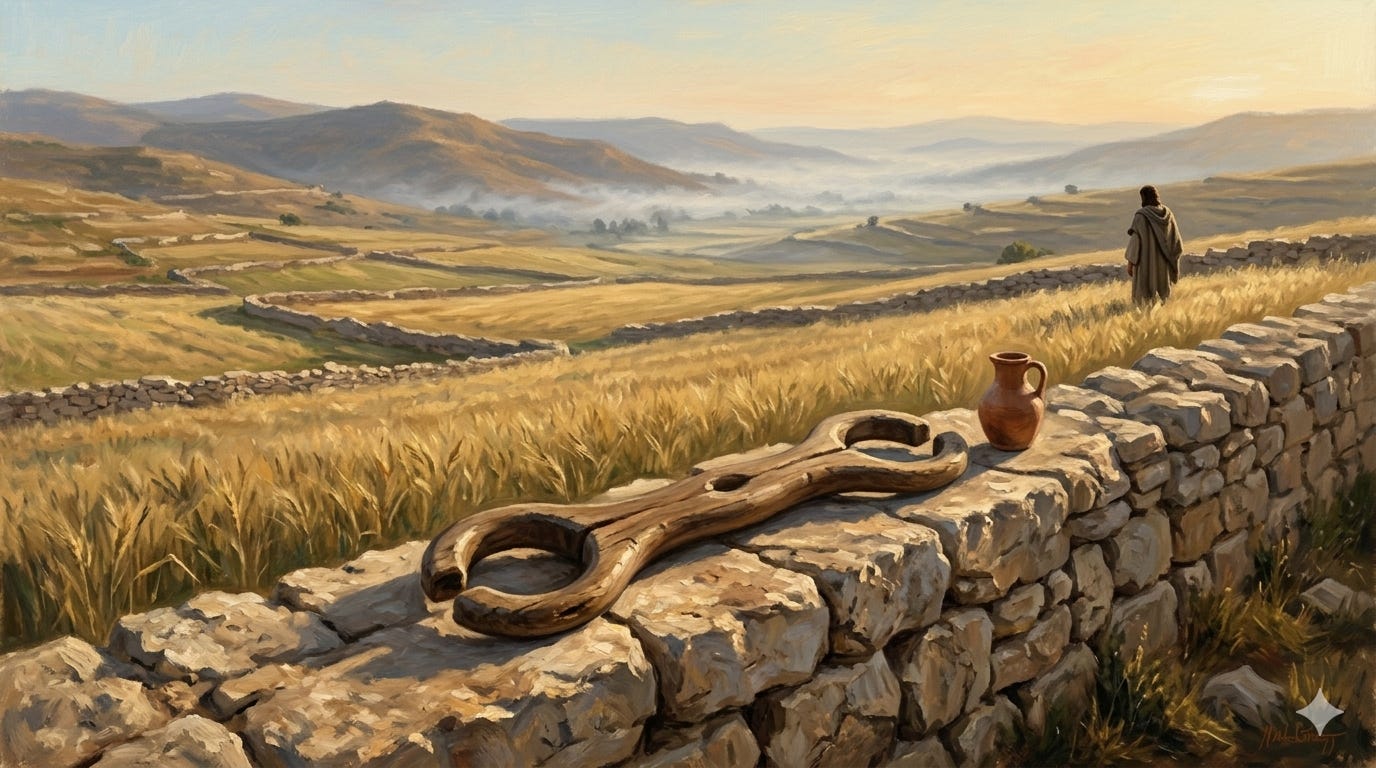
Take my yoke upon you and learn from me, for I am meek and humble of heart. The word translated as easy, chrēstos, means well-fitted, suited to the one who wears it. A well-made yoke does not chafe because it is shaped for the specific animal that bears it. Jesus is not offering the removal of all obligation. He is offering a relationship with a teacher whose yoke is sized for you personally, who walks alongside rather than pronouncing demands from a distance, who is meek and humble of heart rather than crushing and distant.
There is a version of religious life that has stopped feeling like relationship with God and started feeling like an endless performance for a God who is never quite satisfied. This passage names that experience precisely. And it offers not a lighter theology but a specific person. Come to me. The rest is found not in a better system but in the one who made the yoke to fit.
Reflection Question
What religious or moral burden have you been carrying that has begun to feel like performance for a God who is never satisfied, and what would it mean to come to Jesus and let Him fit the yoke to you specifically?