

The Gospel: Matthew 10:34 – 11:1
³⁴ "Do not think that I have come to bring peace upon the earth. I have come to bring not peace but the sword. ³⁵ For I have come to set
a man 'against his father,
a daughter against her mother,
and a daughter-in-law against her mother-in-law;
³⁶ and one's enemies will be those of his household.'
³⁷ "Whoever loves father or mother more than me is not worthy of me, and whoever loves son or daughter more than me is not worthy of me; ³⁸ and whoever does not take up his cross and follow after me is not worthy of me. ³⁹ Whoever finds his life will lose it, and whoever loses his life for my sake will find it.
⁴⁰ "Whoever receives you receives me, and whoever receives me receives the one who sent me. ⁴¹ Whoever receives a prophet because he is a prophet will receive a prophet's reward, and whoever receives a righteous man because he is righteous will receive a righteous man's reward. ⁴² And whoever gives only a cup of cold water to one of these little ones to drink because he is a disciple — amen, I say to you, he will surely not lose his reward."
¹ When Jesus finished giving these commands to his twelve disciples, he went away from that place to teach and to preach in their towns.
Today’s Focus
Jesus reframes his mission as one that will produce real conflict even within families, clarifies that following him requires an ordering of love that places him above every other loyalty, and closes with the promise that even the smallest act of hospitality toward his disciples carries eternal significance before God.
In the Margins
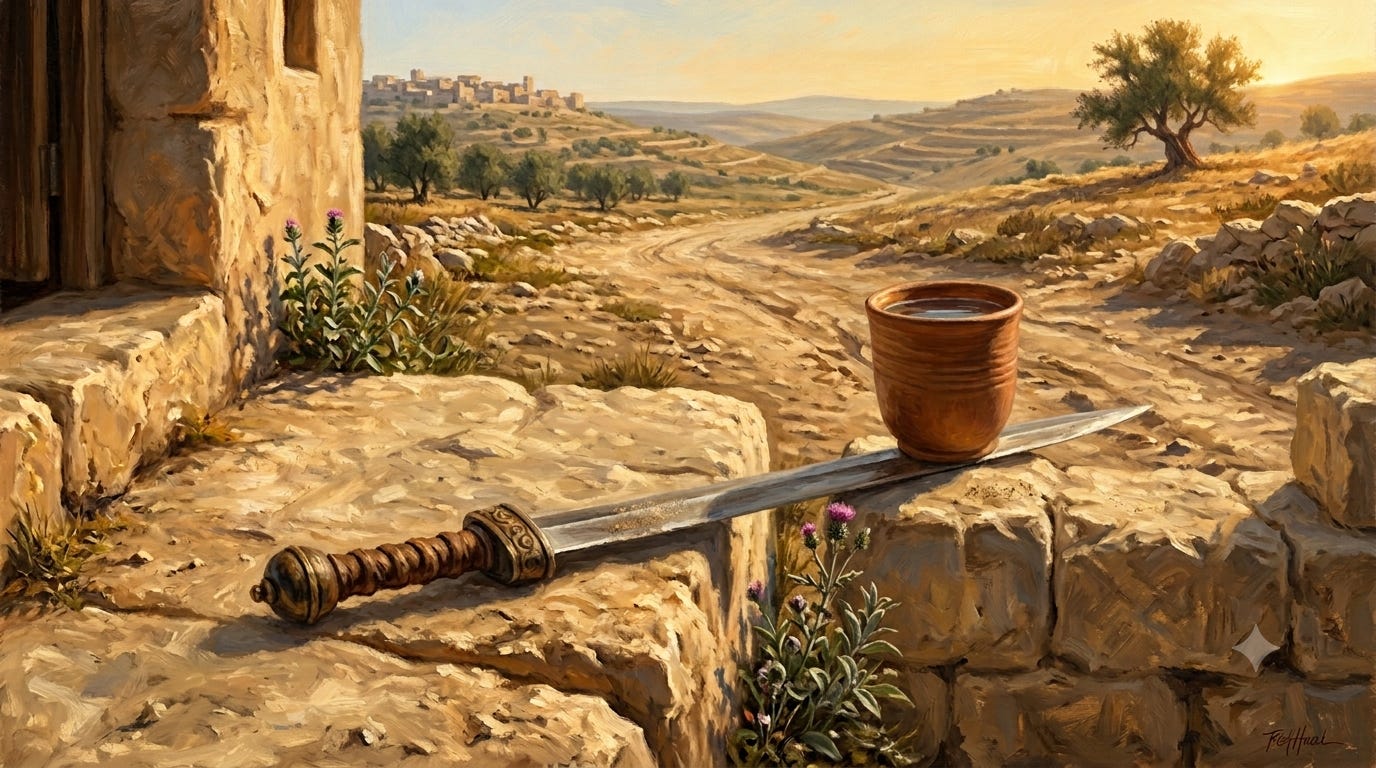
Jesus is the Prince of Peace. He is also the one who says plainly, I have not come to bring peace but a sword. Both of those things are true, and the temptation to dissolve the tension by explaining one away in favor of the other is worth resisting, because the tension itself is the teaching.
The peace Jesus brings is not the absence of conflict. It is right relationship with God, and right relationship with God always cuts against whatever has been organized around a different center. When the center of a life genuinely shifts to Him, it does not shift quietly. Families can fracture along that line. The passage adapts Micah 7:6, originally describing the breakdown of a corrupt generation, and applies it to the unavoidable tension the Gospel introduces into the most intimate human structures. This was not metaphor for the first Christians. Accepting Christ in a Jewish household frequently meant being understood as a traitor to the covenant. In a Gentile household, it meant refusing the gods of the family, the gods whose favor was understood to protect the household from disaster. The cost was real and the fractures were real.
What Jesus is describing with the father and mother and son and daughter language is not a call to love family less. It is a clarification of what happens when any love becomes the organizing principle of a life rather than something held within the love of God. Every human love, for parents, for children, for a community, finds its proper shape when it is ordered underneath the love that created it. When family loyalty and faithfulness to Jesus genuinely conflict, the ordering has to be clear, not because family does not matter, but because the love that can actually hold all the others in their proper place is the only one capable of doing so. Placing any other love above that one does not protect it. It distorts it.
The cross appears in this passage before Jesus carried one. To take up your cross meant something physically specific in a Roman world: carrying the beam toward your own execution. His listeners heard that as a vivid image of total, possibly fatal commitment. They did not yet know it would become the literal description of their teacher’s death and, for most of them, eventually their own.
Then the passage turns, and the turn is the part that tends to get overlooked because what comes before it is so demanding. After the sword and the family division and the cross, Jesus says whoever gives a cup of cold water to one of these little ones because he is a disciple will surely not lose his reward. The smallest possible gesture of welcome, not a sacrifice, not a dramatic act of courage, just water offered because the person receiving it belongs to Jesus, carries eternal weight. The passage that begins with the staggering cost of following Him ends with the staggering accessibility of participating in what He is doing. Not everyone will be asked to carry a cross the way the Twelve were sent to carry one. But everyone has a cup of water and the choice of who to give it to.
Reflection Question
Where is your love for someone close to you functioning as an obstacle to following Jesus rather than being held within and transformed by that following?