

13 Jun 26 | Let Your Yes Mean Yes
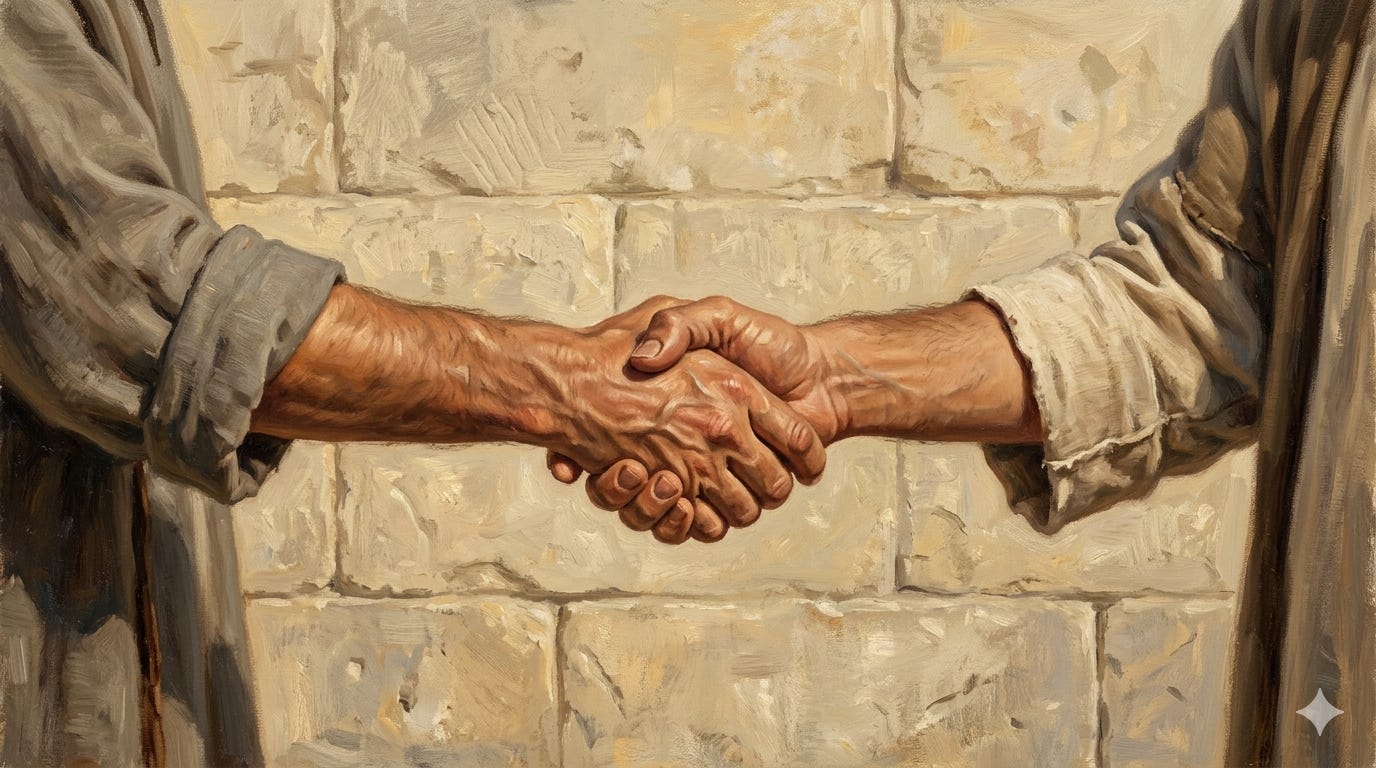
Jesus said let your yes mean yes. The whole oath system existed because people's yes did not mean yes.
The Gospel: Matthew 5:33-37
³³ "Again you have heard that it was said to your ancestors, 'Do not take a false oath, but make good to the Lord all that you vow.' ³⁴ But I say to you, do not swear at all; not by heaven, for it is God's throne; ³⁵ nor by the earth, for it is his footstool; nor by Jerusalem, for it is the city of the great King. ³⁶ Do not swear by your head, for you cannot make a single hair white or black. ³⁷ Let your 'Yes' mean 'Yes,' and your 'No' mean 'No.' Anything more is from the evil one."
Today’s Focus
Jesus dismantles the first century oath taxonomy by showing that every potential guarantee belongs to God and cannot be borrowed, replaces the system with the radical simplicity of yes meaning yes and no meaning no, and points to the interior transformation that makes additional assurances unnecessary.
In the Margins
The fourth antithesis of the Sermon on the Mount addresses the oath system, and to understand what Jesus is dismantling it helps to understand what oaths were for.
In first century Jewish practice a sophisticated taxonomy of oaths had developed. Not all oaths were equally binding. Swearing by heaven, by earth, by Jerusalem, by one’s own head all carried different levels of obligation depending on the rabbinic interpretation. The system created what was essentially a sliding scale of truthfulness. If you swore by something close to God, the oath was maximally binding. If you swore by something more distant, there was more interpretive room. The practical result was a framework in which the weight of your words depended on how cleverly you had framed the assurance rather than on your actual integrity.
Jesus cuts through the entire system. Do not swear at all. Then He explains why invoking anything as collateral is impossible. Heaven is God’s throne. Earth is His footstool. Jerusalem is the city of the great King. Your own head is beyond your control since you cannot make a single hair white or black. Everything the tradition had used as the backing for oaths turns out to belong to God and the person wearing to it had no way to actually meet that oath. Every attempt to invoke something as a guarantee reveals that you are borrowing authority you do not possess.
The diagnosis underneath the instruction is about integrity, the alignment between what is in a person and what comes out of them. The elaborate oath system existed because words alone could not be trusted. Additional weight had to be attached to them because the words themselves were unreliable indicators of what would actually happen. Jesus addresses the root rather than the symptom. Let your yes mean yes and your no mean no. Anything more than this comes from the evil one.
This is more demanding than it sounds. A community in which yes means yes requires not a better system of words but transformed people. The yes is only trustworthy when the person saying it has become trustworthy. The oath system was a workaround for the gap between who people presented themselves to be and who they actually were. Jesus is not offering a better workaround. He is calling the workaround unnecessary by pointing to the interior transformation that makes it obsolete.
The contemporary version of this problem is not hard to recognize. We have developed sophisticated practices for saying what we mean without quite committing to it, for leaving ourselves room to exit the promises we make, for qualifying the yes until the no is always available. This passage calls the community of Jesus to a different standard, not cleverness with words but simplicity born of genuine integrity that has closed the gap.
Reflection Question
Where in your life do you regularly qualify or hedge what you say in ways that suggest your yes does not fully mean yes, and what would it take to close that gap between your words and your actual commitment?