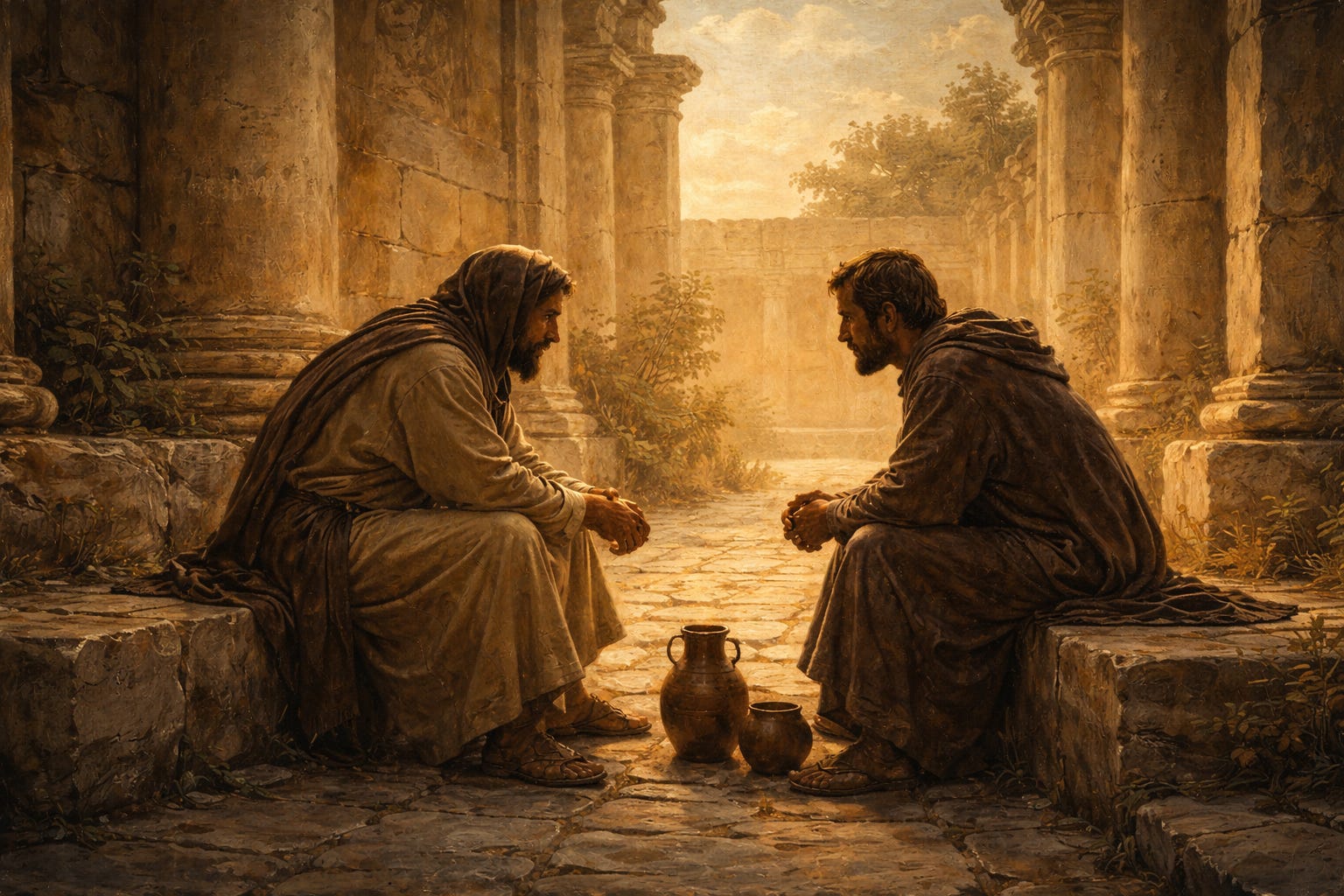
When a scribe asks Jesus which commandment is greatest, the answer Jesus gives is not a ranking but a revelation about what the entire law was always pointing toward.
The Gospel: Mark 12:28-34
One of the scribes came to Jesus and asked him, "Which is the first of all the commandments?" Jesus replied, "The first is this: Hear, O Israel! The Lord our God is Lord alone! You shall love the Lord your God with all your heart, with all your soul, with all your mind, and with all your strength. The second is this: You shall love your neighbor as yourself. There is no other commandment greater than these." The scribe said to him, "Well said, teacher. You are right in saying, He is One and there is no other than he. And to love him with all your heart, with all your understanding, with all your strength, and to love your neighbor as yourself is worth more than all burnt offerings and sacrifices." And when Jesus saw that he answered with understanding, he said to him, "You are not far from the Kingdom of God." And no one dared to ask him any more questions.
Today’s Focus
Among all the attempts to trap Jesus, one scribe asked a genuine question and received the clearest summary of the entire law ever given. Love God completely. Love your neighbor as yourself. These two are inseparable. You cannot claim the first without the second becoming visible in your life. The scribe understood it, affirmed it, and was told he was not far from the Kingdom. Not inside. Not far. The distance between those two places is the distance every reader of this passage has to reckon with.
In the Margins
During this part of the Gospel, Jesus is receiving many challenges from chief priests, Pharisees, Herodians, and Sadducees. Each question is an attempt to trap Jesus or at the very least discredit Him. After all of these questions, the scribe poses his question and Mark describes the scribe as asking sincerely, having observed that Jesus answered the others well.
In total, there are 613 commandments in the Torah, with 248 positives and 365 negatives. The question of which commandment was the greatest, or which summarized all the others, was a standard theological discussion, not a trap. Several rabbis offered their own summaries. Hillel famously said: “What is hateful to you, do not do to your neighbor. That is the whole Torah. The rest is commentary.“
Jesus opens his answer by quoting the Shema (Deuteronomy 6:4–5): “Hear, O Israel, the Lord our God, the Lord is one.” The Shema was not simply a commandment. It was the central daily prayer of Jewish life, recited morning and evening. Every observant Jew in the audience would have known it from childhood, had it on their doorposts in mezuzot, bound it on their arms and foreheads in tefillin. The command to love God with heart, soul, mind, and strength covers the totality of the human person. In Hebrew anthropology these are different ways of naming the whole person from different angles. Together they describe a love that leaves nothing of the person uncommitted.
Jesus volunteers the second commandment without being asked. The scribe asked for one. Jesus gives two and binds them together. This binding is the theological move of the passage. Jesus draws this second commandment from Leviticus 19:18. It appears inside the Holiness Code in Leviticus, a section devoted to Israel’s call to reflect God’s own holiness in communal life. The command to love the neighbor sits alongside commands about honest weights, care for the poor, and not bearing grudges. It is embedded in the practical texture of community life.
Placing Deuteronomy 6 and Leviticus 19 together, Jesus is doing something no single text does on its own. He is drawing a direct line between love of God and love of neighbor, making the second the necessary expression of the first. You cannot fully claim the first without the second becoming visible in your life. This is arguably the cornerstone of Jesus’ entire ministry. Jesus is giving “one” answer, combining that you must love both God and your neighbor, showing this connection is at the heart of holiness.
The scribe expands Jesus’ message, saying love is worth more than burnt offerings and sacrifices. That statement places him inside the prophetic tradition of Samuel, Hosea, and Micah. Jesus affirms him for it. This response from the scribe is taking place in Jerusalem, near the temple, and very close to the time when Jesus would be crucified. The irony is striking. The scribe is standing near the Temple, saying the sacrificial system is secondary to love, while Jesus is days away from rendering that system complete through his own body. What is interesting is that Jesus does not say that this understanding “gets you into the Kingdom.” Instead, He points out that by knowing this, “you are not far.” This is one of the most carefully weighted phrases Jesus uses in Mark. It is not a full welcome. It is not a rejection. It is a precise assessment.
Knowledge of the law’s heart is necessary but not sufficient. The next step the scribe would need to take is the one every person reading this passage faces, we must follow as disciples. Jesus gives us the opportunity to follow, but the choice is ours. He has shown us the way, told us how, and given us tools to be successful in this. We are the ones with the ultimate choice to make, to follow or not.
Reflection Question
Where in your life does your love of God stay private and never reach the person standing next to you?