

The Gospel: John 3:7b-15
⁷ Do not be amazed that I told you, 'You must be born from above.' ⁸ The wind blows where it wills, and you can hear the sound it makes, but you do not know where it comes from or where it goes; so it is with everyone who is born of the Spirit." ⁹ Nicodemus answered and said to him, "How can this happen?" ¹⁰ Jesus answered and said to him, "You are the teacher of Israel and you do not understand this? ¹¹ Amen, amen, I say to you, we speak of what we know and we testify to what we have seen, but you people do not accept our testimony. ¹² If I tell you about earthly things and you do not believe, how will you believe if I tell you about heavenly things? ¹³ No one has gone up to heaven except the one who has come down from heaven, the Son of Man. ¹⁴ And just as Moses lifted up the serpent in the desert, so must the Son of Man be lifted up, ¹⁵ so that everyone who believes in him may have eternal life."
Today’s Focus
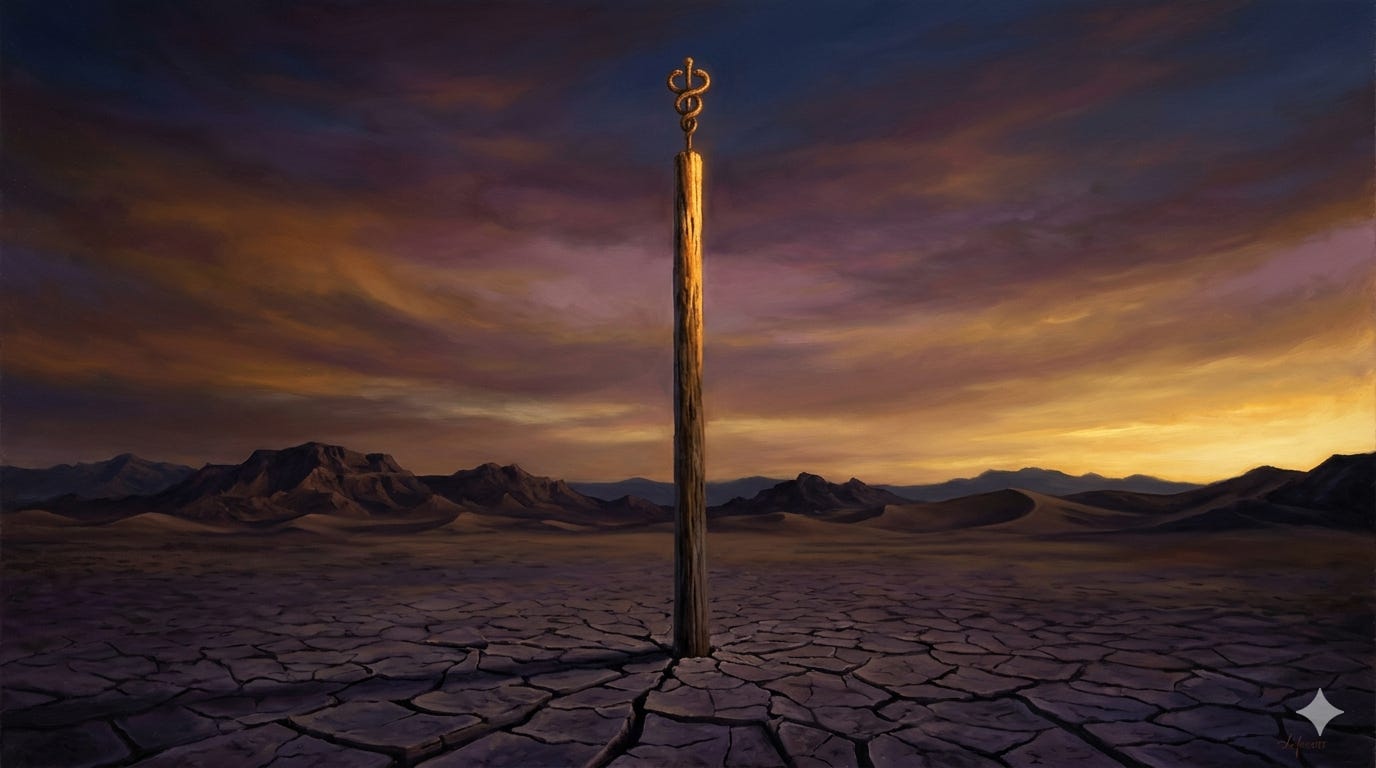
Nicodemus asked how this could happen and Jesus told him to look at a pole in the wilderness where Moses once lifted a bronze serpent so that the dying could look and live. The instrument of judgment lifted up becoming the source of life for those who look toward it in faith. That is the pattern. That is what the cross is. The life Jesus is offering is not only a future inheritance waiting at death. It is the life of the coming age made available now, entered through faith in the one who descended from heaven and will be lifted up. Nicodemus’s credentials do not open the door. Faith does. And it is open to everyone.
In the Margins
Nicodemus asks how this can happen and Jesus responds with a rebuke that is precise and pointed. He calls him the teacher of Israel, not a teacher, the definite article in Greek making clear that this is the highest position of scriptural interpretation in Judaism. The rebuke is not about intellectual failure. It is about the gap between what Nicodemus knows and what he has understood from what he knows. Everything Jesus has described, the birth from above, the water and Spirit, the sovereign movement of the pneuma, has its roots in texts Nicodemus has spent his life studying. Ezekiel 36 contains the promise of clean water, a new heart, and the Spirit placed within. Ezekiel 37 describes the breath of God raising the dead. A teacher formed in those texts should have had categories for what Jesus is announcing. The problem is not the difficulty of the teaching. It is the framework through which it is being received.
Jesus then makes a claim about the nature of His testimony that shifts the entire conversation. We speak of what we know and testify to what we have seen. The authority behind what He is saying is not derived from scriptural interpretation or prophetic vision. He speaks of what He has seen because He comes from where these things are known directly. Nicodemus speaks from within the tradition. Jesus speaks from within the reality the tradition was pointing toward.
No one has gone up to heaven except the one who has come down from heaven, the Son of Man. In the Jewish tradition surrounding this period, figures like Enoch and Elijah were understood to have received heavenly knowledge through their encounters with God. Jesus is not placing Himself in that category. He is drawing a categorical distinction. Those figures received visions or were taken up, but Jesus descended. His knowledge of heavenly is the knowledge of the one who was already there.
The title Son of Man draws directly on Daniel 7, where one like a son of man comes on the clouds to the Ancient of Days and receives dominion, glory, and a kingdom that will not pass away. In Daniel the movement is upward, the Son of Man ascending to receive authority. The Son of Man descends into the human realm, and the cross will be the moment where the descending and ascending converge. The use of the verb lifted up throughout the passion narrative carries both meanings simultaneously. To be lifted up on the cross and to be lifted up in glory, as one singular event.
The connection Jesus draws to the bronze serpent in the wilderness is the earliest reference to the cross in this Gospel and one of the most significant Old Testament typologies in the New Testament. Numbers 21 records Israel complaining against God in the desert, venomous serpents coming among them, and many dying from the bites. When the people confessed and asked Moses to intercede, God instructed him to make a bronze serpent and mount it on a pole. Anyone bitten who looked at it lived. The pattern Jesus applies to Himself follows the same logic. The instrument of judgment is lifted up and becomes the source of life for those who look toward it in faith. The cross is not a defeat that the resurrection then reverses. It is itself the moment where judgment and healing meet, where the thing that should bring death becomes the means of life for everyone who looks toward it in trust.
The word translated as must, dei, is the same word Luke uses throughout his Gospel for the divine necessity of Jesus’ mission. The lifting up is not accidental. It is not simply the product of human malice or political circumstance. It is the path the divine plan requires, written into the structure of what God has determined from the beginning.
Everyone who believes in Him may have eternal life. The phrase eternal life is often reduced to the idea of life after death, which is true but does not capture what it truly means by it. In the Jewish understanding of this period, history moved between the present age and the coming age, the age of God’s final reign characterized by the defeat of death and the direct presence of God among His people. Eternal life, zoe aionios, is the life belonging to that coming age. What Jesus is announcing is that this life is not only a future inheritance. It is a present reality entered through faith in the lifted-up Son of Man. The present tense that is used, may have, not will have, is deliberate. The one who believes has this life now, not only at death.
The coming age has broken into the present through the one who descended from heaven, and what it offers is available to everyone who believes, without qualification of ethnicity, standing, or prior religious achievement. Nicodemus’s credentials are not what gains him entry. Faith in the Son of Man who will be lifted up is the single condition, and it is open to everyone. Simply believing in Jesus, truly believing with all your heart that He is the one to save us, opens us up to an immediate and sustaining relationship with God.
Reflection Question
Are you looking toward the one who was lifted up, or are you still trying to find another way to answer the question of how this can happen?
A Small Invitation
If this reflection helped you, consider sharing it with someone who may benefit from hearing this message.