

Today’s Takeaway
Jesus heals and delivers, but He does not remain where He is most celebrated. He moves on, showing that prayer and mission, not acclaim, govern His ministry.
The Gospel
On leaving the synagogue
Jesus entered the house of Simon and Andrew with James and John.
Simon’s mother-in-law lay sick with a fever.
They immediately told him about her.
He approached, grasped her hand, and helped her up.
Then the fever left her and she waited on them.
When it was evening, after sunset,
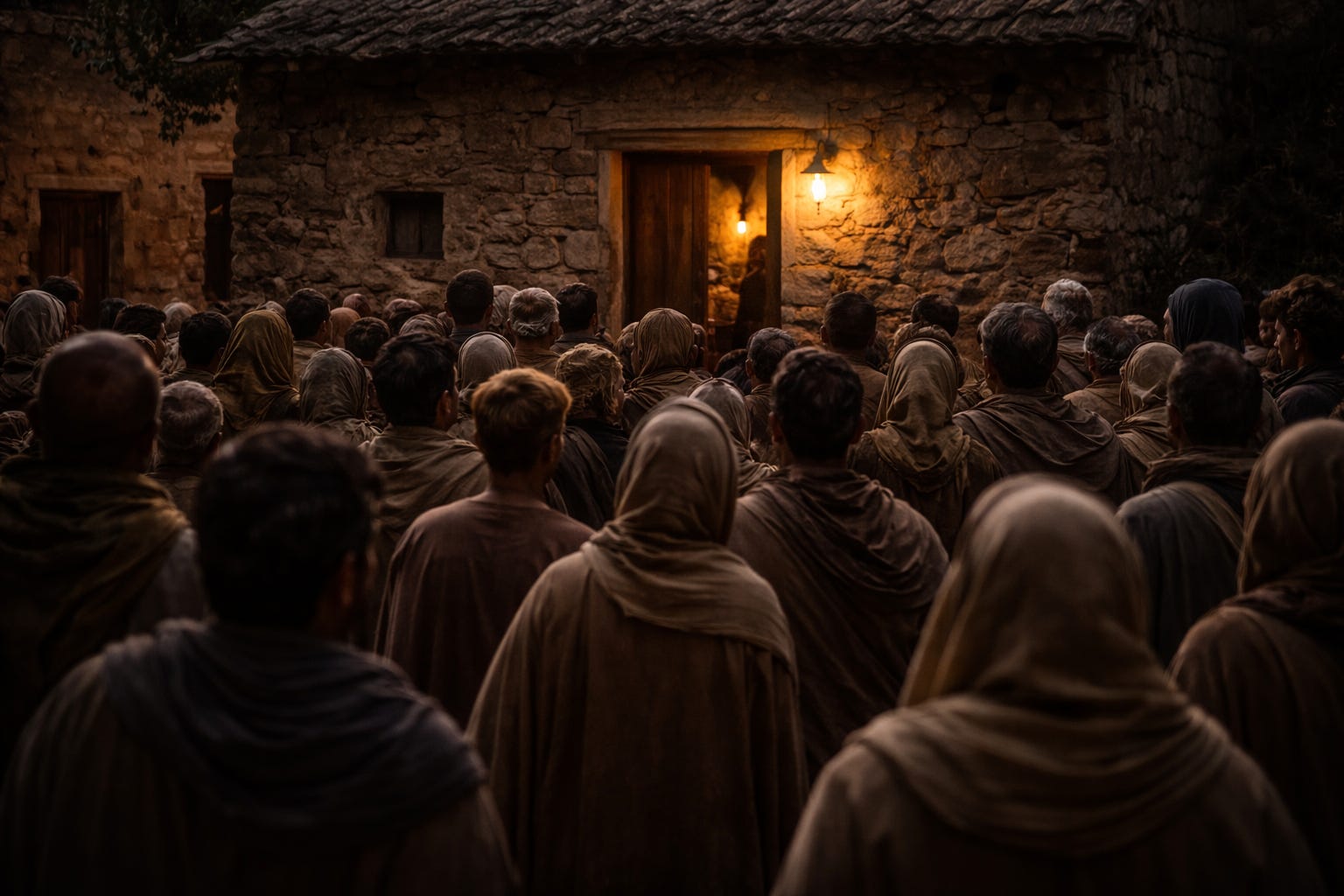
they brought to him all who were ill or possessed by demons.
The whole town was gathered at the door.
He cured many who were sick with various diseases,
and he drove out many demons,
not permitting them to speak because they knew him.
Rising very early before dawn,
he left and went off to a deserted place, where he prayed.
Simon and those who were with him pursued him
and on finding him said, “Everyone is looking for you.”
He told them, “Let us go on to the nearby villages
that I may preach there also.
For this purpose have I come.”
So he went into their synagogues, preaching and driving out demons
throughout the whole of Galilee.
In the Margins
If you were reading yesterday, you know that Jesus drove a demon out of a person in the synagogue. You also know that everyone would have been aware that Jesus was teaching with direct authority, something that was very different than what anyone had been doing. This Gospel picks up right after that with him leaving and heading to the home of Simon and Andrew.
When he enters the home, the first thing he does is to heal their sick mother-in-law. The first thing she does is to begin to serve them. This may seem strange when we look at it today. Jesus shows mercy and compassion by healing her, but doesn’t let her rest. Instead he accepts that she is beginning to serve them right away. The point here is rooted in Old Testament connections and a deep connection with what God expects from healing.
If we look at Exodus 4:11, God identifies Himself as the one who controls sickness and health, tying the ability to heal directly to divine authority. We know Jesus had just declared authority over the spirit before entering this home, and then shows it again through the healing. In Isaiah 38, King Hezekiah’s healing leads to renewal in worship and service, which is what we see with the mother here. God heals and it restores ones covenantal life with him. In addition to this, when God heals, it is done fully. There is no need to continue to rest for a full recovery in this case, she is not just on the mend. Instead, recognizing the gift given and the authority that gave it, she begins to serve the Lord. An amazing example when we apply this to our own lives!
The Gospel makes it sound like there was some time that passed, probably enough time for word to spread throughout the town about what had happened in the synagogue. It was the sabbath, so there would have been major restrictions on labor, which could explain how word would have spread so quickly and the crowd grew so fast as people were likely gathered together. By the time the people gather, the sabbath restrictions would have ended, which explains the gathering at the door.
Jesus shows restraint for his position by silencing the demons because they already knew him. He was letting his work speak for itself. It is a signal that the good defines the Kingdom, not the evil. We see this in 1 Kings 22 where it says that false or corrupted voices of the spirits can speak truth, but mixed with deception. In Job 1-2 the spiritual beings recognize God’s authority, but are not permitted to define His purpose. As in the synagogue scene, Jesus refuses testimony from unclean spirits. Their knowledge is accurate but illegitimate. Jesus does not allow His identity to be proclaimed by forces opposed to God, nor does He permit spectacle to define His mission.
We assume these healings took some time, and the next part of the Gospel has us waking up the next morning. Jesus, in a manner that is seen so many times, leaves to a deserted place. He resists the draw of splendor upon himself and departs to go into prayer instead. This teaches us so much about Jesus, seeing that his action flows from connection with the Father. When we examine our own lives, we have to look at our connection with God as well. When we are able to do great things, do we pray on those achievements and give thanks to God? Do we seek for glory not for ourselves, but for God?
It is easy to get caught up in the world where praise comes upon us. Especially at work or in sports. We want to do good work for various reasons, but we have to be sure that glory is brought to God in how we live. I heard someone once ask “if someone were to come into your home, would they know you were Christian by the things that they see?” I think this is the wrong question. If someone were to enter our homes, would they know us to be followers of Christ before they even got there, by the way we live?
Reflection Question
How can I be sure that if someone were to enter my home, they would know I am a Christian by how I was showing up before they got there?