

The Gospel: Matthew 5:17-37
Jesus said to his disciples:
"Do not think that I have come to abolish the law or the prophets.
I have come not to abolish but to fulfill.
Amen, I say to you, until heaven and earth pass away,
not the smallest letter or the smallest part of a letter
will pass from the law,
until all things have taken place.
Therefore, whoever breaks one of the least of these commandments
and teaches others to do so
will be called least in the kingdom of heaven.
But whoever obeys and teaches these commandments
will be called greatest in the kingdom of heaven.
I tell you, unless your righteousness surpasses
that of the scribes and Pharisees,
you will not enter the kingdom of heaven.
"You have heard that it was said to your ancestors,
You shall not kill; and whoever kills will be liable to judgment.
But I say to you,
whoever is angry with his brother
will be liable to judgment;
and whoever says to his brother, 'Raqa,'
will be answerable to the Sanhedrin;
and whoever says, 'You fool,'
will be liable to fiery Gehenna.
Therefore, if you bring your gift to the altar,
and there recall that your brother
has anything against you,
leave your gift there at the altar,
go first and be reconciled with your brother,
and then come and offer your gift.
Settle with your opponent quickly while on the way to court.
Otherwise your opponent will hand you over to the judge,
and the judge will hand you over to the guard,
and you will be thrown into prison.
Amen, I say to you,
you will not be released until you have paid the last penny.
"You have heard that it was said,
You shall not commit adultery.
But I say to you,
everyone who looks at a woman with lust
has already committed adultery with her in his heart.
If your right eye causes you to sin,
tear it out and throw it away.
It is better for you to lose one of your members
than to have your whole body thrown into Gehenna.
And if your right hand causes you to sin,
cut it off and throw it away.
It is better for you to lose one of your members
than to have your whole body go into Gehenna.
"It was also said,
Whoever divorces his wife must give her a bill of divorce.
But I say to you,
whoever divorces his wife - unless the marriage is unlawful -
causes her to commit adultery,
and whoever marries a divorced woman commits adultery.
"Again you have heard that it was said to your ancestors,
Do not take a false oath,
but make good to the Lord all that you vow.
But I say to you, do not swear at all;
not by heaven, for it is God's throne;
nor by the earth, for it is his footstool;
nor by Jerusalem, for it is the city of the great King.
Do not swear by your head,
for you cannot make a single hair white or black.
Let your 'Yes' mean 'Yes,' and your 'No' mean 'No.'
Anything more is from the evil one."
Today’s Focus
In this Gospel, Jesus does not dismantle Israel’s Law; He reveals its fullness. The Law was never merely about external regulation but about covenant fidelity rooted in the heart. By intensifying commandments against murder, adultery, falsehood, and empty worship, Jesus exposes that righteousness cannot be reduced to visible compliance. It must surpass even the disciplined observance of the scribes and Pharisees because it requires interior transformation. Fulfillment does not mean erasure; it means completion. In Christ, the covenant reaches its intended goal, and righteousness becomes not a checklist of actions but a life reshaped by grace from within.
In the Margins
In this passage we have Jesus opening up and declaring that the law is not abolished, but fulfilled. The verb plērōsai signals culmination. In Jewish understanding, the “Law and the Prophets” refers to the entirety of Israel’s Scriptures. These are the 5 books of Torah (Genesis, Exodus, Leviticus, Numbers, Deuteronomy), the books of the Prophets (Joshua, Judges, Samuel (1–2 Samuel counted as one), Kings (1–2 Kings counted as one), Isaiah, Jeremiah, Ezekiel, The Twelve Minor Prophets (counted as one book)), as well as Writings (Psalms, Proverbs, Job, Song of Songs, Ruth, Lamentations, Ecclesiastes, Esther, Daniel, Ezra–Nehemiah (counted together), Chronicles (1–2 together)). This understanding aligns with Jeremiah 31:31–34 (new covenant written on the heart), Deuteronomy 30:6 (circumcision of the heart), and Ezekiel 36:26–27 (new heart and new spirit).
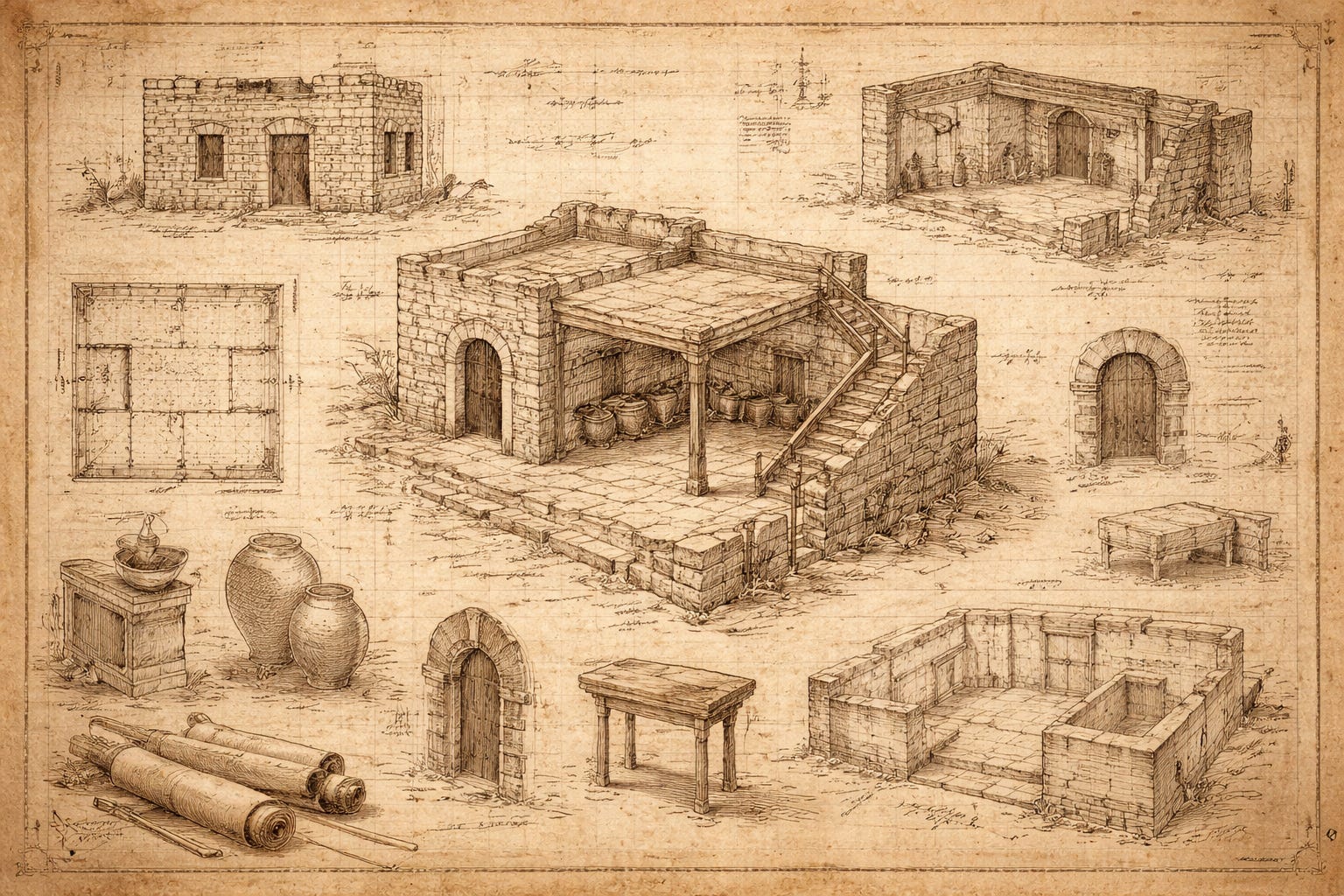
This can all be thought of in an analogy. If the Law is a blueprint, the building would be the fulfillment of that blueprint. The blueprint is not destroyed, it is not meaningless, but it has reached its purpose. This is what Jesus was stressing. In doing such, He reveals the Law’s intended fulfillment and brings its covenantal form to completion.
In these books, there are three separate types of Law. There were civil and judicial laws that were specific to Israel as a nation-state. These laws governed Israel as a theocratic nation and are not binding on Christians as covenant law, though they reveal principles of justice and holiness. The second were ceremonial laws. These are fulfilled in Christ’s sacrifice. They are no longer binding as they reached fullness. The third set are moral laws – such as the ten commandments, which we know to still be binding. We see these distinctions in Acts 15 (Council of Jerusalem), the letters from Paul, as well as early Church practices.
If we look at what Jesus is really teaching, it is that sin begins in the heart. He is not abolishing these laws or lowering them, He is intensifying them to their interior roots. Jesus makes this clear expounding on the fact that the very letters of the Law shall remain for eternity. Jesus makes the point that the righteousness of the Scribes and Pharisees are a bar too low. He was showing that the Kingdom of Heaven cannot be accessed by doing “enough” of the right things, but only through the grace of God.
This does not mean that we can do whatever we want. Jesus takes it all back to the heart. He intensifies so much of the law showing that it is what is in our hearts that makes the sin so bad. We can connect this to when he teaches that it is not what goes into our bodies, but what comes out of them that matters.
There is so much to this Gospel that this could go on for pages and pages. What we have to pull from this is that there were thousands of years of Torah, Law and Prophets. This reached its culmination when Jesus came as the definitive sacrifice. What He asked for in return was our hearts. For us to love Him and be transformed in grace through the Holy Spirit. He made it clear that it would not be easy, but that our hearts being pure would lead to us living holier lives. While there aren’t enough “good acts” to buy our way into Heaven, we do these acts because our hearts are aligned with Him.
Reflection Question
Is my faith shaping only my actions, or is Christ transforming my heart?
A Small Invitation
If this reflection helped you, consider sharing it with someone who may be carrying more than they were meant to.