

The Gospel: Matthew 11:25-27
²⁵ At that time Jesus said in reply, "I give praise to you, Father, Lord of heaven and earth, for although you have hidden these things from the wise and the learned you have revealed them to the childlike. ²⁶ Yes, Father, such has been your gracious will. ²⁷ All things have been handed over to me by my Father. No one knows the Son except the Father, and no one knows the Father except the Son and anyone to whom the Son wishes to reveal him."
Today’s Focus
After condemning unrepentant cities Jesus prays with genuine praise, thanking the Father for a pattern of revelation that bypasses the learned and reaches the childlike, grounding it in the exclusive mutual knowledge between Father and Son that the Son freely opens to those willing to receive rather than achieve it.
In the Margins
There is a pattern Jesus names in this prayer that most of us would rather not sit with. The people who have the most sophisticated religious knowledge, the ones who have studied the hardest, argued the sharpest, and built the most careful theological frameworks, are precisely the ones who miss what He is doing. The people who receive it are the ones who had no framework to begin with.
This is not a comfortable thing to read if you have spent years accumulating knowledge about faith. And it is not a celebration of ignorance. Jesus himself engages the scribes and Pharisees at the most demanding levels of scriptural argument throughout the Gospels. What He is naming is something more specific: a posture of the heart that can exist with or without learning, and a different posture that learning tends to produce when it stops being curious and starts being defended.
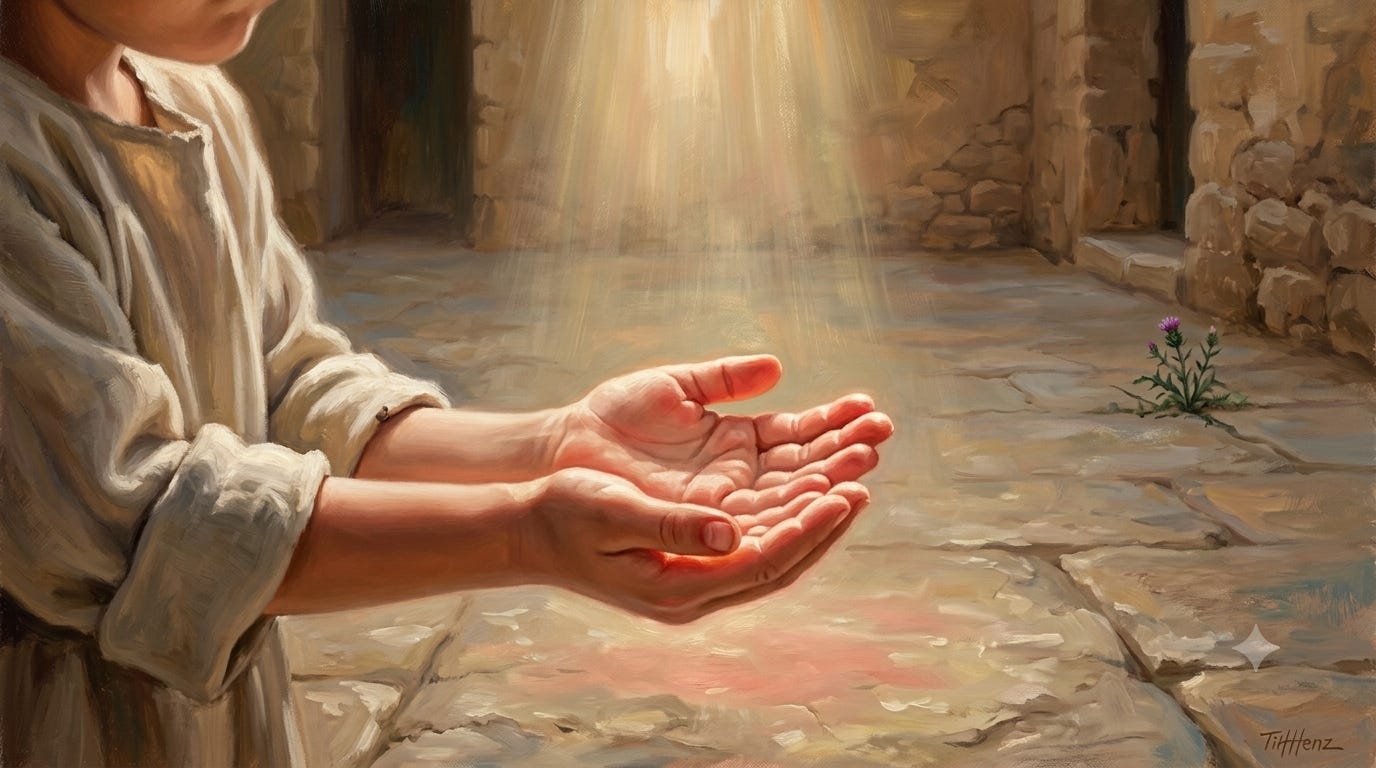
The Greek word translated as childlike, nepioi, means literally infants or very young children. What infants have that experts often lose is not innocence in the sentimental sense. It is receptivity. A child has no prior conclusion to protect, no framework requiring defense, no investment in the revelation arriving in a particular form. Open hands. What the learned can accumulate, over years of serious study, is a closed system, a set of categories that has become so settled it can no longer accommodate something new arriving outside its expected parameters. What they know becomes a wall rather than a window.
Jesus gives this pattern a theological explanation that is startling in its compression. All things have been handed over to me by my Father. No one knows the Son except the Father, and no one knows the Father except the Son and anyone to whom the Son wishes to reveal him. This sentence has been called the Johannine thunderbolt, because it sounds nothing like the surrounding Synoptic material and everything like the kind of mutual divine disclosure that runs through John’s Gospel. The knowledge of the Father and Son described here is not information. It is a total, exclusive intimacy, a knowing that belongs to them alone by nature. And then, without pausing, Jesus opens it. Anyone to whom the Son wishes to reveal him. The exclusive becomes available. But only through the Son’s initiative, and only to those capable of receiving what He gives rather than those who insist on generating it themselves.
This is what makes authentic knowledge of God different from every other kind of knowledge. It cannot be achieved. The disciplines of prayer, study, and sacrament are real and necessary, but they are not techniques for producing the thing. They are postures of availability, ways of keeping the hands open. The person who approaches God as a problem to be solved by sufficient intellectual effort is working against the grain of how God actually discloses Himself. The one who approaches with empty hands, who does not need to manage the revelation before accepting it, is the one the Son can actually give something to.
The context Matthew gives us here is worth holding onto. Jesus has just condemned cities that witnessed miracle after miracle and remained unmoved. He does not respond to that pattern with grief or frustration. He responds with praise, thanking the Father that the gracious will underneath this pattern is exactly as it was intended to be. The closing off and the opening up are both part of the same movement. The question is simply which one describes you.
Reflection Question
Has the knowledge you have accumulated about God brought you closer to trusting Him, or has it quietly become a way of feeling confident in your own understanding of Him rather than genuinely dependent on His?