

15 Mar 26 | The Man Born Blind
Jesus heals a man born blind and the miracle produces a crisis not in the man who received sight but in the religious leaders who refuse to see what is standing in front of them.
The Gospel: John 9:1, 6-9, 13-17, 34-38
As Jesus passed by he saw a man blind from birth.
He spat on the ground and made clay with the saliva,
and smeared the clay on his eyes,
and said to him,
“Go wash in the Pool of Siloam” — which means Sent —.
So he went and washed, and came back able to see.
His neighbors and those who had seen him earlier as a beggar said,
“Isn’t this the one who used to sit and beg?”
Some said, “It is, “
but others said, “No, he just looks like him.”
He said, “I am.”
They brought the one who was once blind to the Pharisees.
Now Jesus had made clay and opened his eyes on a sabbath.
So then the Pharisees also asked him how he was able to see.
He said to them,
“He put clay on my eyes, and I washed, and now I can see.”
So some of the Pharisees said,
“This man is not from God,
because he does not keep the sabbath.”
But others said,
“How can a sinful man do such signs?”
And there was a division among them.
So they said to the blind man again,
“What do you have to say about him,
since he opened your eyes?”
He said, “He is a prophet.”
They answered and said to him,
“You were born totally in sin,
and are you trying to teach us?”
Then they threw him out.
When Jesus heard that they had thrown him out,
he found him and said, “Do you believe in the Son of Man?”
He answered and said,
“Who is he, sir, that I may believe in him?”
Jesus said to him,
“You have seen him, and
the one speaking with you is he.”
He said,
“I do believe, Lord,” and he worshiped him.
Today’s Focus
A man born blind receives sight through a new creation act and ends the passage worshiping the one who made him see. The miracle itself divides everyone who witnesses it. The Pharisees interrogate, debate, and expel. The man simply reports what happened and follows where it leads. By the time Jesus finds him again, the man who never had sight is the only one in the passage who can truly see. The healing of his eyes was the beginning. The worship at the end is where John was always taking him.
In the Margins
This Gospel comes from John, immediately after the Feast of Tabernacles. In the Feast of Tabernacles, Jesus declares that he is “the light of the world.” This event takes place on the Sabbath. The act of healing itself was not prohibited. Instead, there were 39 categories of prohibited labor. The issue that is happening here is not that the healing took place, but that it was done in a manufacturing or physical sense of work. This had been an ongoing issue, since birth, ek genetēs (ἐκ γενετῆς). This shows that there was definitely a miracle, but also that it was not an emergency, which traditions allowed for. Jesus is performing this act on the Sabbath, which is either a violation of the law or a claim to share in God’s ongoing creative work.
The method of healing is striking. Jesus spits on the ground and makes clay. The Greek word for clay is pelos (πηλός), the same word used in the Greek Old Testament (LXX) for the clay God uses to form Adam in Genesis 2:7. Jesus is not performing a medical procedure. He is performing a new creation act. A man born without functional sight is being given what creation itself withheld from him. Jesus is not restoring something lost. He is giving something that never existed.
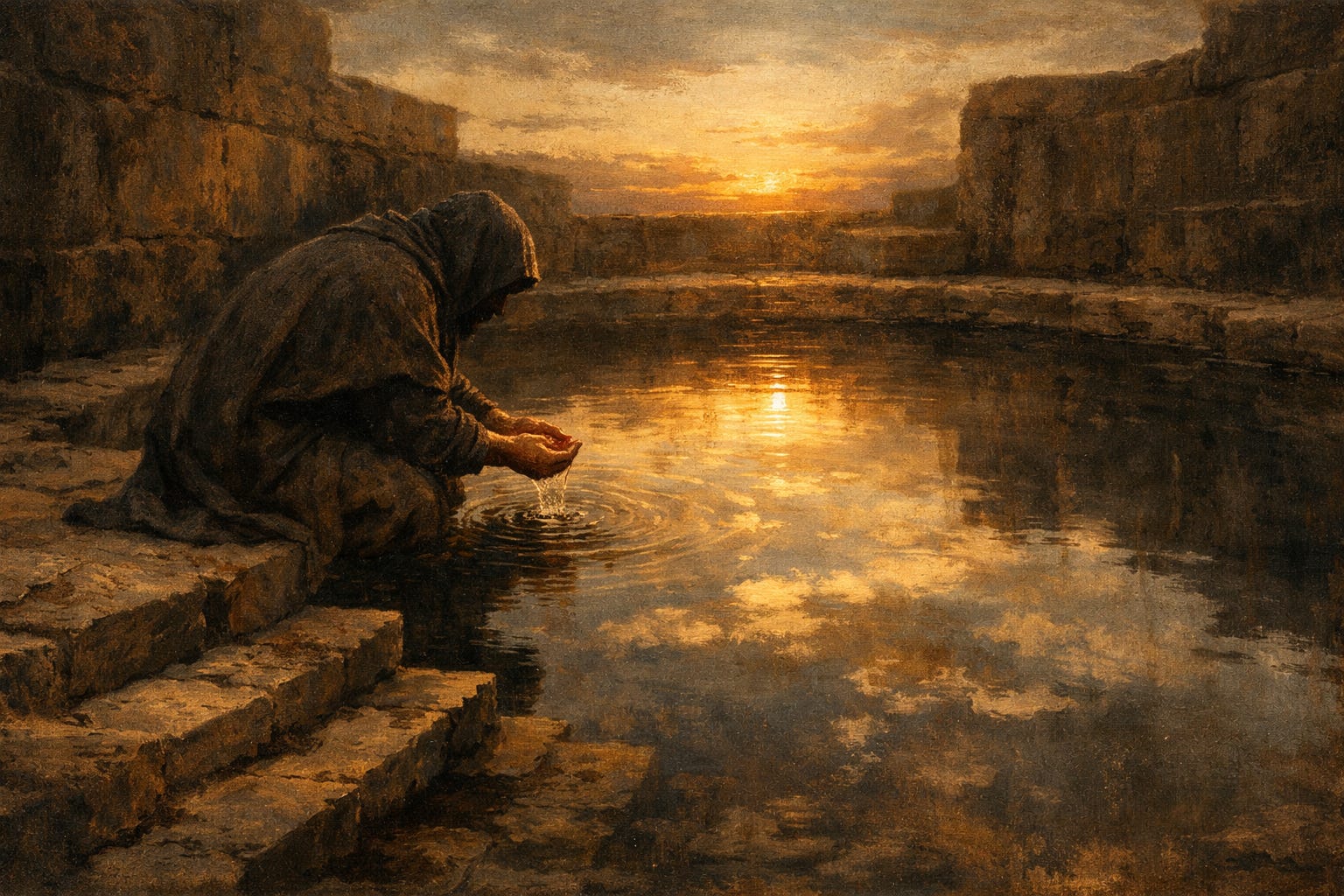
Jesus sends the man to wash in the Pool of Siloam and immediately provides the translation: Siloam means “sent” — apestalmenos (ἀπεσταλμένος). This is the same Greek root as apostolos, apostle, one who is sent. The pool’s name is a compressed Christological statement. The man washes in the waters of the One Who Is Sent and receives sight. For John’s Gospel, where Jesus is consistently identified as the one sent by the Father (3:17, 5:36, 6:29, 7:29), the pool’s name is not a footnote. It is the theological center of the healing.
The Pool of Siloam had specific significance during the Feast of Tabernacles, which immediately precedes this passage in John 7–8. Each morning of the feast, a priest drew water from the Pool of Siloam and carried it in a golden vessel to the Temple, where it was poured out at the altar as a water libation. This was a prayer for rain and a remembrance of the water from the rock in the wilderness. Jesus stands in the Temple during this feast and declares himself the source of living water (7:37–38). The blind man washes in the feast’s central water source and receives sight. The symbolism is layered and deliberate.
The Pharisees’ interrogation of the healed man follows a pattern of escalating pressure. They ask how it happened. They debate among themselves. They question the man’s parents. They question the man again. Each round intensifies. The structure mirrors a formal Jewish legal investigation, with the healed man functioning as a witness in his own case. When they ask the man what he thinks of Jesus, he says “He is a prophet.” This is the first stage of his confession. It is accurate but incomplete. A prophet is one who speaks for God. The man will arrive at a much larger claim by the end of the passage.
Jesus finds the man again, having heard that he was thrown out of the synagogue. This expulsion was a serious social and religious consequence in Second Temple Jewish life. To be cast out of the synagogue was to lose standing in the community, access to the religious life of Israel, and the social network that sustained daily existence. The man receives physical sight and immediately loses everything else. Jesus seeking him out symbolizes the shepherd going after the lost sheep. Where the blind man ends up on is that Jesus is the Son of Man when he encounters Jesus again.
The final confession is the destination of the entire passage. The blind man calls Jesus Kyrios (Lord), the title the Greek Old Testament reserves for the divine name YHWH. The man then worships him, an act reserved for God alone in Jewish practice. The man born blind ends the passage performing an act of divine worship.
This is a promise of Jesus, ultimately. It resonates with baptism as well. We wash in water, receive sight, and are brought into a new community. We cannot always remain where we were if we want to dedicate our lives to He who saves. In us opening our hearts and eyes to truly see Him, we may be cast out from the circles we have come to know. In doing such though, Jesus will never leave us alone. In our darkest times, when we believe all have turned away from us, we must remember that Jesus is there. It will not always be clear, but through our faith we must remember that we are not alone. Jesus can and will open our hearts and eyes, just as He healed the blind and restore sight. We can always turn to him.
Reflection Question
Is there something Jesus has already opened your eyes to that you have not yet been willing to follow through on?
A Small Invitation
If this reflection helped you, consider sharing it with someone who may benefit from hearing this message.