

The Gospel: John 6:1-15
¹ After this, Jesus went across the Sea of Galilee of Tiberias. ² A large crowd followed him, because they saw the signs he was performing on the sick. ³ Jesus went up on the mountain, and there he sat down with his disciples. ⁴ The Jewish feast of Passover was near. ⁵ When Jesus raised his eyes and saw that a large crowd was coming to him, he said to Philip, "Where can we buy enough food for them to eat?" ⁶ He said this to test him, because he himself knew what he was going to do. ⁷ Philip answered him, "Two hundred days' wages worth of food would not be enough for each of them to have a little bit." ⁸ One of his disciples, Andrew, the brother of Simon Peter, said to him, ⁹ "There is a boy here who has five barley loaves and two fish; but what good are these for so many?" ¹⁰ Jesus said, "Have the people recline." Now there was a great deal of grass in that place. So the men reclined, about five thousand in number. ¹¹ Then Jesus took the loaves, gave thanks, and distributed them to those who were reclining, and also as much of the fish as they wanted. ¹² When they had had their fill, he said to his disciples, "Gather the fragments left over, so that nothing will be wasted." ¹³ So they collected them, and filled twelve wicker baskets with fragments from the five barley loaves that had been more than they could eat. ¹⁴ When the people saw the sign he had done, they said, "This is truly the Prophet, the one who is to come into the world." ¹⁵ Since Jesus knew that they were going to come and carry him off to make him king, he withdrew again to the mountain alone.
Today’s Focus
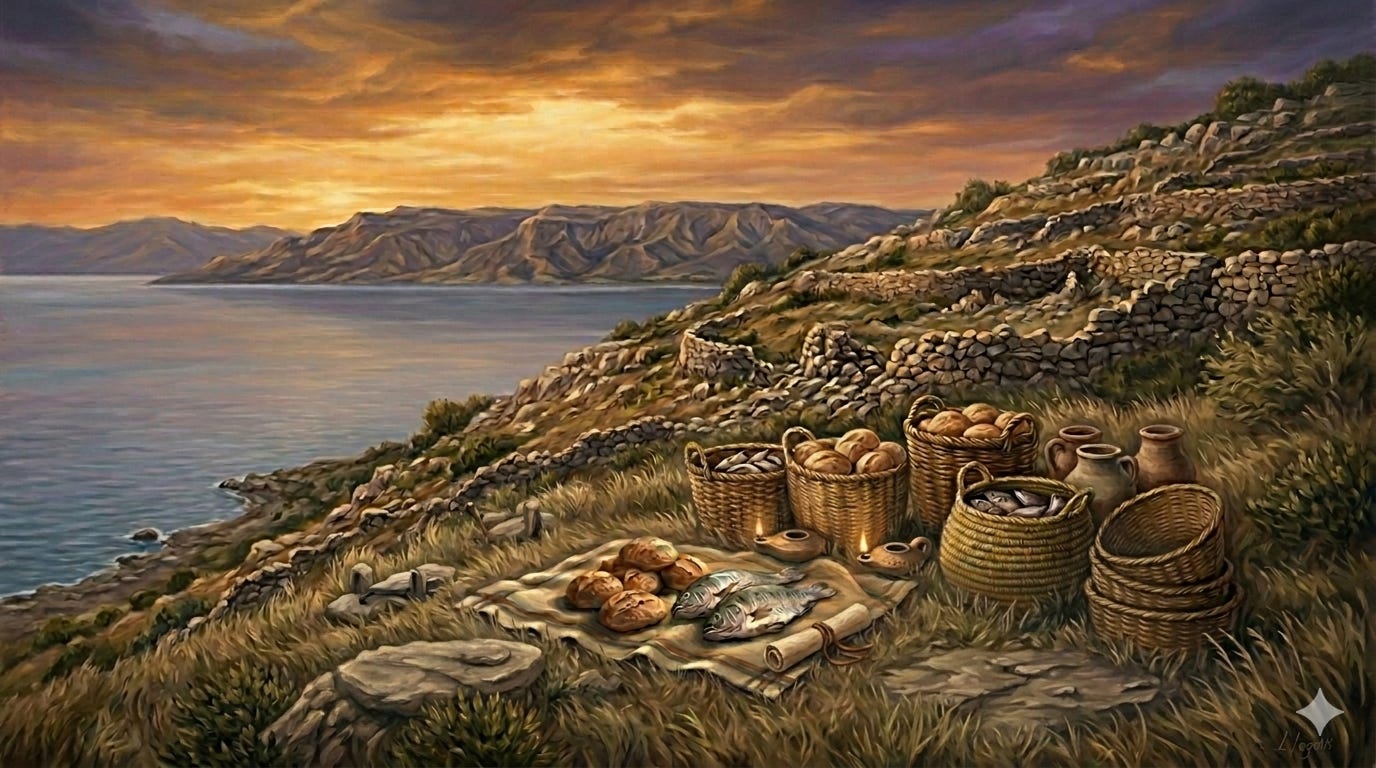
Five thousand people carrying centuries of Exodus memory watched Jesus take five barley loaves and two fish and feed everyone until they were full, with twelve baskets left over. They reached for the right category. He was the Prophet Moses pointed toward. But what they did with that recognition revealed the limits of their understanding. They wanted a king who would do to Rome what Moses did to Pharaoh. Jesus withdrew alone to the mountain. The sign was not pointing toward a revolution. It was pointing toward the one who does with insufficient things what no human calculation can account for, and toward a kingship that would be declared not from a seized throne but from a cross. The crowd saw the miracle and drew the wrong conclusion. The sign was pointing somewhere they were not yet willing to go.
In the Margins
This miracle takes place near the Feast of Passover, and that context matters for understanding what the crowd witnesses and how they interpret it. Passover was the annual commemoration of God leading Israel out of Egypt, the wilderness wandering, and the manna God provided each morning when the people had nothing. Five thousand people gathered near Jesus carry all of that history with them. When they watch what happens with five loaves and two fish, they are not watching it in a vacuum. They are watching it through centuries of covenant memory.
Before the miracle Jesus turns to Philip and asks where they can buy enough bread for the crowd. He already knows what He is going to do. The question is a test, an invitation for Philip to bring an impossible problem to Jesus and see what happens. Philip’s response is careful and practical. Two hundred days’ wages would not cover enough for each person to have even a little. His calculation is correct within what human resources can accomplish. Andrew at least brings what is available, a boy carrying five barley loaves and two fish, though he offers it with no expectation. What good are these for so many? It is a small and honest offering and it is what Jesus works with.
Barley was the grain of the poor. This is not fine bread, it’s the most ordinary provision available, the kind a child would carry for a day. What God multiplies here begins with the least impressive starting point imaginable. Jesus takes the loaves, gives thanks, and distributes them to the crowd. John uses the Greek word eucharistesas here, gave thanks, the root of the word Eucharist. The crowd eats and is satisfied and twelve baskets of fragments are gathered afterward. Twelve is the number of Israel’s tribes and the number of the disciples. The abundance that remains overflows precisely into the symbol of the fullness of God’s covenant people.
The closest parallel in the Old Testament is in 2 Kings 4, where the prophet Elisha feeds one hundred men with twenty barley loaves and has food left over. The pattern is the same. Provision that is humanly insufficient is multiplied by divine action and abundance remains. But the crowd does not reach for Elisha, rather they reach for Moses. They identify Jesus as the Prophet, drawing on the promise in Deuteronomy 18 where Moses tells Israel that God will raise up a prophet like him from among the people. By the first century that expectation had taken on significant messianic weight. The crowd has placed Jesus inside a legitimate and important category. They are not wrong that He is the one Moses pointed toward. But what they do with that identification reveals the limits of their understanding. Jesus far exceeds this standard.
They move to make Him king. A wilderness feeding by a figure in the Moses tradition meant, in their framework, a leader who would gather the people and drive out Rome the way Moses drove out Pharaoh. They want the sign to produce a revolution. Jesus withdraws alone to the mountain. He does not accept the kingship they are offering because the kingship they are imagining is not the one He has come to establish. He will be declared king, but from a cross, not from a throne seized by popular demand. Zechariah had already described the coming king arriving on a donkey rather than a war horse. The crowd’s version of messianic kingship and the one God had always intended are not the same thing.
John calls this event a sign, semeion, meaning it points beyond itself to something greater than the miracle itself. Jesus will make this explicit in the discourse that follows in John 6, telling the crowd plainly that they are seeking Him because they ate bread and were filled, not because they understood what the sign meant. The feeding is not primarily about bread. It is a sign about who provides it, about what God does with what is insufficient when it is placed in His hands, and about where the real bread that sustains human life ultimately comes from. The crowd saw the miracle and drew the wrong conclusion from it. The sign was pointing somewhere they were not yet willing to go.
Reflection Question
Is there something insufficient in your hands right now that you have not yet placed in his?
A Small Invitation
If this reflection helped you, consider sharing it with someone who may benefit from hearing this message.