

The Gospel: Matthew 11:28-30
²⁸ "Come to me, all you who labor and are burdened, and I will give you rest. ²⁹ Take my yoke upon you and learn from me, for I am meek and humble of heart; and you will find rest for yourselves. ³⁰ For my yoke is easy, and my burden light."
Today’s Focus
Jesus' invitation to rest arrives directly after condemning religious familiarity without repentance, addressed specifically to those whose burden is a religious life that has drifted from relationship into obligation management, offering not the removal of the yoke but a teacher who carries it alongside you and fits it to who you actually are.
In the Margins
The invitation comes immediately after one of the harshest passages in Matthew’s Gospel. Jesus has just condemned Chorazin, Bethsaida, and Capernaum for seeing everything and remaining unmoved. He has praised the Father for a pattern of revelation that bypasses the expert and reaches the childlike. And then, without pause, he turns and says come to me, all you who labor and are burdened, and I will give you rest.
The sequence matters. This is not a generic comfort offered to anyone having a hard week. It arrives directly after a passage about the failure of religious knowledge to produce what it was supposed to produce, which means the burden Jesus is addressing is at least partly the burden of a religious life that has stopped working as a relationship and become a system of obligations to maintain.
The first century Jewish context makes this specific. The yoke was a recognized rabbinic metaphor for the obligations of Torah observance as interpreted and applied by the teachers. Every Jewish person understood what it meant to take the yoke of the Torah upon yourself. What had happened over generations was a layering of interpretation upon interpretation, fence upon fence, until the ordinary person could not navigate the system without constant anxiety about whether they were in or out of compliance at any given moment. The Pharisaic project was serious and in many ways admirable, a sincere attempt to extend the holiness of the Temple into every corner of daily life. But the weight it produced was crushing, and the crushing was not what the Torah was for.
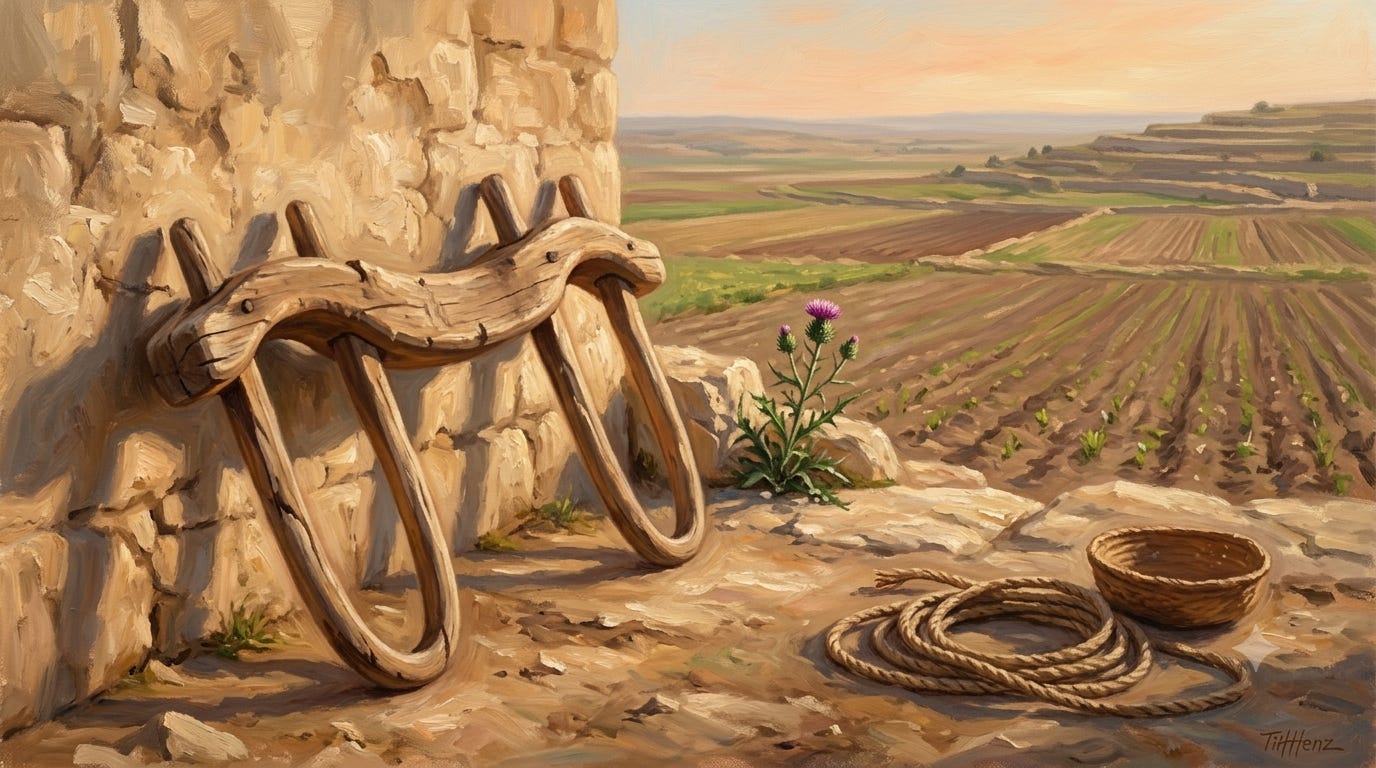
Take my yoke upon you and learn from me, for I am meek and humble of heart. The contrast is not between a yoke and no yoke. It is between two different kinds of yoke and, more significantly, two different kinds of teacher. The religious system of Jesus’ day placed demands on people without getting under the load with them. Jesus describes himself as meek and humble of heart, which in practice means the teacher is present in the carrying, not issuing requirements from a position of removed authority.
The word translated as easy, chrēstos, does not primarily mean simple or undemanding. It means well-fitting, suited to the one who wears it. A well-fitted yoke distributes weight rather than concentrating it, and it does not chafe because it was made for the specific animal bearing it. The rest Jesus promises is not the rest of having nothing to carry. It is the rest of carrying the right thing with the right help, in the right relationship with the one who assigned the load.
This is worth sitting with honestly. Most people who have been in the faith for any length of time have accumulated a version of the burden Jesus is describing, not necessarily from bad teaching but from the natural drift of religious life toward obligation management. The disciplines and practices that began as ways of drawing near to God gradually become things to maintain, standards to meet, boxes to check in order to feel like you are still in good standing. The relationship quietly becomes a performance, and the performance is exhausting in a way that is difficult to name because it looks so much like faithfulness from the outside.
The invitation to rest is not an invitation to do less. It is an invitation to come back to the person underneath all of it, and to let the yoke be refitted for who you actually are and what you are actually carrying right now.
Reflection Question
What has your practice of faith become in this season, a relationship with a person or a system of obligations you are trying to maintain, and what would it mean to bring that specific weight to Jesus rather than continuing to manage it alone?