

The Gospel: Matthew 28:16-20
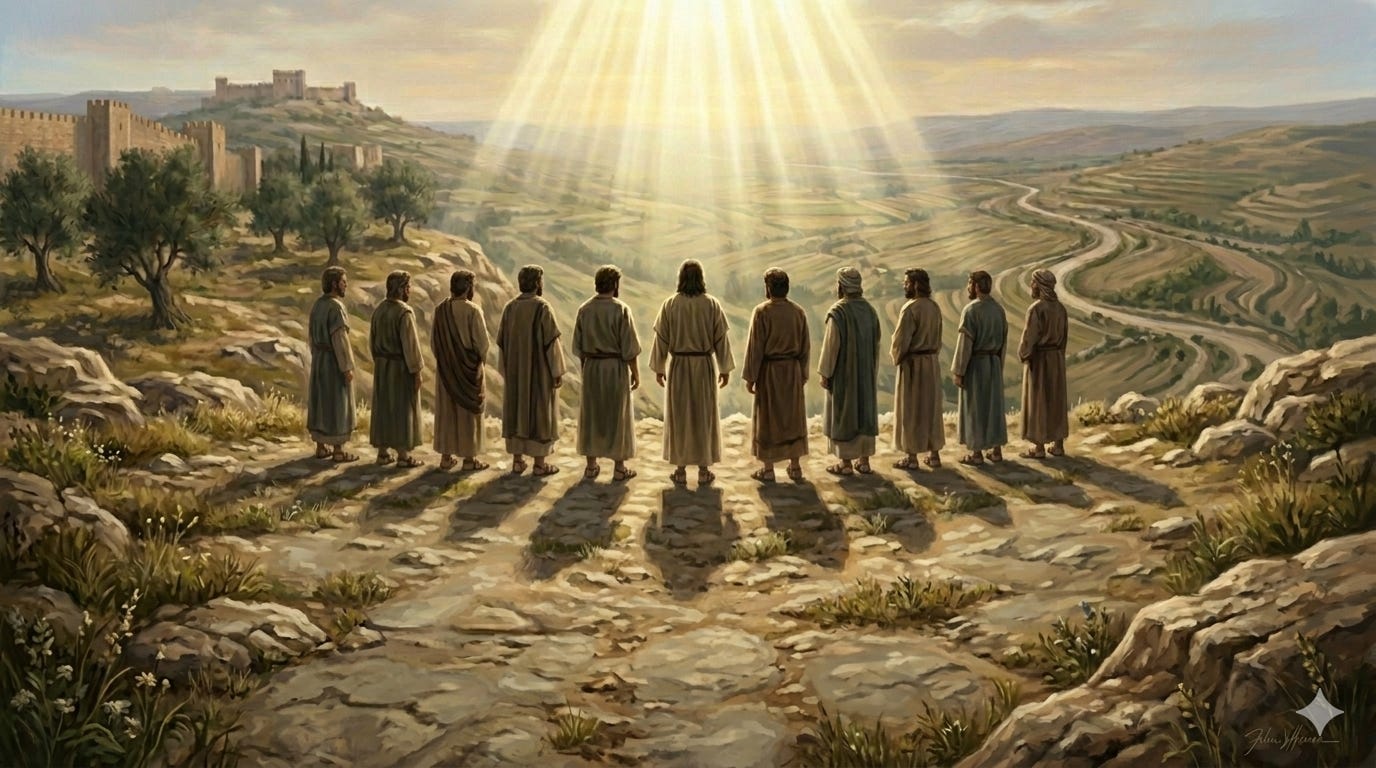
¹⁶ The eleven disciples went to Galilee, to the mountain to which Jesus had ordered them. ¹⁷ When they saw him, they worshiped, but they doubted. ¹⁸ Then Jesus approached and said to them, "All power in heaven and on earth has been given to me. ¹⁹ Go, therefore, and make disciples of all nations, baptizing them in the name of the Father, and of the Son, and of the holy Spirit, ²⁰ teaching them to observe all that I have commanded you. And behold, I am with you always, until the end of the age."
Today’s Focus
Jesus gives the Great Commission from an unnamed mountain in Galilee to disciples who worship and doubt simultaneously, grounding the command to make disciples of all nations in the all-authority of the Daniel 7 Son of Man, the Abrahamic and Isaianic promises, and closing with the shekinah promise of His personal presence until the end of the age.
In the Margins
The eleven go to Galilee, to the mountain Jesus appointed. Eleven, not twelve. The gap where Judas stood is the permanent mark of the betrayal on the community that carries the commission forward. When they see Jesus they worship and they doubt simultaneously. Matthew preserves both without resolving the tension and without recording any rebuke. The Greek word edistasan, to waver and be of two minds, is the same word used in Matthew 14 when Peter began to sink on the water and Jesus asked why he doubted. The doubt is not the opposite of faith. It is the condition of faith that has not yet seen everything it needs to see. Moses doubted his ability to speak at the burning bush. Gideon asked for signs. Jeremiah said he was too young. Israel’s great commissioning narratives consistently sent people from within their limitation rather than after it had been resolved. The commission does not wait for the doubt to clear.
The mountain carries weight that a first century Jewish listener would have felt immediately. Every significant mountain in Matthew is a place of divine authority and lawgiving. Sinai was where God gave the Torah and constituted Israel as His covenant people. Deuteronomy 34 has Moses dying on Mount Nebo, viewing the promised land, passing leadership forward. Jesus is the new Moses giving the final commission from a mountain, but unlike Moses He does not die there. He commissions from the other side of death. The name Jesus is the Greek form of the Hebrew Joshua, meaning God saves, and the original Joshua commission was to lead God’s people into what had been promised. The structure is the same here but the land has become all nations and the inheritance eternal life. Galilee itself carries the weight of Isaiah 9:1, where the prophet named it as the place where people walking in darkness would see a great light. Matthew cited that verse at the opening of the public ministry. The commission from Galilee closes the circle Isaiah opened.
All authority in heaven and on earth has been given to Jesus. Daniel 7:13-14 describes the Son of Man receiving from the Ancient of Days dominion, glory, and a kingdom that all peoples shall serve. That vision was one of the most discussed texts in first century Judaism. Jesus claiming all authority in Daniel’s vocabulary on a mountain in Galilee is the unmistakable declaration that He is the one Daniel described. The passive voice, has been given, is the divine passive, the grammatical form used to describe God’s action. The Ascension is the moment when the giving occurred.
The main verb of the commission is make disciples. The going, the baptizing, and the teaching all serve that one command. The scope fulfills what God promised Abraham in Genesis 12, that all the families of the earth would be blessed through his descendants, and what Isaiah announced in chapter 49, that the servant would be a light to the nations. Jewish expectation was that the nations would stream toward Jerusalem in the messianic age. Jesus reverses the direction entirely. The disciples go to the nations. The ingathering becomes a sending out.
The baptism is into a single name encompassing three persons. The phrase eis to onoma, into the name, was a legal term in the first century meaning into the ownership of. To be baptized into the Trinitarian name is to be transferred into the possession and life of the Father, Son, and Holy Spirit. The commission closes with the promise that carries the full weight of Israel’s most sustaining tradition. After the destruction of the Temple the rabbis developed the teaching of the shekinah, the divine presence accompanying Israel into exile. The tradition that God’s presence went with His people through every dispersal and suffering was the central source of comfort through centuries without the Temple. I am with you always, every single day, until the end of the age. Jesus is speaking the language of the shekinah promise in His own person. Not a disembodied presence filling a tabernacle. The risen Son Himself, personally present, to every disciple in every nation until the completion of all things.
The disciples in the upper room were troubled because Jesus was going somewhere they could not follow. The commission on the mountain is the final answer to that trouble. He is not leaving them. He is going with them.
Reflection Question
Where in your life are you waiting to feel more certain or more prepared before stepping forward in faith, and what would it mean to accept the commission as the disciples received it, in the midst of doubt, trusting the authority and presence of the one who sends you?