

The Gospel: John 6:16-21
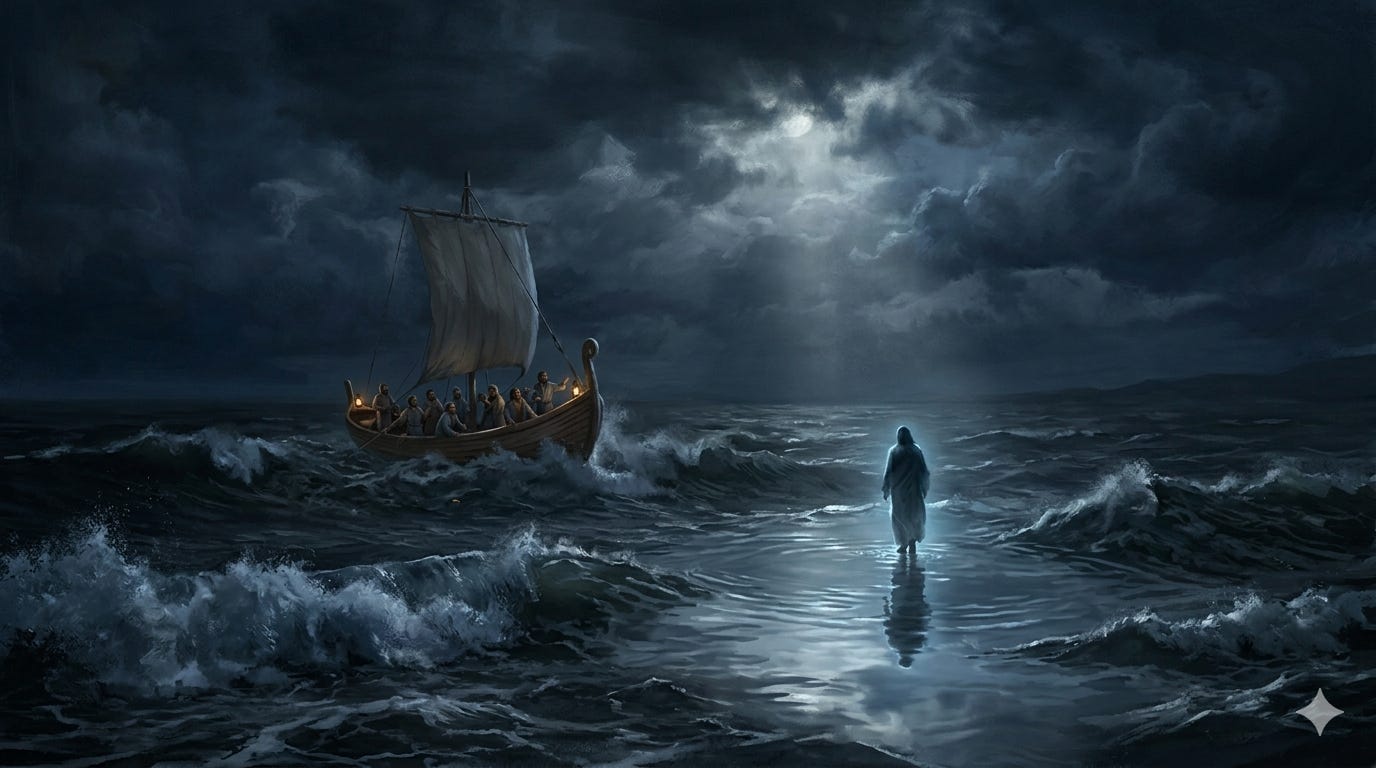
¹⁶ When it was evening, his disciples went down to the sea, ¹⁷ embarked in a boat, and went across the sea to Capernaum. It had already grown dark, and Jesus had not yet come to them. ¹⁸ The sea was stirred up because a strong wind was blowing. ¹⁹ When they had rowed about three or four miles, they saw Jesus walking on the sea and coming near the boat, and they began to be afraid. ²⁰ But he said to them, "It is I. Do not be afraid." ²¹ They wanted to take him into the boat, but the boat immediately arrived at the shore to which they were heading.
Today’s Focus
Several of them had worked that sea their entire lives and what they saw walking toward them had no category available to them. Jesus spoke into the fear with the two words that carry more weight in John’s Gospel than any others. Ego eimi. I AM. The same words God spoke to Moses at the burning bush. Job and the Psalms had said God alone walks on the waves. The disciples were not watching a miracle performed by a holy man. They had been rowing for hours and getting nowhere, and the moment Jesus came aboard they were at the shore. That is the passage. That is also the offer. The presence of Jesus does not always stop the wind on the timeline we prefer. But it changes the entire nature of the crossing, and the shore we cannot reach on our own has a way of arriving the moment we take him in.
In the Margins
The disciples get into the boat without Jesus and as evening comes, they set out across the sea toward Capernaum. A strong wind stirs the water against them. After three or four miles of rowing into that wind they see Jesus walking on the water toward the boat and they are afraid. Their fear is the honest human response to something that exceeds every natural framework. These are fishermen and several of them have worked this sea their entire lives. What they are seeing has no category available to them.
Jesus speaks into the fear immediately. It is I. Do not be afraid. In the Greek those words are ego eimi, the same construction Jesus uses throughout John’s Gospel when making His most significant declarations about who He is, the same words that carry the weight of the divine name God revealed to Moses at the burning bush in Exodus 3. He is not simply identifying Himself to calm anxious disciples. He is declaring who He is in the language that carries the most weight in the entire Gospel.
The Old Testament grounds what the disciples are witnessing. Job 9:8 describes God alone as the one who treads on the waves of the sea. Psalm 77:19 recalls that God’s path was through the mighty waters. Walking on the surface of a storm-stirred sea was not a feat attributed to any prophet or figure in Israel’s history, it belonged to God alone. The disciples are not watching a miracle performed by a holy man. They are watching God walk toward them across the water.
They take Jesus into the boat and immediately reach the shore they had been laboring toward. John records this without explanation. What hours of rowing against a strong wind could not accomplish is resolved the moment Jesus comes aboard. The destination they could not reach on their own is suddenly where they are.
This passage follows the feeding of the five thousand, where the crowd tried to make Jesus a king on their own terms and He withdrew. The disciples find themselves in the dark, working hard, making slow progress against conditions they cannot control. It is a sequence that moves from the crowd’s misunderstanding of who Jesus is to the disciples encountering who He actually is, not a political king seized by popular demand, but the one who walks on water and speaks peace into storms.
Most of us know what it is to be in that boat. We are moving in the right direction, doing the work, and the wind is against us. The progress is slow and Jesus has not yet come and the dark is pressing in from every side. What this passage puts before us is not a promise that the crossing will always be easy or that the wind will always stop on our preferred timeline. What it offers is the Jesus who walks across the storm toward wherever we are, who speaks His own name into our fear, and whose presence changes the entire nature of the journey. The shore we cannot reach on our own has a way of arriving the moment we take Him in.
Reflection Question
Is there a crossing you have been laboring through in the dark where you have not yet taken Jesus into the boat?
A Small Invitation
If this reflection helped you, consider sharing it with someone who may benefit from hearing this message.