

18 Jun 26 | The Lord's Prayer
Jesus said your Father already knows what you need. Then He showed what prayer is actually for.
The Gospel: Matthew 6:7-15
⁷ "In praying, do not babble like the pagans, who think that they will be heard because of their many words. ⁸ Do not be like them. Your Father knows what you need before you ask him.
⁹ "This is how you are to pray:
Our Father in heaven,
hallowed be your name,
¹⁰ your kingdom come,
your will be done,
on earth as in heaven.
¹¹ Give us today our daily bread;
¹² and forgive us our debts,
as we forgive our debtors;
¹³ and do not subject us to the final test,
but deliver us from the evil one.
¹⁴ If you forgive others their transgressions, your heavenly Father will forgive you. ¹⁵ But if you do not forgive others, neither will your Father forgive your transgressions."
Today’s Focus
Jesus corrects the pagan assumption that prayer works by multiplying words, establishing that the Father already knows what we need, and gives a compressed model prayer that moves from orientation toward God's holiness through alignment with His kingdom and will, through daily dependence and mutual forgiveness, to protection from the evil one.
In the Margins
Do not babble like the pagans who think they will be heard because of their many words is the line that has been cited by many to counter any repetition of prayer. As an organization that is centered on the belief that prayer works – we want to help clarify what this is really getting at. There are two main points that we have to dissect, the word babble, but also – how did the pagans pray.
The Greek word for babble, battalogeo, refers to empty repetition, the multiplication of words as a technique for securing divine attention. In the religious world surrounding first century Judaism, elaborate and lengthy prayer formulas were understood as mechanisms. More words, more carefully constructed, invoked with greater precision, might produce the result. With this – we have Jesus telling us to not offer all the words as a technique.
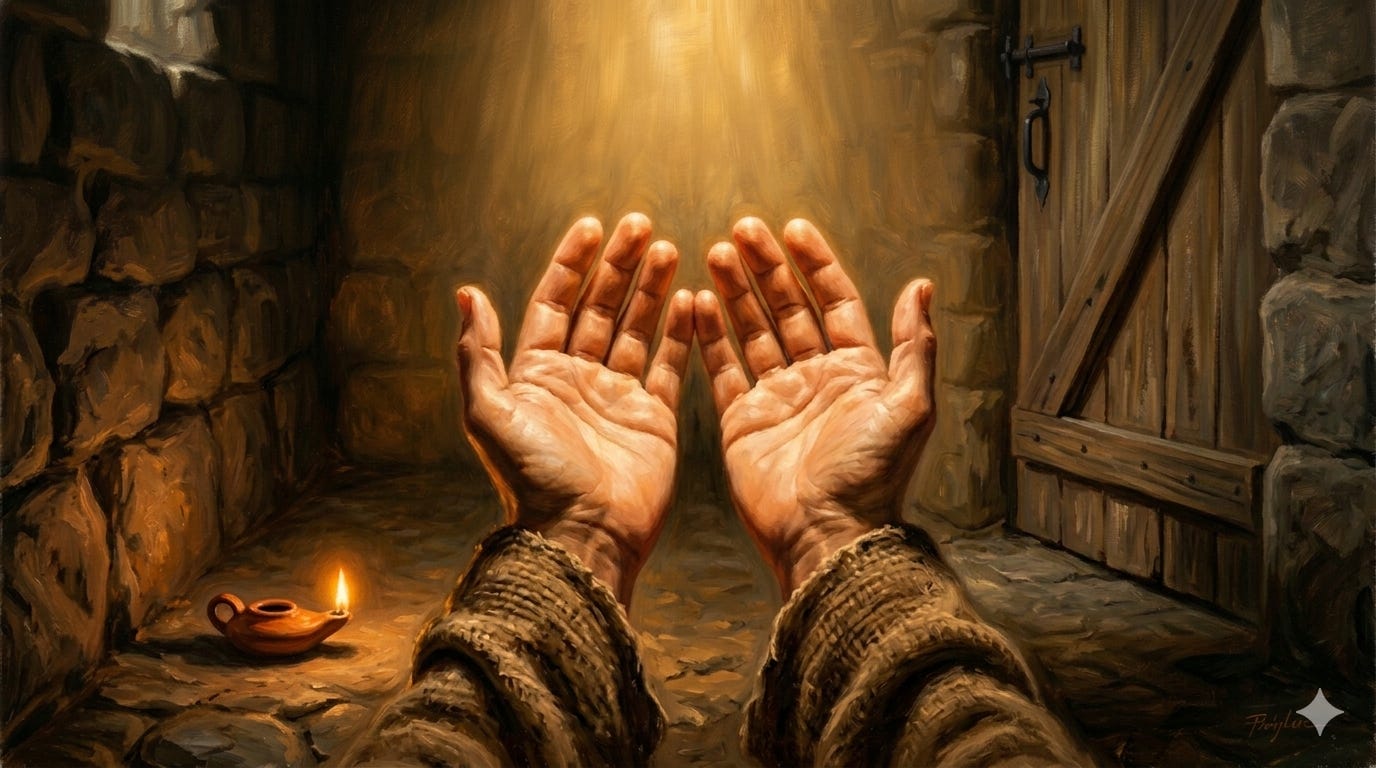
Because this was written in Greek, we look at how Greek and Roman pagans prayed. Roman prayer was highly formal and transactional, using a concept of do ut des (”I give so that you may give”) which governed the relationship between worshiper and deity. Prayer was spoken aloud, typically standing with arms raised and palms upward (orans posture). Precision of wording was critical; a mispronounced prayer was considered void and had to be redone. The pontifex (priest) would often dictate the exact words and the worshiper would repeat them. When we look at Greek prayer, it was somewhat less rigid than Roman but still formulaic. The worshiper would typically invoke the god by multiple names and epithets, both to make sure the right deity heard and also to state the request. The point was often reminding the god of past sacrifices or favors rendered. Homer’s Iliad and Odyssey give vivid examples of this pattern. Like Romans, Greeks prayed standing with hands raised.
What we are hearing Jesus say is that there is no mechanism or specific repetition you can use to talk with God – that is not how it works. He actually dismisses the entire framework in a single sentence. Your Father knows what you need before you ask Him. Knowing how the Greeks were praying as an information transfer and reminder – Jesus makes it clear that God cannot be persuaded through many words. The God who needs to be informed or convinced is not the Father Jesus is describing.
The prayer He gives in response is striking in its compression. Everything that prayer needs to be is present in a few lines, without a wasted word.
Our Father in heaven. The address holds intimacy and transcendence simultaneously in a single phrase. Not my Father, a purely private devotion, but our Father, the prayer of a community. Not a vague spiritual force but a Father who is in heaven, which means both present and transcendent, personal and beyond. Before any request is made the pray-er has already placed themselves in right relationship.
Hallowed be your name. The first movement of prayer is not toward what we need but toward who God is. The holiness of God’s name is not a request so much as an orientation, a declaration that what matters first is not our situation but His character. The pray-er begins by getting properly small.
Your kingdom come, your will be done, on earth as in heaven. Three parallel expressions of the same surrender. The pray-er is aligning themselves with what God is doing rather than asking God to align Himself with what they want. This is the most countercultural petition in the prayer. It is a surrender of the agenda before the conversation about specific needs begins.
Give us today our daily bread. The shift to petition is modest. Not abundance or security or certainty about tomorrow. Today’s bread. The manna in the wilderness was given one day at a time. This petition places the pray-er in the position of daily dependence rather than stocked sufficiency. It is a prayer that has to be prayed again tomorrow.
Forgive us our debts as we forgive our debtors. Jesus expands this immediately after the prayer in verses 14-15. The forgiveness asked for is conditioned on the forgiveness extended. The one who has received forgiveness and refuses to extend it has not understood what they received. This is not peripheral to the prayer. Jesus returns to it after everything else because it is the hinge the whole relationship turns on.
Deliver us from the evil one. The prayer ends by naming the enemy and asking for protection, completing a movement that began with the character of God and ends with the need for His defense.
Reflection Question
When you pray, do you typically begin by orienting yourself toward who God is before moving to what you need, and what would change if your prayer consistently started there?