

The Gospel: John 1:29-34
The disciples of John and of the Pharisees were accustomed to fast.
People came to Jesus and objected,
“Why do the disciples of John and the disciples of the Pharisees fast,
but your disciples do not fast?”
Jesus answered them,
“Can the wedding guests fast while the bridegroom is with them?
As long as they have the bridegroom with them they cannot fast.
But the days will come when the bridegroom is taken away from them,
and then they will fast on that day.
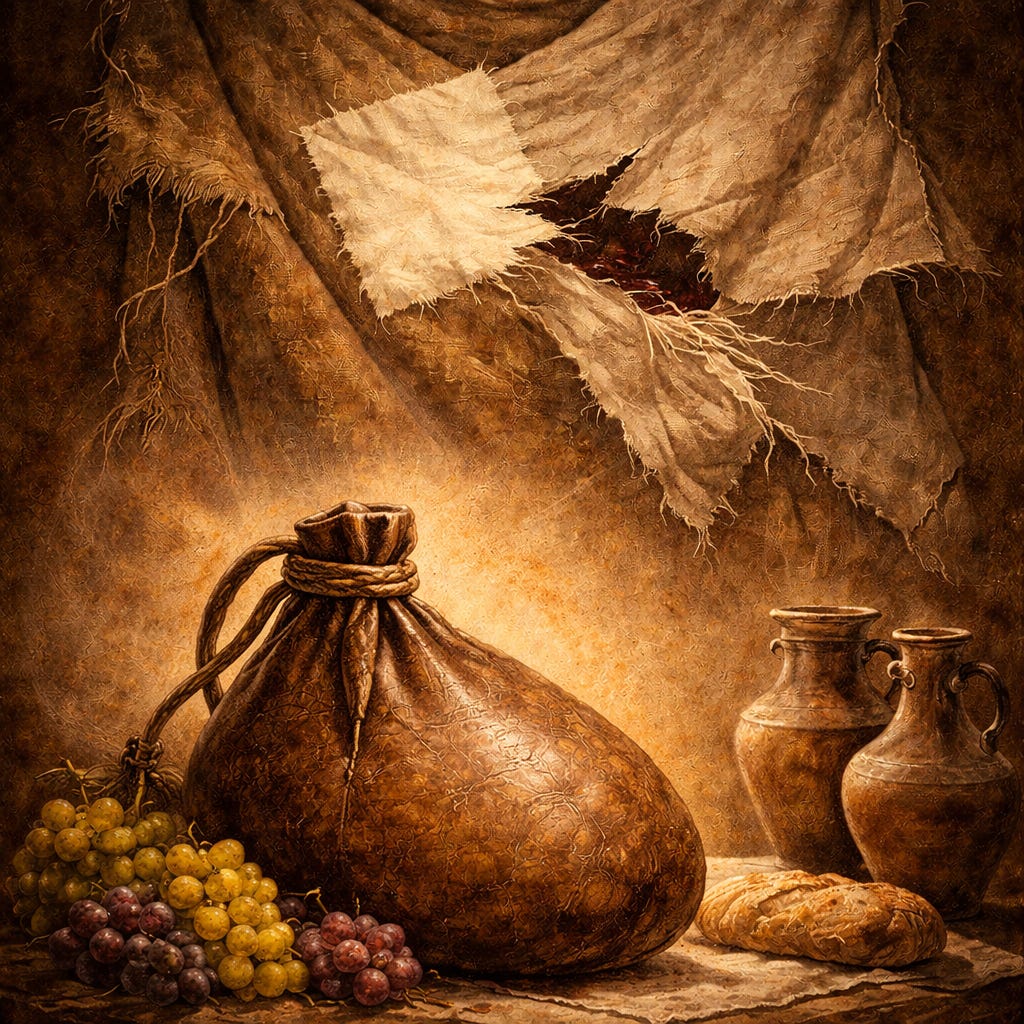
No one sews a piece of unshrunken cloth on an old cloak.
If he does, its fullness pulls away,
the new from the old, and the tear gets worse.
Likewise, no one pours new wine into old wineskins.
Otherwise, the wine will burst the skins,
and both the wine and the skins are ruined.
Rather, new wine is poured into fresh wineskins.”
Today’s Takeaway
Jesus reveals that the heart of the Law is not ritual, but relationship. By calling Himself the Bridegroom, He shows that God’s covenant with His people has entered its moment of fulfillment, where joy replaces mere obligation and presence replaces preparation. The images of cloth and wineskins teach that Christ does not simply add something new to our lives, He calls us to be made new, able to stretch and receive the transforming life of the Kingdom.
In the Margins
John the Baptist serves as a legal and prophetic witness drawing on Israel’s Scriptures, and identifies Jesus as the sacrificial Lamb, the pre-existent Son, and the Spirit-bearer who brings God’s final answer to sin. This testimony frames everything that follows in the Gospel: signs, discourses, and ultimately the Cross all unfold what John has already proclaimed. It is easy to read this Gospel as a quick explanation of Jesus through the testimony by John, but it has so much more going on when you pull the Old Testament references into it.
One of the first things that pops out early is the use of “Lamb of God, who takes away the sin of the world.” This is pulling together so much Old Testament into one phrase! The lamb whose blood protected Israel from death is the Passover lamb seen in Exodus 12. Lambs were used as a daily Temple sacrifice for Israel’s ongoing covenant with God in Exodus 29 and Numbers 28. Finally, when we look at Isaiah’s suffering servant in Isaiah 53, we hear of the servant described as a lamb to the slaughter and bearing the sins of many.
Here we see Jesus being foretold as the Lamb of God, which signifies God offering the sacrifice on our behalf. The next part of this is the mention that this lamb is for the sins of the whole world. This is very different than the other sacrifices, which were done for those with the covenant with God. This shows that God is making a sacrifice that opens the covenant to the whole world. The sins are removed through this sacrifice, not merely covered up.
We know that Jesus was born months after John and we also know that John knew who Jesus was, but there is some insight in how Mary and Joseph raised Jesus. Mary knew from the Angel who Jesus would be, yet no one revealed it to John. This shows us that Jesus was not revealed until He chose to be revealed. God does not operate on the timelines of others, but on His alone. John was preparing the way in line with scripture. Noting the pre-existence of Jesus would have spoken to the divine attribute for his Jewish audience. Knowing who Jesus is proves to be very different from just knowing of Jesus. We hear this from Jesus himself later, when He says that there were many who would do things in His name, but He would tell them that He never knew them.
In Jewish Scripture, “son of God” can refer to Israel or the Davidic king, but here it carries deeper weight. Combined with pre-existence, Spirit being upon, and worldwide redemption, the title points to unique divine sonship, not metaphorical adoption. Based on the use of Lamb of God, pre-existence, Spirit-anointed, being one who would baptize with the Spirit, and Son of God to describe Jesus – it would have been clear who John claimed He was. This is something that we need to remember in modern life as well.
There is a tendency to reduce Jesus to inspiration, ethics, or personal preference. In a world shaped by self-definition, algorithmic truth, and competing narratives, John grounds faith in revealed identity, not subjective experience. Jesus is not one solution among many; He is named as the Lamb provided by God, the pre-existent Son, and the permanent bearer of the Spirit. That means sin is not merely managed, excused, or reframed, but decisively removed through God’s action, not human effort.
For our daily life, this reframes how we approach meaning, guilt, and transformation. Many modern systems promise improvement through optimization, wellness, or moral effort, yet leave the deeper fracture untouched. John’s testimony insists that real healing begins with receiving what we cannot produce: forgiveness, new life, and the Spirit’s abiding presence. Knowing Jesus, in the biblical sense, is not familiarity, cultural association, or even religious activity. It is recognition of His divine identity and submission to it.
This Gospel challenges believers to examine whether their faith rests on proximity and habit or on revealed truth. It also frees them from the pressure to save themselves. The Lamb has already been given. The Spirit now remains. Life, therefore, is not about earning belonging, but living from it.
A Question For Reflection
What is one way I can strengthen my relationship with Jesus to accept His truth?
A Small Invitation
If this reflection helped you, consider sharing it with one person who may need encouragement today.