

20 Jun 26 | Do Not Worry
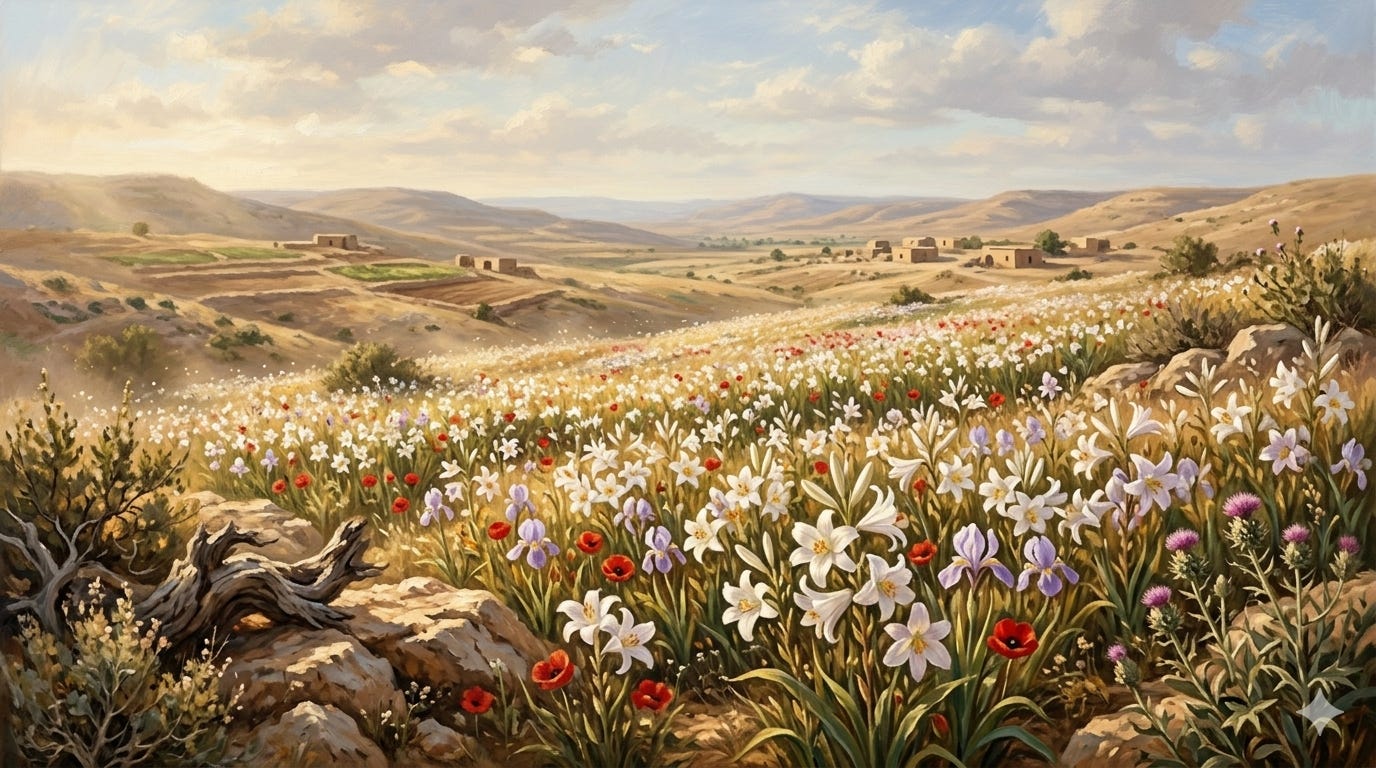
Jesus said not even Solomon was clothed like a wildflower. Then He asked why you are worried about what to wear.
The Gospel: Matthew 6:24-34
²⁴ "No one can serve two masters. He will either hate one and love the other, or be devoted to one and despise the other. You cannot serve God and mammon.
²⁵ "Therefore I tell you, do not worry about your life, what you will eat or drink, or about your body, what you will wear. Is not life more than food and the body more than clothing? ²⁶ Look at the birds in the sky; they do not sow or reap, they gather nothing into barns, yet your heavenly Father feeds them. Are not you more important than they? ²⁷ Can any of you by worrying add a single moment to your life-span? ²⁸ Why are you anxious about clothes? Learn from the way the wild flowers grow. They do not work or spin. ²⁹ But I tell you that not even Solomon in all his splendor was clothed like one of them. ³⁰ If God so clothes the grass of the field, which grows today and is thrown into the oven tomorrow, will he not much more provide for you, O you of little faith? ³¹ So do not worry and say, 'What are we to eat?' or 'What are we to drink?' or 'What are we to wear?' ³² All these things the pagans seek. Your heavenly Father knows that you need them all. ³³ But seek first the kingdom of God and his righteousness, and all these things will be given you besides. ³⁴ Do not worry about tomorrow; tomorrow will take care of itself. Sufficient for a day is its own evil."
Today’s Focus
Jesus establishes that divided allegiance between God and mammon produces the anxiety He then addresses, using birds and wildflowers as lesser-to-greater arguments for the Father's provision, and calls for the reordering of priorities that places the kingdom first and receives material needs in their proper place.
In the Margins
No one can serve two masters. Jesus begins with an observation about how human beings work before He addresses the worry that follows from divided allegiance. The word mammon, which He uses for the competing master, is an Aramaic word for wealth and material security more broadly. It was used in the rabbinical tradition to describe the power that money exerts over a person’s choices and attention. It would be like saying, you cannot serve God and the dollar, in modern English. Jesus does not say wealth is evil. He says it functions as a master, making demands on the heart in the same way that God makes demands, and the two sets of demands are incompatible.
The worry He addresses flows directly from divided allegiance. If your security rests partly in God and partly in material provision, then the state of your material provision is always a spiritual anxiety. You cannot trust God fully while also requiring a certain level of financial security before you will feel safe. The worry is the symptom of the divided heart.
What Jesus offers in response to worry is not a promise that material needs will always be met in the way or timeline you prefer. He offers a different frame for seeing. Look at the birds of the sky. They do not sow or reap or gather into barns. Your heavenly Father feeds them. The birds are not passive. They work. They search for food. But they do not work from anxiety about tomorrow because they are not oriented toward tomorrow. They live from what is available today and the Father provides it.
The lilies of the field are a more striking example. They do not labor or spin and yet not even Solomon in all his splendor was clothed like one of them. Solomon’s wealth was legendary in Israel’s tradition. The most elaborately dressed king in Israel’s history is outclassed by a wildflower that exists for a single day and is thrown into the oven tomorrow. If God clothes something that temporary in that kind of beauty, what does that say about His intentions toward people made in His image?
The argument is a lesser to greater argument, what the rabbis called qal vachomer. If God does this for birds, for grass, for flowers, how much more will He do for you? The if is not conditional in the sense of uncertain. It is categorical. The category of God’s provision for lesser things is the basis for confidence about greater things.
Seek first the kingdom of God and His righteousness and all these things will be given to you besides. The priority is not the elimination of concern for material needs. It is the reordering of what you pursue first. When the kingdom is the primary orientation, the material needs find their proper place. They are not ignored. They are received in the right order.
Do not worry about tomorrow. Tomorrow will take care of itself. Sufficient for a day is its own evil. This last line is often passed over. Each day carries its own weight of difficulty. The person who carries tomorrow’s weight today is carrying a double load on a single day’s strength. Jesus is not dismissing the reality of difficulty. This also doesn’t mean that you shouldn’t save or prepare for the future. It is about who you trust and the worry you carry. He is naming the precise form of the burden that worry adds to it.
Reflection Question
What specific worry are you carrying today that belongs to tomorrow, and what would it mean to set it down and take only today's weight?