

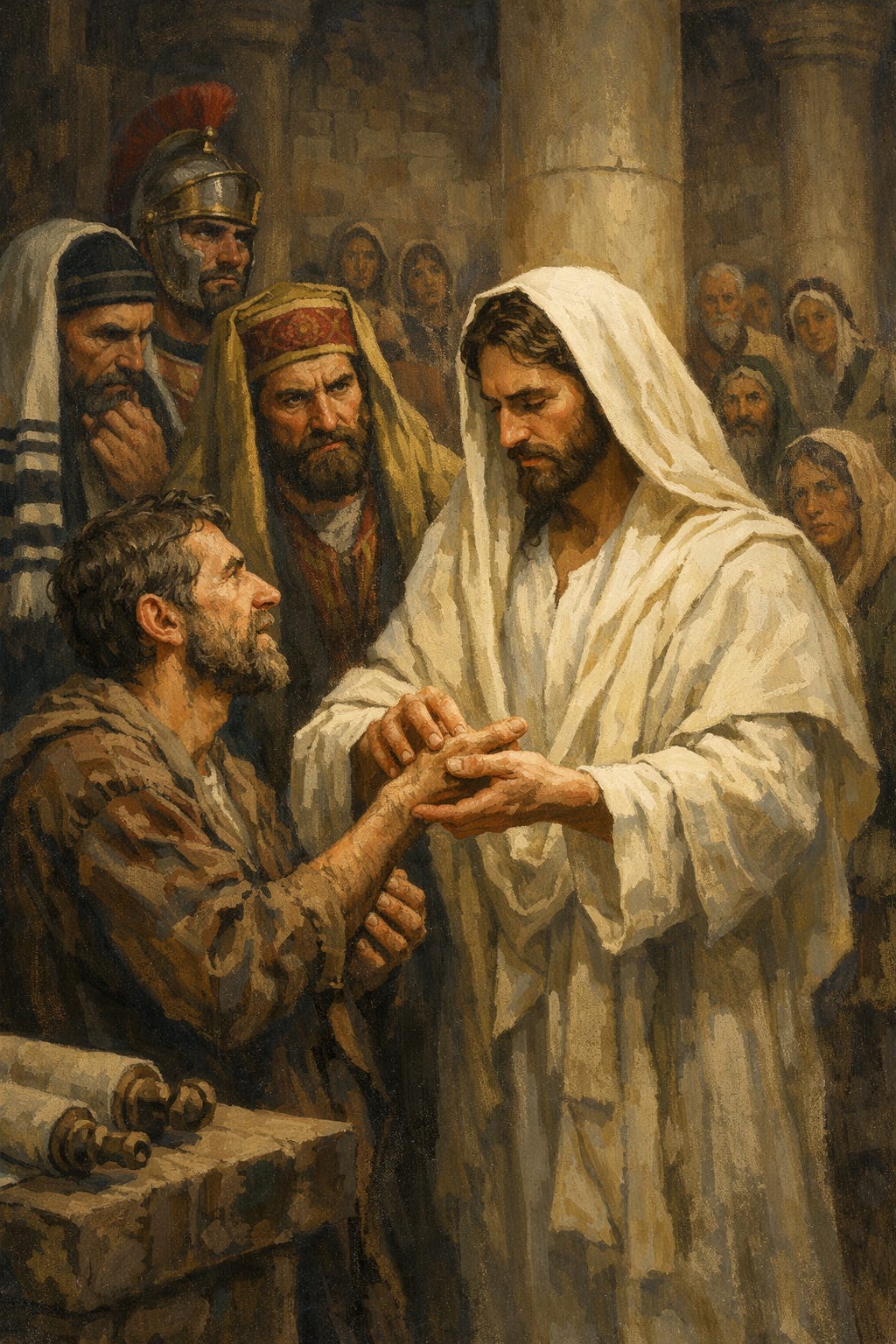
The Gospel: Mark 3:1-6
Jesus entered the synagogue.
There was a man there who had a withered hand.
They watched Jesus closely
to see if he would cure him on the sabbath
so that they might accuse him.
He said to the man with the withered hand,
"Come up here before us."
Then he said to the Pharisees,
"Is it lawful to do good on the sabbath rather than to do evil,
to save life rather than to destroy it?"
But they remained silent.
Looking around at them with anger
and grieved at their hardness of heart,
Jesus said to the man, "Stretch out your hand."
He stretched it out and his hand was restored.
The Pharisees went out and immediately took counsel
with the Herodians against him to put him to death.
Today’s Focus
This Gospel reveals the synagogue as a public arena of authority where Jesus deliberately confronts distorted interpretations of God’s Law. The healing on the Sabbath exposes that refusing to do good when one has the power to act is itself a form of evil. Jesus forces the Law to face a real human life, revealing that Sabbath was always meant to restore dignity, not protect systems of control. The unlikely alliance between Pharisees and Herodians shows that Jesus’ mercy threatened both religious authority and political stability. Strikingly, in Mark’s Gospel, it is not rebellion or blasphemy but an act of healing that first sets the plot for Jesus’ death.
In the Margins
The Synagogue was somewhat of a merger between a modern day court room, church, and town square all at the same time in the same place. It was not merely a place for people to pray, but a center for teaching, judgement, and interpretation of the Torah. Because of this, challenging in the Synagogue as seen between Jesus and these Pharisees was almost like a court battle as we would see today. It was deliberate and meant to expose faulty religious authority in the place where authority ruled.
In this way, when “they watched Jesus closely,” this was not in a sense of awe per se. They were watching to ensure they could report what they were about to see. It was hostile scrutiny of Jesus’ actions, not support. During this period, it was lawful to heal on the Sabbath if life was at risk, but this man’s condition was not life threatening. Jesus was openly being tested as to whether he would violate Sabbath, or refuse mercy and potentially discredit His authority.
What Jesus does is ensure everyone was able to see what was about to happen. He doubled down on the entire situation and called the man up before everyone. In this way, he was forcing the Law to answer to man, not just a theoretical situation. In doing such, Jesus reframes the Law in moral absolutes. “Is it lawful to do good on the sabbath rather than to do evil, to save life rather than to destroy it?” This shows that there is a false neutrality, where refusing to do good is a form of evil. The inaction, in itself, is destructive.
The last major thing I want to hit on for this post is who was there. The Gospel says that it was Pharisees who then headed to the Herodians. Pharisees during this period were religious legalists, the interpreted the Law as it applied to Judaism. The Herodians were political collaborators with Rome. These two groups were normally in opposition with each other. In this Gospel, we are hearing that they were working together! Jesus was actively threatening both religious control and political stability with this challenge. This is also the first explicit death plot in the Book of Mark. Ironic that it is not triggered by blasphemy or rebellion, rather healing.
Today’s Sabbath looks a lot different than that as explained in the Torah and Gospels. We do not see such a heavy standard applied to people. What do we do with this day in our own lives? If the Sabbath is made for us, do we put it to good use? Even if we don’t go into the discussion of going to church, do we at least take time to glorify God?
Reflection Question
When obedience to religious rules conflicts with the restoration of human dignity, which do we instinctively protect, the rule or the person?
A Small Invitation
If this reflection helped you, consider sharing it with someone who may be carrying more than they were meant to.