

23 Jun 26 | The Narrow Gate
Jesus said the easy road is crowded and the road to life is narrow. Most people choose the crowd.
The Gospel: Matthew 7:6, 12-14
⁶ "Do not give what is holy to dogs, or throw your pearls before swine, lest they trample them underfoot, and turn and tear you to pieces.¹² "Do to others whatever you would have them do to you. This is the law and the prophets.¹³ "Enter through the narrow gate; for the gate is wide and the road broad that leads to destruction, and those who enter through it are many. ¹⁴ How narrow the gate and constricted the road that leads to life. And those who find it are few."
Today’s Focus
Jesus warns against offering sacred things where they will not be received, gives the positive form of the Golden Rule as the summary of the entire law and prophets, and contrasts the crowded easy road to destruction with the narrow demanding road to life that requires the transformation the Sermon on the Mount has described.
In the Margins
Do not give what is holy to dogs, or throw your pearls before swine, lest they trample them underfoot and turn and tear you to pieces. This single verse, easily passed over between the Golden Rule that precedes it and the narrow gate that follows, carries far more theological weight than its brevity suggests and has historically been used as bearing directly on how the Church handles the most sacred things entrusted to her.
In the first century Jewish imagination, dogs and pigs were not affectionate household companions. They occupied the lowest tier of unclean and despised creatures, dogs as scavengers roaming outside the camp, pigs as the explicit and paradigmatic unclean animal under the dietary law of Leviticus 11:7. To call something dogs or swine in that culture was to name the most extreme category of ritual unfitness available in the entire Jewish vocabulary. Jesus reaches for the strongest possible image, not to dehumanize any person, but to make an unmistakable point about mismatch between a sacred gift and an unprepared or hostile recipient.
What is holy, to hagion, in Jewish religious vocabulary referred specifically to consecrated things, particularly meat from sacrifices that had been set apart for God and could only be consumed by priests under strict conditions, as detailed throughout Leviticus and Numbers. Exodus 22:31 and Leviticus 22:1-16 establish the principle that what has been consecrated to God carries restrictions on who may receive it and how. To give consecrated meat to a dog, an animal incapable of recognizing its sacred character and likely to treat it as ordinary scavenged food, was not merely wasteful. It was a category violation, treating the holy as if it were common.
The Didache, one of the earliest Christian documents outside the New Testament, dating to the late first or early second century, explicitly quotes this verse in its instructions regarding the Eucharist, stating that no one should eat or drink of the Eucharist except those who have been baptized in the name of the Lord, for concerning this the Lord said, do not give what is holy to dogs. This is among the earliest documented applications of Matthew 7:6, and it establishes that the apostolic generation itself understood Jesus’ words as bearing on sacramental discipline, not merely general social wisdom.
This is not a license for an elitist or withholding posture toward evangelization. Jesus Himself spent His ministry pursuing sinners, tax collectors, and the irreligious with extraordinary persistence, and the Church’s missionary mandate from the Great Commission is unambiguous in its universality, go and make disciples of all nations. The principle Matthew 7:6 establishes is one of pastoral wisdom and right order, not exclusion. Casting pearls before those who have no framework to value them, who will trample what was meant to be treasured, does no service to the gift or to the recipient. It risks the gift being despised and, as Jesus says, the giver being turned on by those who received something they could not understand and resented being given.
What this verse asks of every disciple, then, is the cultivation of pastoral discernment alongside missionary zeal. Generosity in proclaiming the Gospel does not mean an absence of wisdom about timing, readiness, and the proper sequence of formation. The Church has always held together the universal call to evangelize every person with the careful, ordered discipline of how the sacraments and the deepest truths of the faith are actually transmitted, because both halves of that balance flow from the same reverence for what has been entrusted to her.
Then Jesus gives the summary statement that has echoed through every century since. Do to others whatever you would have them do to you. This is the law and the prophets. The negative form of this principle, do not do to others what you would not want done to you, was already present in Jewish tradition. Rabbi Hillel, one of the most influential teachers of the generation before Jesus, was reportedly asked to summarize the entire Torah while standing on one foot, and answered with the negative form of this rule, adding that everything else was commentary. Jesus states the positive form, which is more demanding. Avoiding harm to others is one standard. Actively seeking their good as you would want your own good sought is another. The positive form requires imagination and initiative rather than simple restraint.
By calling this the law and the prophets, Jesus is doing what He has done throughout the Sermon on the Mount, naming the principle that holds the entire body of Scripture together. This is the same move He made with the Shema and Leviticus 19:18 in His answer about the greatest commandment. The Golden Rule is not a separate ethical insight alongside the law. It is the law’s summary.
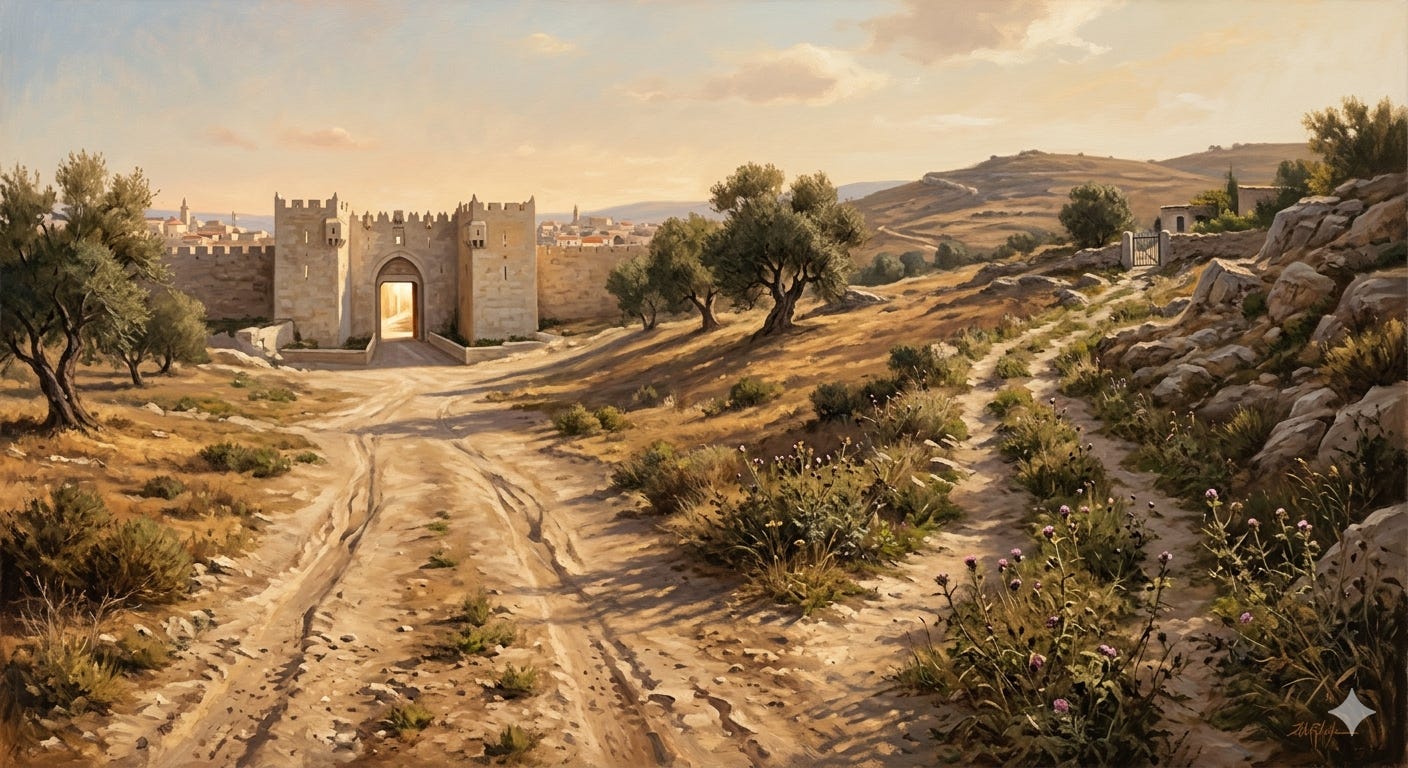
Then the passage shifts to the gate and the road. Enter through the narrow gate. The gate is wide and the road broad that leads to destruction, and many enter through it. How narrow the gate and constricted the road that leads to life, and few find it. The image would have resonated with Jewish wisdom literature’s frequent contrast between the way of the righteous and the way of the wicked, most prominently in Psalm 1. What Jesus adds is the observation about numbers. The easy path is crowded. The path to life requires a constriction that most people will not choose.
This is not a statement about exclusivity for its own sake. It is an honest description of cost. The way that leads to life requires the kind of self-denial, reconciliation, enemy-love, and interior transformation that the entire Sermon on the Mount has just described. That way is narrow not because God has made it artificially difficult but because the demands of genuine love are inherently more exacting than the easier path of self-interest. Few find it not because it is hidden but because most people, when they see what it actually requires, choose the broader road instead.
Reflection Question
Where in your life have you been on the wide road because it required less of you, and what would the narrow gate actually cost you to enter?