

24 Jun 26 | The Birth of John the Baptist
Zechariah could not speak for nine months. The first words he wrote down changed his family's whole future.
The Gospel: Luke 1:57-66, 80
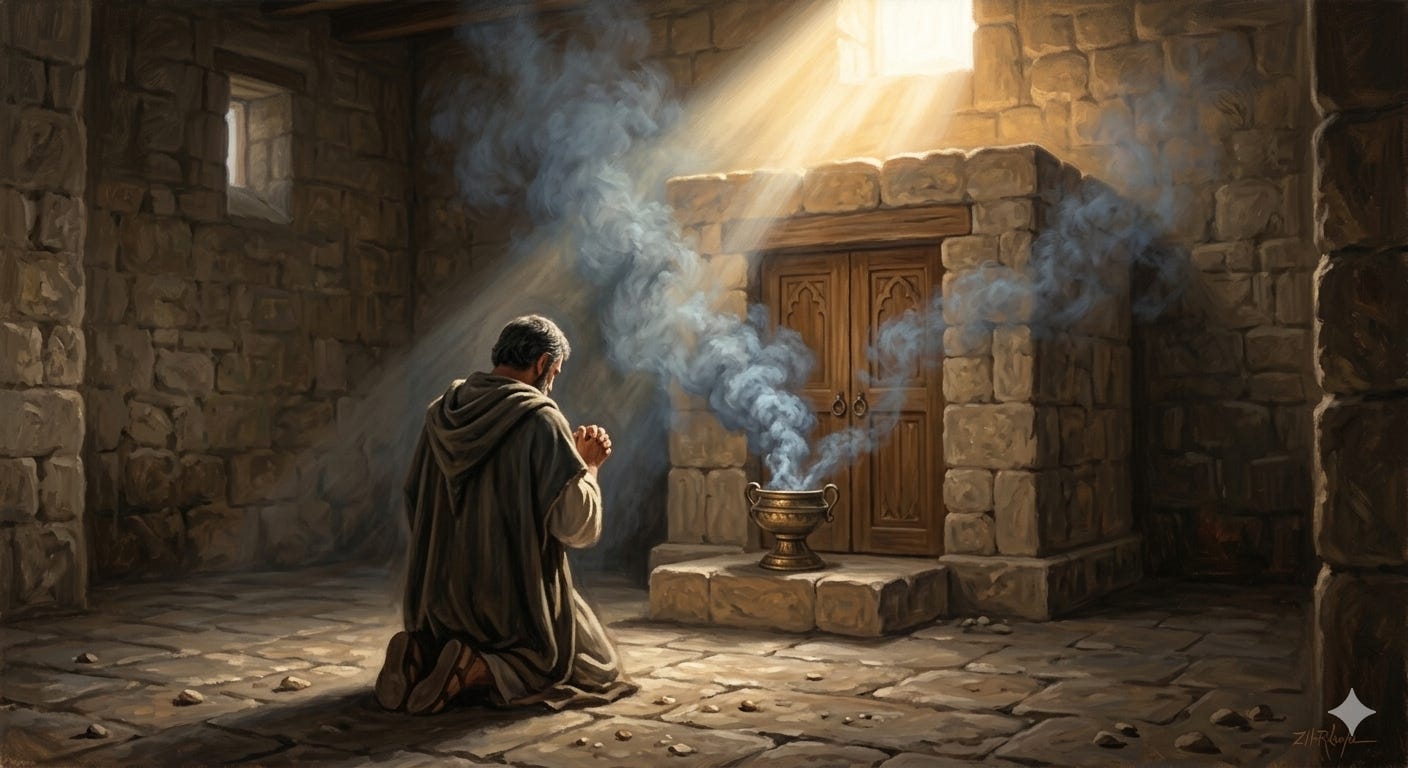
⁵ In the days of Herod, King of Judea, there was a priest named Zechariah of the priestly division of Abijah; his wife was from the daughters of Aaron, and her name was Elizabeth. ⁶ Both were righteous in the eyes of God, observing all the commandments and ordinances of the Lord blamelessly. ⁷ But they had no child, because Elizabeth was barren and both were advanced in years. ⁸ Once when he was serving as priest in his division's turn before God, ⁹ according to the practice of the priestly service, he was chosen by lot to enter the sanctuary of the Lord to burn incense. ¹⁰ Then, when the whole assembly of the people was praying outside at the hour of the incense offering, ¹¹ the angel of the Lord appeared to him, standing at the right of the altar of incense. ¹² Zechariah was troubled by what he saw, and fear came upon him. ¹³ But the angel said to him, "Do not be afraid, Zechariah, because your prayer has been heard. Your wife Elizabeth will bear you a son, and you shall name him John. ¹⁴ And you will have joy and gladness, and many will rejoice at his birth, ¹⁵ for he will be great in the sight of the Lord. He will drink neither wine nor strong drink. He will be filled with the holy Spirit even from his mother's womb, ¹⁶ and he will turn many of the children of Israel to the Lord their God. ¹⁷ He will go before him in the spirit and power of Elijah to turn the hearts of fathers toward children and the disobedient to the understanding of the righteous, to prepare a people fit for the Lord."
Today’s Focus
Elizabeth gives birth to John after the angel's promise, Zechariah's insistence on the name John despite family naming convention restores his speech, and the surrounding community recognizes an unmistakable divine visitation in a child whose calling is described in language drawn directly from Malachi's prophecy of the one who would prepare the way before the Lord.
In the Margins
For nine months Zechariah has been unable to speak. The angel Gabriel struck him silent in the Temple when he doubted the announcement that his elderly and barren wife would bear a son, the very announcement that fulfilled what generations of righteous, Torah-observant Jews like Zechariah and Elizabeth had longed for and largely given up hoping to see in their own lifetime.
When the time arrives, Elizabeth gives birth to a son. The neighbors and relatives rejoice with her, recognizing what Luke has already told us, that this birth is an act of God’s specific mercy toward a woman whose barrenness had likely carried social stigma for decades. On the eighth day, in keeping with Genesis 17:12 and the covenant of circumcision given to Abraham, the child is brought to be circumcised. The neighbors assume he will be named Zechariah after his father, the standard expectation in a culture where naming a son after the father carried significant honor and continuity.
Elizabeth insists on the name John, which the angel had specified to Zechariah before his silence began. The name Yochanan in Hebrew means the Lord is gracious or the Lord has shown favor, and it was not a name with any precedent in either Zechariah’s or Elizabeth’s family line. The community asks Zechariah directly, presumably expecting him to override his wife and restore the family naming convention. Instead he asks for a writing tablet and writes, His name is John. The same moment his speech returns and the first words out of his mouth, according to the following verses Luke includes, are a song of blessing that has been prayed by the Church for two thousand years as the Benedictus.
The fear that falls on the entire neighborhood when they witness this is not modern unease. It is the appropriate response in Jewish tradition to an unmistakable divine visitation, the kind of fear that accompanied theophany throughout the Hebrew Scriptures. Word spreads throughout the Judean hill country. Everyone who hears it ponders what kind of child this will be, for clearly the hand of the Lord was with him.
The angel’s earlier description of who this child would become carries the weight of Israel’s deepest prophetic expectation. He will be filled with the Holy Spirit from his mother’s womb, an extraordinary statement of consecration before birth that echoes the calling of Jeremiah, known by God before he was formed in the womb. He will turn many of the children of Israel back to the Lord their God. And he will go before Him in the spirit and power of Elijah, to turn the hearts of fathers toward their children, language drawn directly from the closing words of the prophet Malachi, the last verses of the Hebrew prophetic canon as it was arranged in Jewish tradition. Malachi had promised that before the great and terrible day of the Lord, God would send Elijah to turn hearts, to prepare a people ready to receive what was coming. First century Jews who knew their Scriptures would have heard in this announcement that the long prophetic silence since Malachi was finally being broken.
Luke closes the account of John’s childhood with characteristic brevity. The child grew and became strong in spirit, and he was in the wilderness until the day of his manifestation to Israel. The wilderness was the place of testing and preparation throughout Israel’s history, from the forty years after the Exodus to Elijah’s own wilderness experience. John’s formation happens away from the public eye, in the place where Israel had always been shaped before being sent.
This passage is fundamentally about how God works in the long silences. Zechariah and Elizabeth had likely stopped expecting an answer to their prayer for a child decades before the angel appeared. The fulfillment came not on their timeline but on God’s, and it came wrapped in a sign, Zechariah’s silence, that forced the entire community to recognize that something larger than family tradition was unfolding. The God who kept covenant with two elderly, faithful people in their decades of unanswered prayer is the same God whose timing, in every generation, rarely matches our own expectations for when and how the answer should arrive.
Reflection Question
Where have you stopped expecting an answer to a long-unanswered prayer, and what would it take for you to remain as faithful as Zechariah and Elizabeth were through the decades of waiting before the angel ever appeared?