

26 Jun 26 | The Cleansing of a Leper
Touching a leper was supposed to make you unclean. Jesus reversed the direction completely.
The Gospel: Matthew 8:1-4
¹ When Jesus came down from the mountain, great crowds followed him. ² And then a leper approached, did him homage, and said, "Lord, if you wish, you can make me clean." ³ He stretched out his hand, touched him, and said, "I will do it. Be made clean." His leprosy was cleansed immediately. ⁴ Then Jesus said to him, "See that you tell no one, but go show yourself to the priest, and offer the gift that Moses prescribed; that will be proof for them."
Today’s Focus
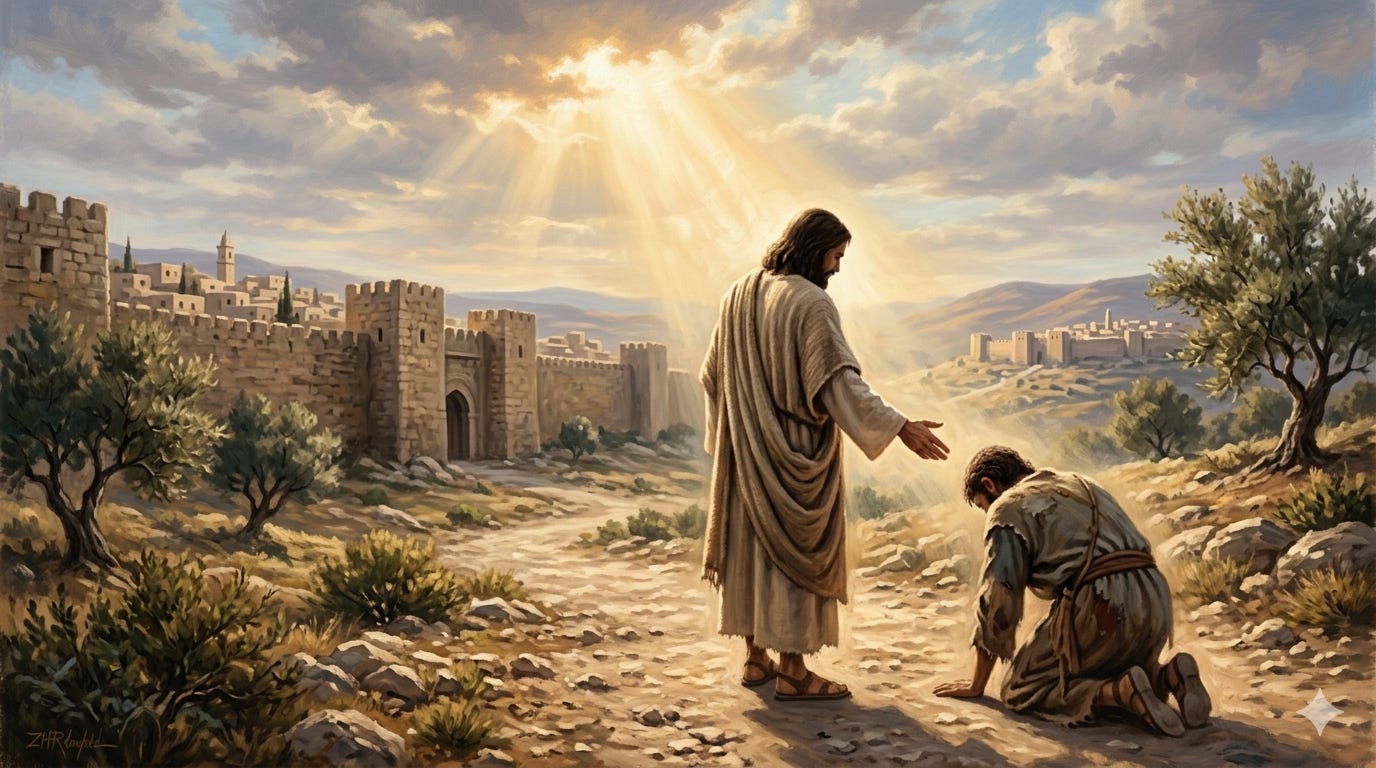
A leper approaches Jesus in violation of the social and religious boundaries meant to isolate him, expresses confident faith in Jesus' ability while submitting to His will, and Jesus touches him before speaking the healing word, reversing the normal direction of ritual contamination and then directing him to the priest to fulfill the Mosaic process for restoration.
In the Margins
When Jesus came down from the mountain, great crowds followed Him. The Sermon on the Mount has just ended with the crowd astonished at His authority. Now that authority moves immediately from words to action, and the first action Matthew records is an encounter with someone the Sermon’s audience would have considered untouchable.
A leper approached. The word translated as leprosy in the Gospels covered a range of skin conditions, not exclusively the disease known today as Hansen’s disease, but whatever the specific condition, the religious and social consequences were severe and codified in detail in Leviticus 13 and 14. A person diagnosed with this condition was declared unclean, required to live outside the camp or the city, required to tear their clothes and cover their upper lip and cry out unclean, unclean to warn others away. Leviticus 13:45-46 makes the isolation explicit. The leper was not simply sick. The leper was ritually unclean, and that uncleanness was understood to be contagious through contact, which meant touching a leper made the toucher unclean as well.
This man approaches Jesus directly, in violation of the social and religious boundary that should have kept him at a distance, and does Him homage, an act of worship-like reverence. Lord, if you wish, you can make me clean. The statement is remarkable for what it does not ask. He does not beg for mercy as though uncertain of Jesus’ ability. He states the ability as a fact and submits the willingness to Jesus’ own choice. The faith here is not faith that Jesus might be able to heal. It is faith that healing is entirely within His capacity, with the only open question being whether He will choose to extend it to this particular person.
Jesus stretched out His hand and touched him. This detail would have stopped a first century Jewish reader cold. The Law was unambiguous about the consequence of touching someone unclean. The toucher becomes unclean. Jesus touches the leper anyway, before the healing word is even spoken, in an act that under the normal operation of the purity system should have rendered Him unclean as well. Instead, the reverse happens. Jesus’ touch does not absorb the leper’s uncleanness, it transfers wholeness in the other direction. I will do it. Be made clean. His leprosy was cleansed immediately.
This is one of the clearest enacted demonstrations in the Gospels of what Jesus’ authority actually does to the boundaries that organized first century religious life. The purity system existed to protect the holy from contamination by separation. Jesus operates by a different logic entirely. His holiness does not need protection from contact with uncleanness. His holiness overcomes uncleanness on contact. This is a different category of holiness than the Temple system was built to manage.
Then Jesus tells him, see that you tell no one, but go show yourself to the priest and offer the gift that Moses prescribed, that will be proof for them. Jesus does not bypass the Mosaic law that governed the certification of healed lepers, described in Leviticus 14. He sends the man through the proper channel, to be examined by a priest and to offer the prescribed sacrifice, which would result in his official restoration to the community. Jesus has just fulfilled the Torah’s deepest hope embedded in that law, that the unclean might one day become clean, while still honoring the structure the Torah established for confirming and celebrating exactly that.
What this passage puts before the reader is the question of what we believe is beyond reach of restoration. The leper had been told by every social and religious structure around him that his condition placed him outside what could be touched, what could be approached, what could be made whole. Jesus reaches across that boundary without hesitation. The condition that everyone else organized their lives around avoiding is the condition Jesus moves toward first.
Reflection Question
What part of your life have you assumed is too far outside the boundary of what God would reach toward, and what would it mean to approach Him the way this man did, with confidence in His ability and submission to His will?