

26 Mar 26 | Before Abraham Was, I AM
Jesus makes a statement about his identity that the crowd understands perfectly, and their response tells you everything about what he actually said.
The Gospel: John 8:51-59
Jesus said to the Jews:
“Amen, amen, I say to you,
whoever keeps my word will never see death.”
So the Jews said to him,
“Now we are sure that you are possessed.
Abraham died, as did the prophets, yet you say,
‘Whoever keeps my word will never taste death.’
Are you greater than our father Abraham, who died?
Or the prophets, who died?
Who do you make yourself out to be?”
Jesus answered, “If I glorify myself, my glory is worth nothing;
but it is my Father who glorifies me,
of whom you say, ‘He is our God.’
You do not know him, but I know him.
And if I should say that I do not know him,
I would be like you a liar.
But I do know him and I keep his word.
Abraham your father rejoiced to see my day;
he saw it and was glad.”
So the Jews said to him,
“You are not yet fifty years old and you have seen Abraham?”
Jesus said to them, “Amen, amen, I say to you,
before Abraham came to be, I AM.”
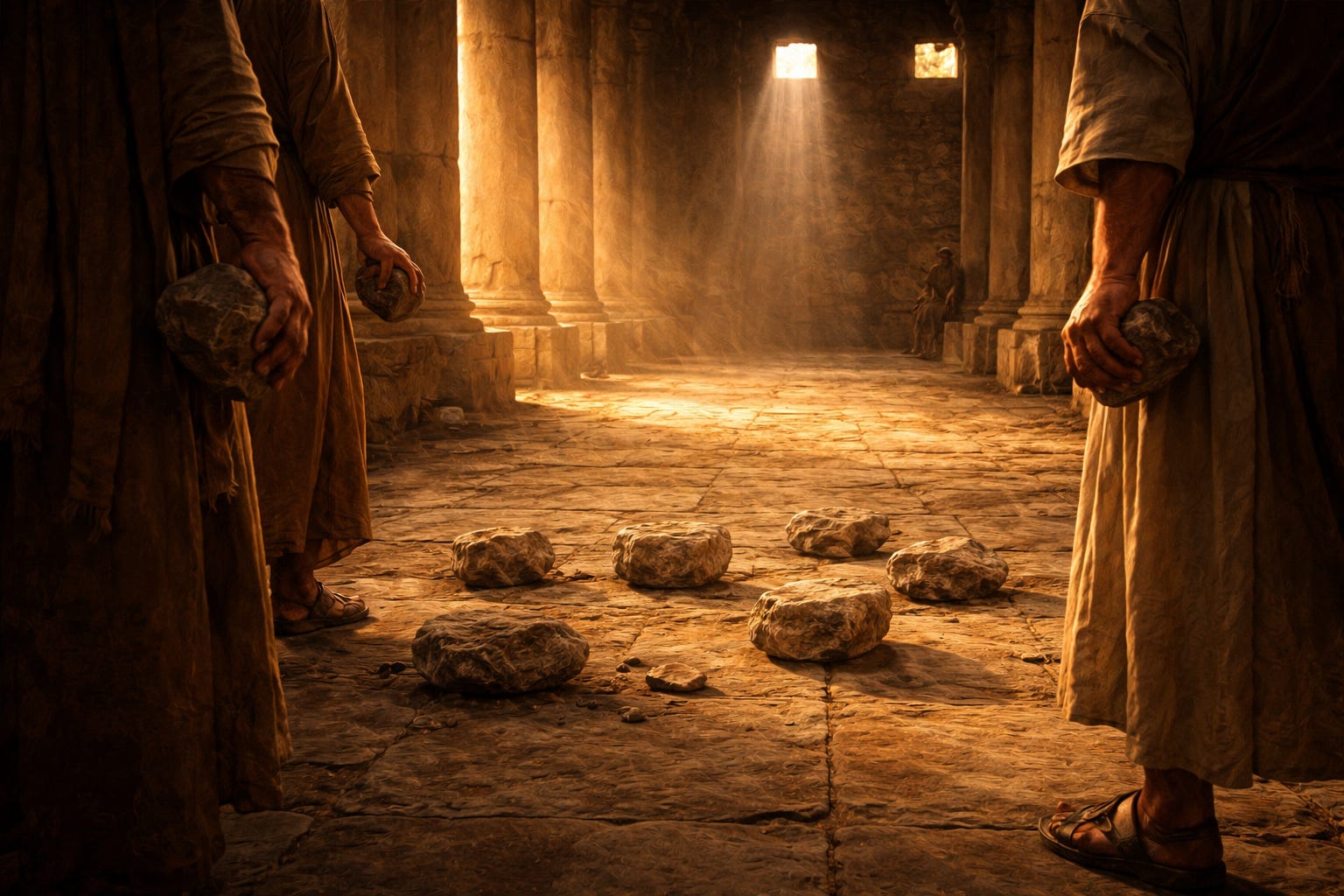
So they picked up stones to throw at him;
but Jesus hid and went out of the temple area.
Today’s Focus
The crowd had access to the same words every reader of this passage has. Some believed while other reached for stones. The difference was not information, rather how each person was willing to do with the claim being made. Jesus did not soften it or walk it back, holding firm, “before Abraham came to be, I AM.” That is either the most important truth you will ever encounter or it is blasphemy. The question John places before every reader is the same one the crowd faced that day in the Temple. Who do you say that He is?
In the Margins
This incident takes place inside the Temple during a sustained confrontation between Jesus and the religious leaders of Jerusalem. It has been escalating for some time by the time we get here. This exchange reaches its climax here, moving from what started as a theological debate and now ends with the group reaching for stones. Jesus is making claims that leave no middle ground, people would have been in a place where they had to accept or deny what they were hearing.
This Gospel opens with Jesus telling the group, “whoever keeps my word will never see death.” They hear this at a literal level, and believe this to mean actual life and death. They look to Abraham and the prophets who died. Knowing these figures walked faithfully with God, and having still died, they could not understand what Jesus was saying, they missed Him pointing to the spiritual life. This spiritual separation from God, the final and ultimate consequence of rejecting the one the Father has sent.
Their question, “Who do you make yourself out to be?” drives this passage. They intend it as a challenge. Jesus does not answer their question directly, rather redirects it to the Father. The distinction Jesus draws is pointed. They say “He is our God” but Jesus tells them plainly: you do not know him. This is not a minor correction. In the framework we see, to claim the Father while rejecting the Son is to reveal that one does not truly know the Father at all. Knowing the Father and knowing Jesus are inseparable throughout this Gospel. The claim to possess God while rejecting the one he sent cannot hold.
Then Jesus says something that stops the conversation entirely. “Abraham your father rejoiced to see my day; he saw it and was glad.” The crowd’s response is understandable. They are still reading him in purely human terms, measuring him by a human lifespan. That is precisely the misunderstanding Jesus has been diagnosing throughout this chapter.
This passage’s climax comes with Jesus saying, “before Abraham came to be, I AM.” The Greek is ego eimi (ἐγώ εἰμι) and it is the same construction that echoes the divine self-identification in Exodus 3:14, where God reveals his name to Moses at the burning bush. This resonance would be unmistakable to anyone formed in the Jewish scriptures. Jesus is not saying that he existed before Abraham in the way an elderly person existed before a younger one. He uses the present tense in a way that transcends normal human categories of time, signaling not just pre-existence but divine identity. This is why the crowd reaches for stones immediately. They understand it as a claim that crosses into blasphemy within their framework. Under Leviticus 24:16, blasphemy was punishable by stoning. They are not overreacting by their own legal standards. They are responding to what they heard as a claim to be God.
This passage asks us directly, who do we say that Jesus is? The crowd had access to the same words. Some believed what they heard while others reached for stones. The difference was not information, everyone heard the same message. It was what each person was willing to do with the claim being made. Jesus did not soften the statement or walk it back either. He was clear and firm, “before Abraham came to be, I AM.” That claim is either the most important truth we will ever encounter or it is grounds for the crowd’s response. There is no comfortable middle position available. What we do with it is the question John is placing before every reader, then and now.
Reflection Question
Have you settled the question of who Jesus is, or are you still standing in the crowd deciding what to do with what you have heard?
A Small Invitation
If this reflection helped you, consider sharing it with someone who may benefit from hearing this message.