

The Gospel: John 10:11–21
¹¹ "I am the good shepherd. A good shepherd lays down his life for the sheep. ¹² A hired man, who is not a shepherd and whose sheep are not his own, sees a wolf coming and leaves the sheep and runs away, and the wolf catches and scatters them. ¹³ This is because he works for pay and has no concern for the sheep. ¹⁴ I am the good shepherd, and I know mine and mine know me, ¹⁵ just as the Father knows me and I know the Father; and I will lay down my life for the sheep. ¹⁶ I have other sheep that do not belong to this fold. These also I must lead, and they will hear my voice, and there will be one flock, one shepherd. ¹⁷ This is why the Father loves me, because I lay down my life in order to take it up again. ¹⁸ No one takes it from me, but I lay it down on my own. I have power to lay it down, and power to take it up again. This command I have received from my Father."
¹⁹ Again there was a division among the Jews because of these words. ²⁰ Many of them said, "He is possessed and out of his mind; why listen to him?" ²¹ Others said, "These are not the words of one possessed; surely a demon cannot open the eyes of the blind, can he?"
Today’s Focus
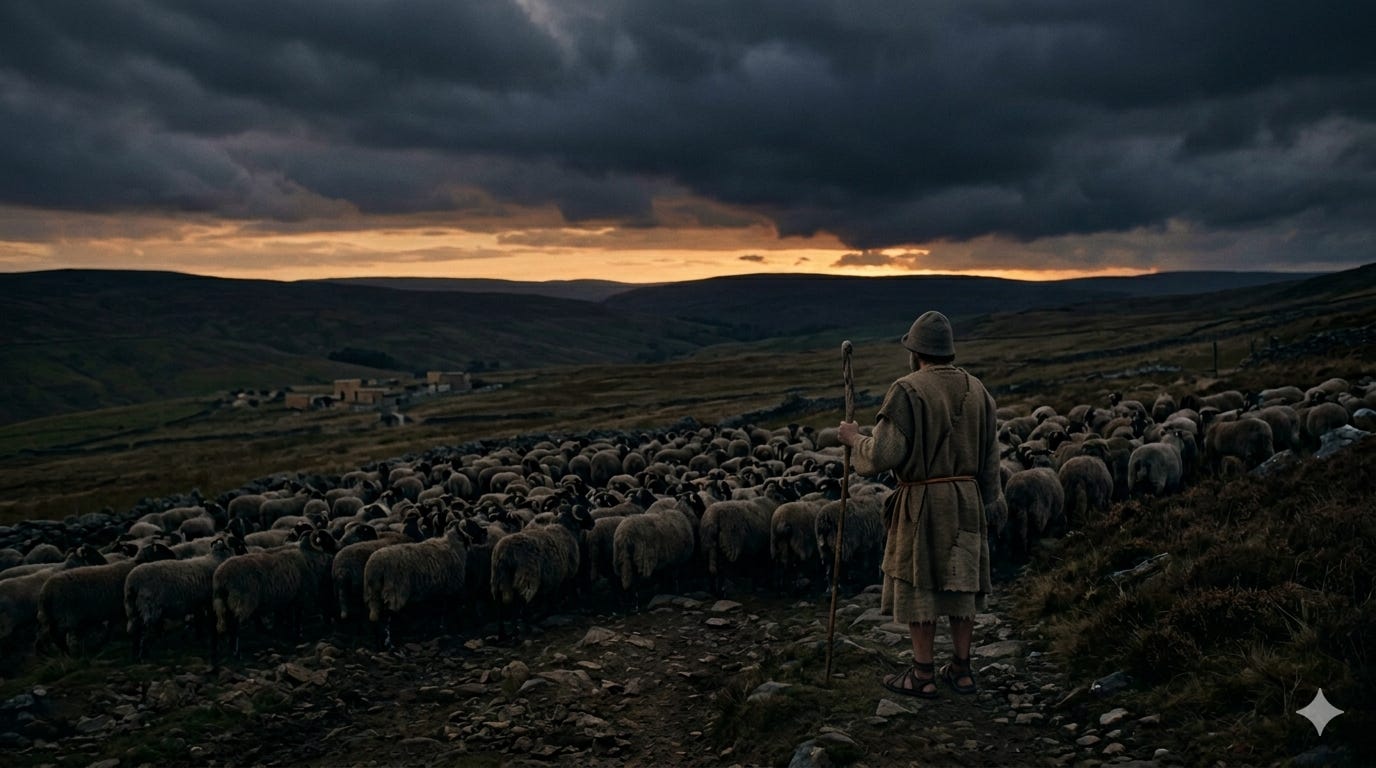
The hired man runs when the wolf comes. His running is not simple cowardice. It is the logical response of someone who has no stake in the sheep. They are not his. Jesus has a different relationship to the flock entirely. He knows them. They know him. He lays down his life for them not because he has no other option but because no one takes it from him. He lays it down on his own authority and he has the power to take it up again. The cross is not something that happens to Jesus. It is something he does, freely, in obedience to the Father, out of love for the sheep. And the flock he is gathering does not stop at the borders of Israel. He has other sheep not of this fold, and there will be one flock and one shepherd. That shepherd is still calling. The one true voice that has not changed.
In the Margins
Jesus has already declared Himself the gate through which the sheep enter and find pasture. Now He makes a second I AM declaration that deepens the first. I AM the good shepherd. The gate describes access, the shepherd describes relationship, care, and the willingness to die.
The contrast Jesus draws between the good shepherd and the hired man is not about competence, it is about ownership and love. The hired man does his job when it costs him nothing. He is a good worker, but when the wolf comes, when the real test arrives, he runs. His running is not cowardice in the simple sense. It is the logical response of someone who has no stake in the sheep. They are not his, he works for pay and when the cost exceeds the wage, he leaves. The sheep are scattered and the wolf takes what it came for.
The background for this contrast runs directly through Ezekiel 34, where God delivers a detailed indictment of Israel’s shepherds, the religious and political leaders who fed themselves from the flock rather than feeding the flock. These are the people who abandoned the weak and sick and scattered, rather than gathering and protecting. God declares through Ezekiel that He will come Himself and shepherd His people. Jesus standing before the Pharisees, who have just expelled the man born blind for coming to faith, is the fulfillment of that promise. The false shepherds are present. The true shepherd is present. The contrast Ezekiel described centuries earlier is standing in the same room.
What distinguishes the good shepherd is not skill or strategy. It is that he lays down his life for the sheep. Jesus states this twice in close succession, and then develops it in a way that no human shepherd could. He will lay down his life and take it up again. No one takes it from him. He lays it down on his own, with full authority, and he has the power to take it up again. This is a sovereign act, not a victim’s fate. The cross is not something that happens to Jesus. It is something He does, freely, in obedience to the Father’s command, out of love for the sheep.
This is where the passage connects to something Jesus says about the Father. The Father loves the Son because He lays down His life in order to take it up again. The love between the Father and the Son is not simply an eternal divine reality operating at a distance from human history. It is expressed and demonstrated in the specific act of the Son’s death and resurrection. Isaiah 53 described the suffering servant who would pour out his soul to death and bear the sins of many. What Isaiah saw from the outside Jesus describes from the inside, as a free and loving act undertaken in union with the Father.
Then Jesus introduces something that would have been startling to every Jewish listener present. He has other sheep that do not belong to this fold. These also He must lead, and there will be one flock and one shepherd. The other sheep are the Gentiles, the nations outside of Israel who are not yet part of the covenant community but who will hear the shepherd’s voice and come. This is the fulfillment of Isaiah 49:6, where God tells His servant that it is too small a thing to restore only the tribes of Jacob, that He will make him a light to the nations so that salvation reaches the ends of the earth. The one flock and one shepherd Jesus describes is the Church drawn from every people, the universal community gathered under the shepherd who laid down his life for all of it.
The division this produces is immediate. Some say He is possessed and out of his mind. Others push back. A demon cannot open the eyes of the blind. The works are standing as evidence and the crowd cannot reconcile them with the dismissal. The claims Jesus makes here do not allow for comfortable neutrality. A man who says he lays down his life on his own authority and takes it up again is either exactly who he says he is or he is not worth listening to at all. The crowd is split on that question and so is every person who encounters it.
What Jesus offers in this passage is not the hired man’s arrangement, protection when it is convenient and departure when it costs too much. It is the shepherd who stayed when the wolf came, who went to the cross freely, who knows his sheep by name, and who is gathering a flock from every corner of the world into one. That shepherd is still calling. The one true voice that has not changed.
Reflection Question
Do you know His voice and are you coming to Him when He calls?
A Small Invitation
If this reflection helped you, consider sharing it with someone who may benefit from hearing this message.