

27 Jun 26 | The Centurion's Faith
A Roman soldier had more faith than anyone Jesus had found in Israel. He never even asked Jesus to come.
The Gospel: Matthew 8:5-17
⁵ When he entered Capernaum, a centurion approached him and appealed to him, ⁶ saying, "Lord, my servant is lying at home paralyzed, suffering dreadfully." ⁷ He said to him, "I will come and cure him." ⁸ The centurion said in reply, "Lord, I am not worthy to have you enter under my roof; only say the word and my servant will be healed. ⁹ For I too am a person subject to authority, with soldiers subject to me. And I say to one, 'Go,' and he goes; and to another, 'Come here,' and he comes; and to my slave, 'Do this,' and he does it." ¹⁰ When Jesus heard this, he was amazed and said to those following him, "Amen, I say to you, in no one in Israel have I found such faith. ¹¹ I say to you, many will come from the east and the west, and will recline with Abraham, Isaac, and Jacob at the banquet in the kingdom of heaven, ¹² but the children of the kingdom will be driven out into the outer darkness, where there will be wailing and grinding of teeth." ¹³ And Jesus said to the centurion, "You may go; as you have believed, let it be done for you." And at that very hour his servant was healed.
¹⁴ Jesus entered the house of Peter, and saw his mother-in-law lying in bed with a fever. ¹⁵ He touched her hand, the fever left her, and she rose and waited on him.
¹⁶ When it was evening, they brought him many who were possessed by demons, and he drove out the spirits by a word and cured all the sick, ¹⁷ to fulfill what had been said by Isaiah the prophet:
"He took away our infirmities and bore our diseases."
Today’s Focus
A Roman centurion demonstrates a faith in Jesus' word-based authority that Jesus declares unmatched in Israel, prompting a startling reordering of the messianic banquet guest list, and Matthew connects the subsequent healings to Isaiah's suffering servant who bears what others cannot carry themselves.
In the Margins
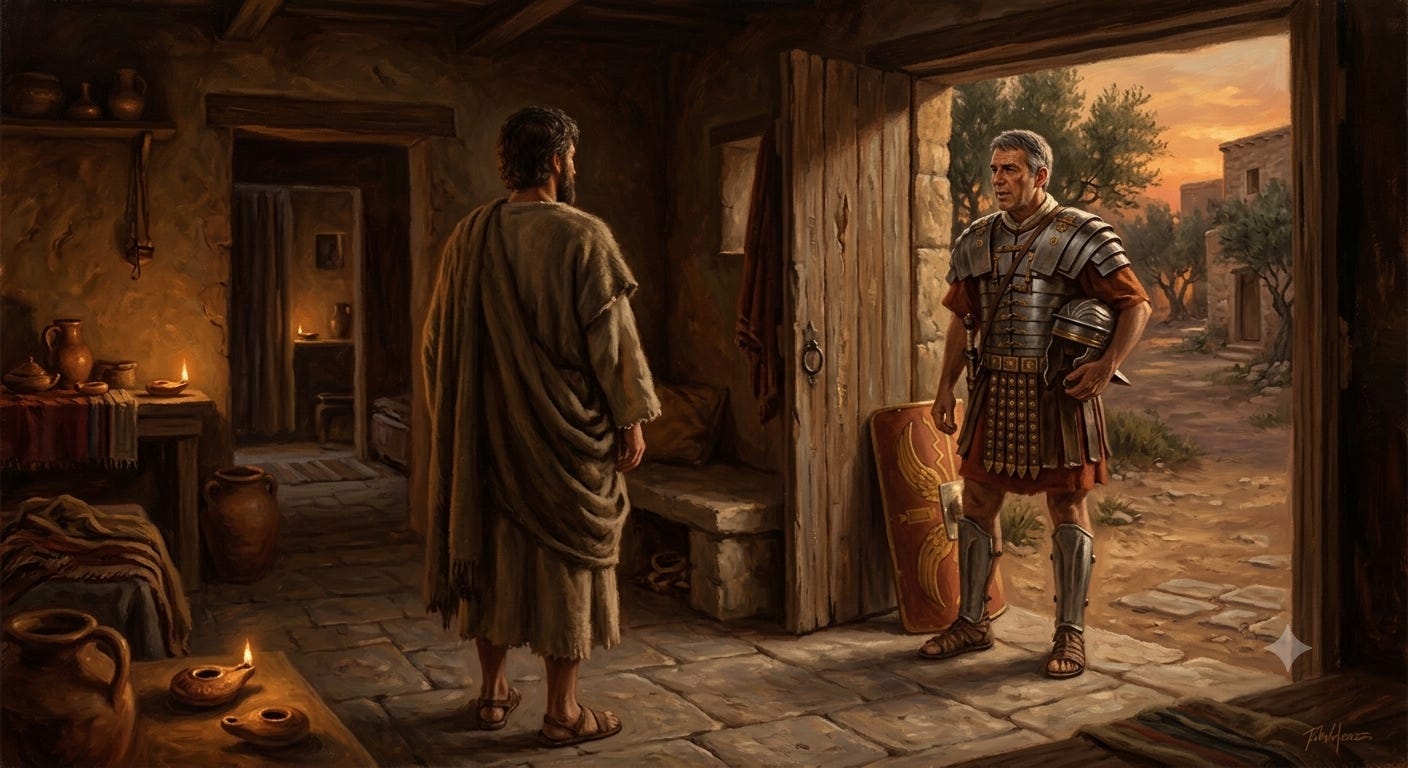
A centurion approaches Jesus in Capernaum, and the encounter that follows contains one of the most theologically significant statements of faith in the entire Gospel of Matthew, spoken by someone entirely outside the covenant community of Israel.
A centurion commanded roughly one hundred soldiers within the Roman military structure, and his presence in Capernaum placed him as a representative of the occupying power that first century Jews lived under and often resented. He approaches Jesus and appeals on behalf of his servant, who is paralyzed and suffering terribly at home. Jesus responds immediately, I will come and cure him. This would have been the expected and appropriate response, a healer traveling to the location of the afflicted person.
The centurion’s reply reverses the expectation entirely. Lord, I am not worthy to have you enter under my roof. Only say the word and my servant will be healed. The centurion is doing something remarkable here, recognizing a purity concern that a Gentile household would have represented for a Jewish teacher, something Jesus had not raised but the centurion anticipated out of respect. More than that, he articulates a theology of authority that the disciples themselves had not yet fully grasped. For I too am a person subject to authority, with soldiers subject to me. And I say to one, go, and he goes, and to another, come here, and he comes. The centurion understands command structures intimately from his military experience. He recognizes that Jesus operates within a command structure as well, one where the word itself carries authority sufficient to accomplish the task without requiring physical presence.
Jesus’ response indicates this was a remarkable insight even by His own standard. He was amazed, and said to those following Him, Amen, I say to you, in no one in Israel have I found such faith. The crowd following Jesus throughout His Galilean ministry, His own disciples included, had not yet articulated faith of this depth, and the person who finally does is a Roman military officer with no covenant standing in Israel whatsoever.
What Jesus says next would have been startling and uncomfortable to a first century Jewish audience. Many will come from the east and the west and will recline with Abraham, Isaac, and Jacob at the banquet in the kingdom of heaven, but the children of the kingdom will be driven out into outer darkness. The messianic banquet, drawn from Isaiah 25:6 and developed throughout Jewish eschatological expectation, was understood as the celebration awaiting the faithful of Israel at the consummation of the age. Jesus reorders the guest list. Gentiles whose faith resembles the centurion’s will recline at that table. Some who assumed their place was secured by covenant birth will not. This is not a rejection of Israel. It is a warning that covenant membership without the kind of faith the centurion displayed does not guarantee a seat at the table.
The healing happens at a distance, exactly as the centurion’s faith anticipated. You may go, as you have believed, let it be done for you. And at that very hour his servant was healed. Matthew then moves immediately into Peter’s mother-in-law, healed with a touch, and a broader healing of many possessed and sick people that evening, with the citation from Isaiah 53:4, He took away our infirmities and bore our diseases. The healing ministry, in Matthew’s reading, is the enactment of the suffering servant’s mission, the one who would carry what others could not carry themselves.
The centurion’s faith stands as a model precisely because it required no physical proximity, no visible sign, no preliminary evidence beyond the word itself. He trusted the authority of the speaker more than he needed the presence of the healer. That is a category of faith that anyone, in any era, can still choose to have.
Reflection Question
The centurion trusted Jesus' word without needing His physical presence or any visible proof first. Where in your own life are you waiting for a sign before you will trust what Jesus has already said?