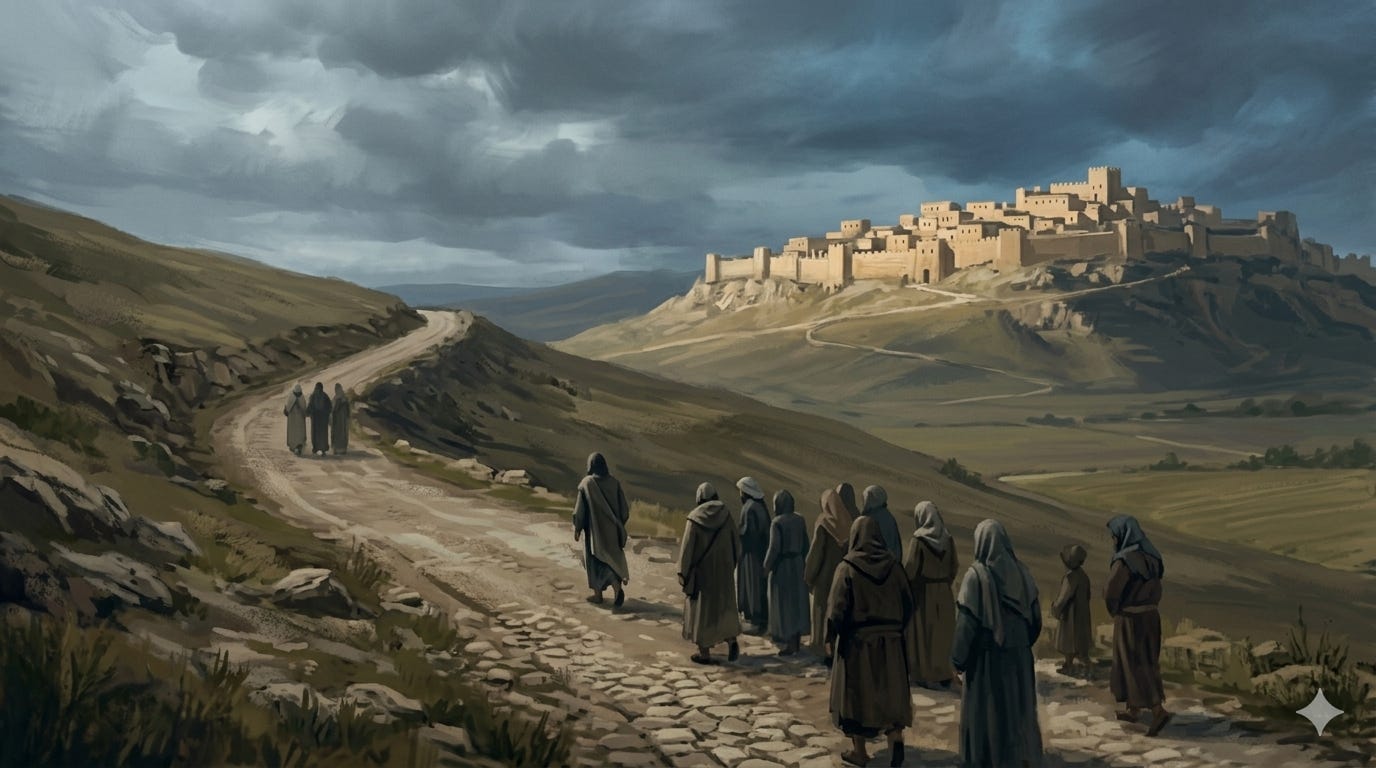
Jesus predicted the cross and before He finished two of His disciples asked for thrones.
The Gospel: Mark 10:32-45
³² They were on the way, going up to Jerusalem, and Jesus went ahead of them. They were amazed, and those who followed were afraid. Taking the Twelve aside again, he began to tell them what was going to happen to him. ³³ "Behold, we are going up to Jerusalem, and the Son of Man will be handed over to the chief priests and the scribes, and they will condemn him to death and hand him over to the Gentiles ³⁴ who will mock him, spit upon him, scourge him, and put him to death, but after three days he will rise." ³⁵ Then James and John, the sons of Zebedee, came to him and said to him, "Teacher, we want you to do for us whatever we ask of you." ³⁶ He replied, "What do you wish me to do for you?" ³⁷ They answered him, "Grant that in your glory we may sit one at your right and the other at your left." ³⁸ Jesus said to them, "You do not know what you are asking. Can you drink the cup that I drink or be baptized with the baptism with which I am baptized?" ³⁹ They said to him, "We can." Jesus said to them, "The cup that I drink, you will drink, and with the baptism with which I am baptized, you will be baptized; ⁴⁰ but to sit at my right or at my left is not mine to give but is for those for whom it has been prepared." ⁴¹ When the ten heard this, they became indignant at James and John. ⁴² Jesus summoned them and said to them, "You know that those who are recognized as rulers over the Gentiles lord it over them, and their great ones make their authority over them felt. ⁴³ But it shall not be so among you. Rather, whoever wishes to be great among you will be your servant; ⁴⁴ whoever wishes to be first among you will be the slave of all. ⁴⁵ For the Son of Man did not come to be served but to serve and to give his life as a ransom for many."
Jesus gives the third passion prediction and is immediately met with James and John's request for positions of honor, using their ambition as the occasion to redefine greatness in the kingdom as servant leadership modeled on the Son of Man who gives His life as a ransom for many.
In the Margins
They are on the road going up to Jerusalem and Jesus is walking ahead of them. Mark notes that those who followed were afraid. He has already told them twice what is coming. Now He tells them a third time, in more detail. The Son of Man will be handed over to the chief priests and scribes. They will condemn Him to death. The Gentiles will mock Him, spit on Him, scourge Him, and kill Him. After three days He will rise.
Before the words have settled, James and John make their request. Teacher, we want you to do for us whatever we ask. Grant us the seats at your right and left in your glory. The timing is not incidental. Jesus has just described the cross with specific and brutal detail and they are asking for thrones. They have heard the passion prediction and filtered it through their own expectations of what glory looks like on the other side.
Jesus does not rebuke them harshly. He asks whether they can drink the cup He drinks or be baptized with the baptism He undergoes. The cup in the prophetic tradition, particularly in Isaiah 51 and Jeremiah 25, is the cup of God’s wrath borne on behalf of others. They say they can. Jesus says they will, and it will be true. James will be the first apostle martyred. John will survive persecution and exile. But the seats at His right and left belong to those for whom they have been prepared by the Father.
When the ten hear about the request they are indignant, which reveals they wanted the same thing and are angry that James and John asked first. Jesus gathers all of them and draws the line. Among the Gentiles, greatness means authority exercised over others. Among you it will not be so. Whoever wishes to be great will be servant. Whoever wishes to be first will be slave of all. The Son of Man did not come to be served but to serve and to give His life as a ransom for many.
The word ransom, lytron, is the language of the Exodus, of God purchasing Israel’s freedom from Egypt. Isaiah 53 stands behind it, the servant who pours out his soul to death and bears the sin of many. Jesus is describing His death not as tragedy but as the act that purchases the freedom of those He came to serve.
The ambition of James and John is not unusual. It is the default human orientation toward significance and position. What Jesus offers in its place is not the absence of greatness but its complete redefinition. The one who leads by serving is not diminished. They are doing what the Son of Man came to do.
Reflection Question
Where are you measuring greatness by the world's standard of authority and position, and what would it look like to reorient toward the standard Jesus describes here?