

28 Apr 26 | My Sheep Hear My Voice
The security of the sheep is grounded in the unity of Father and Son, because the hand holding them from the Son's side and the hand holding them from the Father's side are the same hand.
The Gospel: John 10:22-30
²² The feast of the Dedication was taking place in Jerusalem. ²³ It was winter. And Jesus walked about in the temple area on the Portico of Solomon. ²⁴ So the Jews gathered around him and said to him, "How long are you going to keep us in suspense? If you are the Christ, tell us plainly." ²⁵ Jesus answered them, "I told you and you do not believe. The works I do in my Father's name testify to me. ²⁶ But you do not believe, because you are not among my sheep. ²⁷ My sheep hear my voice; I know them, and they follow me. ²⁸ I give them eternal life, and they shall never perish. No one can take them out of my hand. ²⁹ My Father, who has given them to me, is greater than all, and no one can take them out of the Father's hand. ³⁰ The Father and I are one."
Today’s Focus
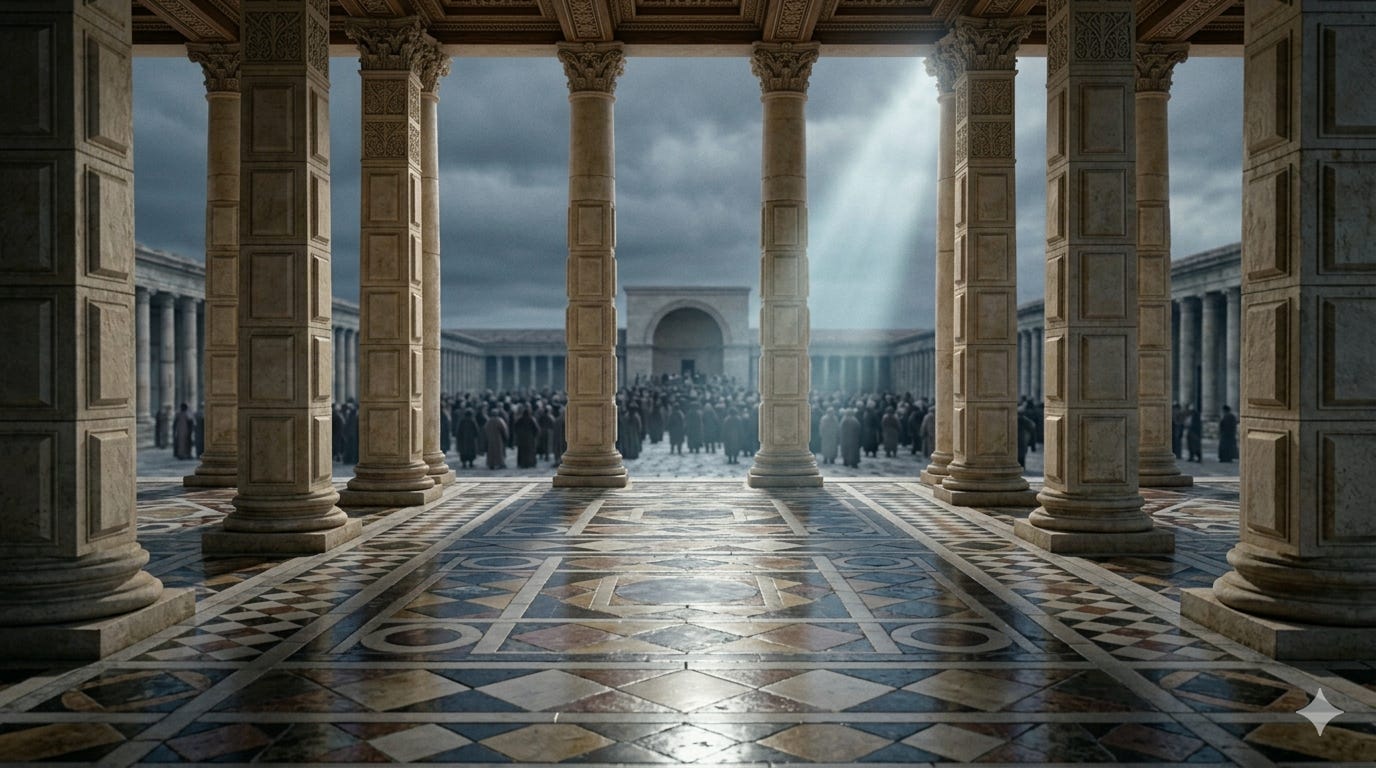
It is winter. The feast celebrating Temple rededication surrounds everything. Jesus is walking in the Portico of Solomon when the crowd demands a plain answer. He has already given them one. The works testify. The problem is not ambiguity. It is the condition of those asking. They are not among his sheep, which is another way of saying they have refused what was offered. Then he tells the sheep what they have. Eternal life. A grip that will not let go. No one can snatch them from his hand, using the same word for snatch that the wolf uses on the scattered flock. Then the security is doubled into the Father’s hand. Then the reason is given. The Father and I are one. The neuter hen rather than the masculine heis. One in nature, not one person. The crowd understood and reached for stones. The Nicene Creed is the theological unpacking of those two words.
In the Margins
It is winter in Jerusalem and Jesus is walking in the Portico of Solomon, a covered colonnade on the east side of the Temple complex. The Feast of Dedication surrounds everything that happens here. Hanukkah commemorated the rededication of the Temple in 164 BC after Antiochus IV Epiphanes had desecrated it, forcing pagan worship in the place God had set apart for His own. The Maccabees recaptured Jerusalem, cleansed the Temple, and restored authentic worship. The feast celebrating that restoration is the setting in which Jesus makes His most direct declaration of unity with the Father. The irony is deliberate. The feast honors the defense of true worship in the Temple and Jesus is the one in whom the Temple finds its fulfillment, as He made clear in John 2 when He said destroy this temple and in three days I will raise it up.
The crowd surrounds Him and the demand they make has the appearance of a reasonable request. How long will you keep us in suspense? If you are the Christ, tell us plainly. As with many of the times Jesus is asked a question directly, He identifies the problem immediately. He has told them. The works done in the Father’s name have testified. The healing of the man born blind is still recent. The signs have accumulated across the entire Gospel. The issue is not that Jesus has been withholding a clear answer, it is the condition of those asking. He tells them that they do not believe because they are not among His sheep.
This is not a statement of predetermined exclusion. This is a statement of condition. The sheep hear the shepherd’s voice because they belong to him, because they have received what he offers and follow where he leads. Those surrounding Jesus in the Portico have heard the same words and seen the same works as those who believe, and they have refused them. Not believing and not being among the sheep describe the same reality from two separate angles.
What Jesus says next about the sheep is among the most reassuring promises in the entire Gospel. He gives them eternal life and they will never perish. The Greek construction uses the strongest negative available, an absolute impossibility. They shall not under any circumstances perish. No one can snatch them from His hand. The word for snatch, harpasei, is the same word used earlier in chapter 10 for the wolf seizing the sheep. The very threat the hired man fled from cannot overcome the security the good shepherd provides. The sheep are held, not by their own grip on the shepherd, but by his grip on them.
Then the security is doubled. The Father who gave the sheep to the Son is greater than all, and no one can snatch them from the Father’s hand either. The sheep are held simultaneously by the hand of the Son and the hand of the Father. Ezekiel 34 had promised that God Himself would come and hold His flock, searching for the lost and binding up the injured. Isaiah 43 declares that there is none who can deliver from God’s hand. What those promises anticipated is stated here as present reality. The flock is in both hands at once.
The reason no one can snatch the sheep from either hand is contained in the final statement. The Father and I are one. The Greek word for one here is hen, the neuter form, meaning one in nature or essence rather than one person. If Jesus had intended to say he and the Father were the same person he would have used the masculine heis. What hen esmen declares is unity of being, one divine nature in two persons. The crowd understands this immediately. In the following verses, they will pick up stones.
The Council of Nicaea in 325 AD formulated the doctrine that the Son is homoousios, of the same substance, with the Father, drawing directly on the Johannine testimony of which this verse is the most concentrated expression. The Nicene Creed that remains the foundational confession of Catholic faith and is shared across most of Christian tradition is the theological unpacking of two Greek words, hen esmen. The hand of the Son and the hand of the Father are not two different hands holding the sheep from two directions. They are the one hand of the one God, because the Father and the Son are one.
Reflection Question
xxx
A Small Invitation
If this reflection helped you, consider sharing it with someone who may benefit from hearing this message.