

The Gospel: Mark 4:1-20
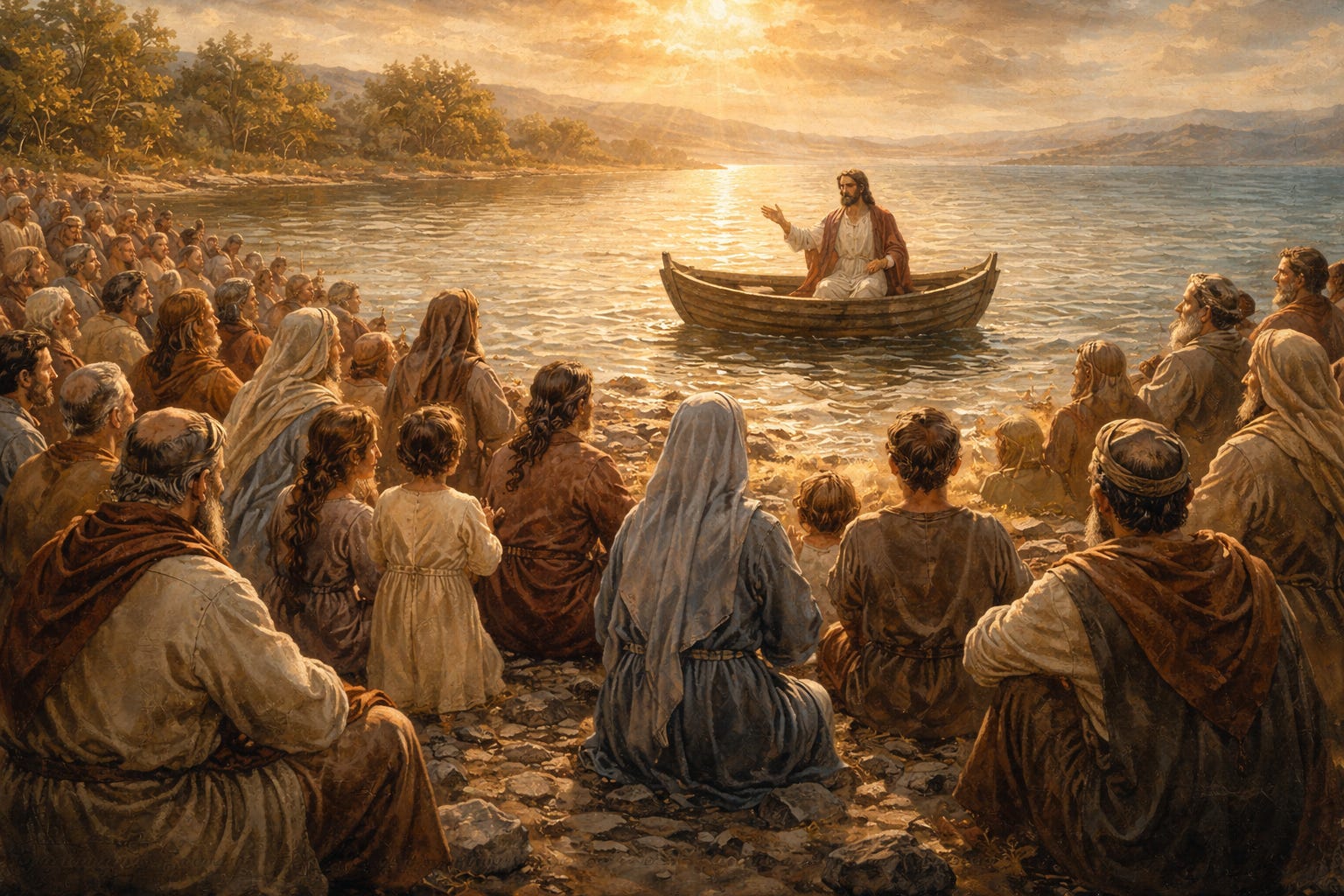
On another occasion, Jesus began to teach by the sea.
A very large crowd gathered around him
so that he got into a boat on the sea and sat down.
And the whole crowd was beside the sea on land.
And he taught them at length in parables,
and in the course of his instruction he said to them,
"Hear this! A sower went out to sow.
And as he sowed, some seed fell on the path,
and the birds came and ate it up.
Other seed fell on rocky ground where it had little soil.
It sprang up at once because the soil was not deep.
And when the sun rose, it was scorched and it withered for lack of roots.
Some seed fell among thorns, and the thorns grew up and choked it
and it produced no grain.
And some seed fell on rich soil and produced fruit.
It came up and grew and yielded thirty, sixty, and a hundredfold."
He added, "Whoever has ears to hear ought to hear."
And when he was alone,
those present along with the Twelve
questioned him about the parables.
He answered them,
"The mystery of the Kingdom of God has been granted to you.
But to those outside everything comes in parables, so that
they may look and see but not perceive,
and hear and listen but not understand,
in order that they may not be converted and be forgiven."
Jesus said to them, "Do you not understand this parable?
Then how will you understand any of the parables?
The sower sows the word.
These are the ones on the path where the word is sown.
As soon as they hear, Satan comes at once
and takes away the word sown in them.
And these are the ones sown on rocky ground who,
when they hear the word, receive it at once with joy.
But they have no roots; they last only for a time.
Then when tribulation or persecution comes because of the word,
they quickly fall away.
Those sown among thorns are another sort.
They are the people who hear the word,
but worldly anxiety, the lure of riches,
and the craving for other things intrude and choke the word,
and it bears no fruit.
But those sown on rich soil are the ones who hear the word and accept it
and bear fruit thirty and sixty and a hundredfold."
Today’s Focus
Jesus teaches in parables not to hide the Kingdom, but to reveal the condition of the heart. The Word is generously sown, yet it bears fruit only where it is received with openness, perseverance, and fidelity. Discipleship is not proven by closeness or enthusiasm, but by a heart willing to be cultivated so the Word can truly take root.
In the Margins
This Gospel is deep in parables and teachings, so it will be a little different than the others. First, let’s look at why Jesus is in the boat, then we can break down each part after that. We know that Jesus was previously concerned about being crushed by the crowds. The boat shows he was still trying to give His message but maintaining order and peace in doing such. We know this sea can be volatile, but here it is calm enough for everyone to hear His words and for Him to take the rabbinic teaching posture of sitting at the same time.
Overall, this teaching is not one parable, but a cluster of parables anchored in Israel’s prophetic tradition. Jesus is reusing familiar Old Testament imagery in a way that forces self-examination.
In the Old Testament, God is repeatedly described as the one who sows His Word through prophets. Isaiah 55 compares God’s Word to rain that waters the earth and causes it to bear fruit. Jeremiah and Ezekiel portray Israel as a field that God has cultivated but which repeatedly fails to yield obedience. The seed represents covenant revelation, not private inspiration. To hear God’s Word is to be summoned into covenant loyalty.
Ultimately, this seed can be viewed in many lenses. Jesus Himself explains it in pretty great detail and it would be pointless to try to compete with that. Something to note here is that the four soils describe conditions of the heart, not permanent categories of people. A person can move between soils over time. Fruitfulness, not enthusiasm or proximity to Jesus, is the biblical test of authentic reception of the Word.
Jesus then paraphrases Isaiah from the Old Testament when he says “they may look and see but not perceive, and hear and listen but not understand, in order that they may not be converted and be forgiven.” In His answer about the parables, Jesus is telling the Apostles that their hearts are already opened and able to understand. They are not hardened to the word of God. If taken just at face value, it can sound like Jesus is saying, “I speak in parables so people won’t understand and won’t repent.” It is something that is cleared up when we look at the term “so that” in biblical usage.
When Scripture says, “so that they may not understand,” it actually means, “this is the result when truth meets a closed heart.” Think of it like this, “The sun shines, so that the clay hardens.” The sun is not trying to harden the clay. The clay hardens because of its nature. Jesus speaks in parables not to prevent repentance, but to reveal whether someone desires it.
Today, the Word can become lost in the noise of the world. Many “birds” exist and swarm all around us, ready to challenge the sowing of our faith. One thing we must do is be the caretaker of our fields of faith. We must work to make sure the conditions of our hearts are right to allow our faith and love for God to prosper. It isn’t going to be easy, but it is necessary!
Reflection Question
What in my life is preventing the Word from taking deep root and bearing lasting fruit?
A Small Invitation
If this reflection helped you, consider sharing it with someone who may be carrying more than they were meant to.