

28 Jun 26 | Whoever Receives You Receives Me
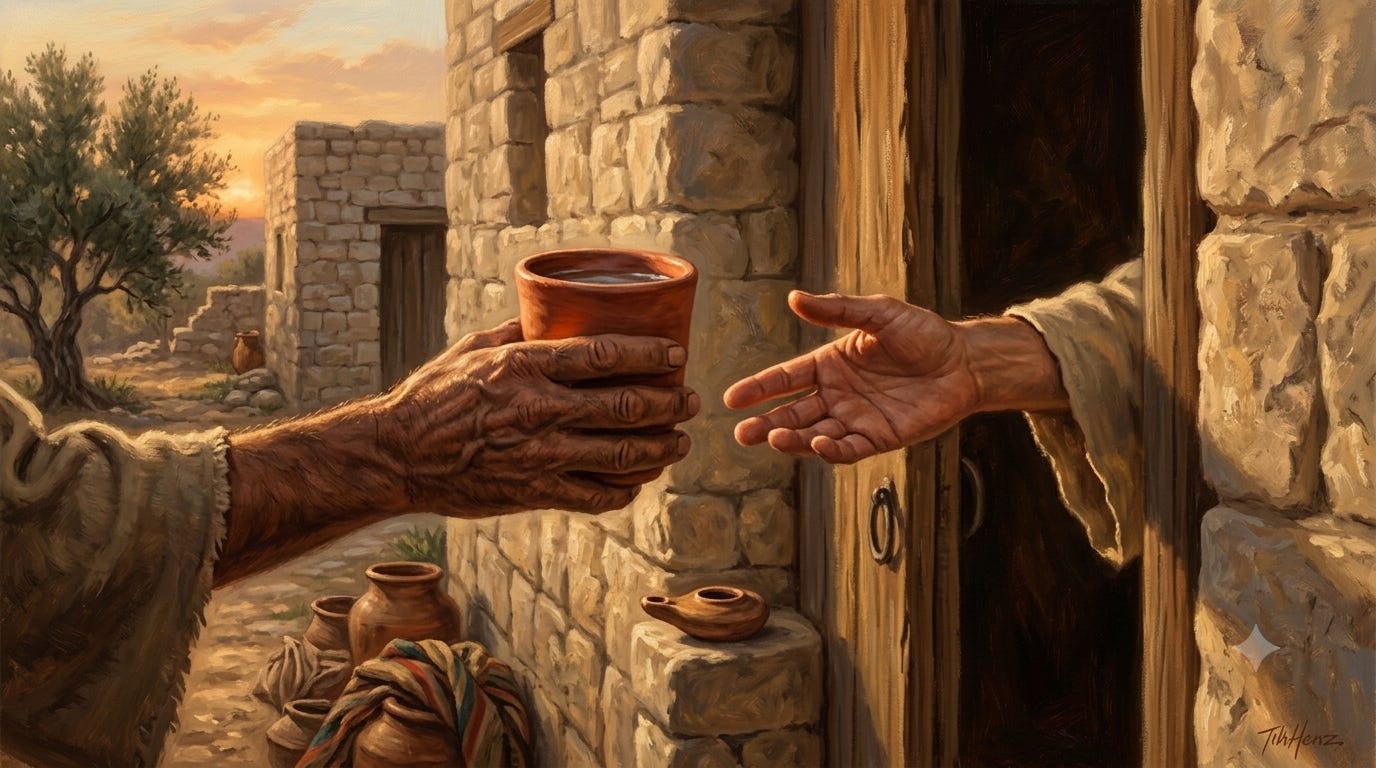
Jesus said a cup of cold water given to one of His disciples carries eternal weight. The gesture does not have to be large.
The Gospel: Matthew 10:37-42
³⁷ "Whoever loves father or mother more than me is not worthy of me, and whoever loves son or daughter more than me is not worthy of me; ³⁸ and whoever does not take up his cross and follow after me is not worthy of me. ³⁹ Whoever finds his life will lose it, and whoever loses his life for my sake will find it.
⁴⁰ "Whoever receives you receives me, and whoever receives me receives the one who sent me. ⁴¹ Whoever receives a prophet because he is a prophet will receive a prophet's reward, and whoever receives a righteous man because he is righteous will receive a righteous man's reward. ⁴² And whoever gives only a cup of cold water to one of these little ones to drink because he is a disciple — amen, I say to you, he will surely not lose his reward."
Today’s Focus
Jesus establishes total allegiance to Himself above even the deepest family loyalty, describes the paradox where preserving one's life loses it and surrendering it for His sake finds it, and closes by establishing that receiving His messengers is functionally receiving Him, with even the smallest gesture of hospitality toward a disciple carrying eternal reward.
In the Margins
Jesus has just told the Twelve that He has not come to bring peace but a sword, that His coming will divide households. What follows is the most demanding statement of priority in the entire missionary discourse.
Whoever loves father or mother more than me is not worthy of me, and whoever loves son or daughter more than me is not worthy of me. Jesus is not telling people to love their parents or children less, and He is certainly not undoing the commandment to honor father and mother, one of the Ten Commandments. What He is doing is naming who gets to occupy the top position in a person’s life. Every life has a center, the thing or person every other relationship and decision orbits around. For most people that center is family. Jesus is saying that center now belongs to Him. Family love does not disappear. It gets reordered underneath a deeper allegiance. In practical terms, this means that when a parent’s expectations and Jesus’ call genuinely conflict, when a son or daughter’s approval and faithfulness to Christ cannot both be had, the follower of Jesus chooses Him. That was a real and costly possibility for His first hearers, since following Jesus often meant exactly this kind of family rupture, and it remains a real possibility today whenever loyalty to a relationship would require compromising what Jesus actually asks of us.
Whoever does not take up his cross and follow after me is not worthy of me. The cross was a real instrument of Roman execution. To take one up meant carrying the beam toward your own death. Jesus is describing total, costly allegiance, not yet knowing His listeners would one day watch Him carry that same beam Himself.
Whoever finds his life will lose it, and whoever loses his life for my sake will find it. The life a person tries to protect and secure above everything else is precisely the life that slips away. The life surrendered for Jesus is the life that is actually found. This is the kingdom inverting the world’s entire logic of self-preservation.
The passage then shifts from cost to welcome. Whoever receives you receives me, and whoever receives me receives the one who sent me. The disciples carry Jesus’ own presence with them. To welcome His messenger is to welcome Him.
Whoever receives a prophet because he is a prophet will receive a prophet’s reward, and whoever receives a righteous man because he is righteous will receive a righteous man’s reward. Supporting someone doing God’s work was understood to share in the merit of that work.
And whoever gives only a cup of cold water to one of these little ones because he is a disciple will surely not lose his reward. Not a banquet. Not significant resources. A cup of water, offered specifically because the recipient belongs to Jesus, carries eternal weight.
The passage that begins with the staggering cost of discipleship ends with the staggering accessibility of its reward. Not everyone is called to carry a cross the way the Twelve were. But everyone has access to a cup of water and the choice of who to give it to.
Reflection Question
Where is your life organized around preservation and security rather than surrender, and what would it look like to lose that particular grip for the sake of Jesus?