

28 Mar 26 | The Cost of Believing
Caiaphas speaks better than he knows, and the death he plots to protect his position becomes the very thing that accomplishes what the prophets were always pointing toward.
The Gospel: John 11:45-56
Many of the Jews who had come to Mary
and seen what Jesus had done began to believe in him.
But some of them went to the Pharisees
and told them what Jesus had done.
So the chief priests and the Pharisees
convened the Sanhedrin and said,
“What are we going to do?
This man is performing many signs.
If we leave him alone, all will believe in him,
and the Romans will come
and take away both our land and our nation.”
But one of them, Caiaphas,
who was high priest that year, said to them,
“You know nothing,
nor do you consider that it is better for you
that one man should die instead of the people,
so that the whole nation may not perish.”
He did not say this on his own,
but since he was high priest for that year,
he prophesied that Jesus was going to die for the nation,
and not only for the nation,
but also to gather into one the dispersed children of God.
So from that day on they planned to kill him.
So Jesus no longer walked about in public among the Jews,
but he left for the region near the desert,
to a town called Ephraim,
and there he remained with his disciples.
Now the Passover of the Jews was near,
and many went up from the country to Jerusalem
before Passover to purify themselves.
They looked for Jesus and said to one another
as they were in the temple area, “What do you think?
That he will not come to the feast?”
Today’s Focus
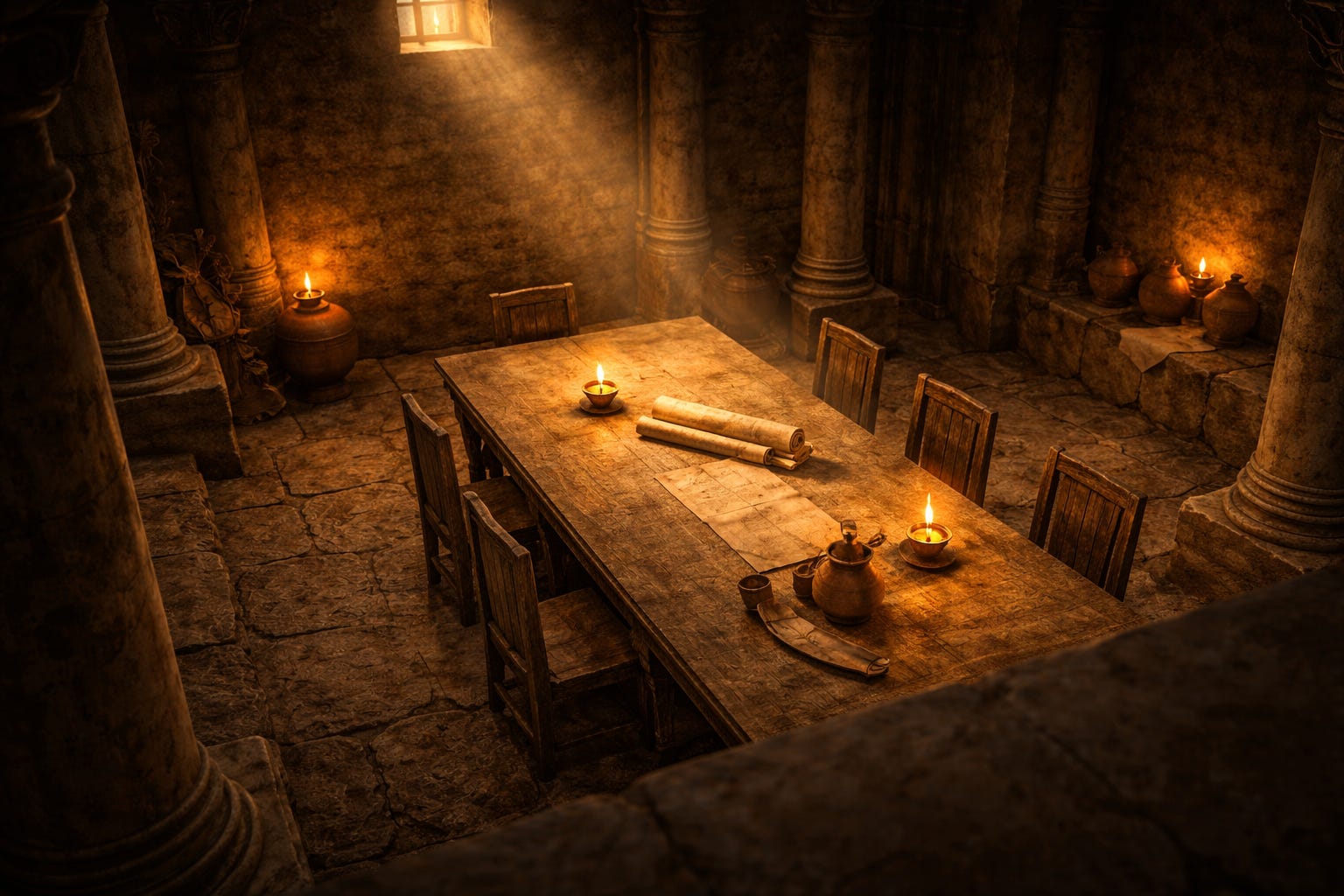
The Sanhedrin did not dispute the signs or argue the witnesses were unreliable. They gathered in a room, acknowledged that Jesus was working, and asked what believing in him would cost them politically. Caiaphas gave them a way out. One man dies, the nation survives, the institution holds. What he did not know was that his words were truer than his intentions. One man would die for the nation, and not only for the nation, but to gather into one the scattered children of God. The very death being plotted in that room would accomplish what Isaiah and Ezekiel had been pointing toward for centuries. The question this passage presses on every reader is the same one the Sanhedrin was really asking. Not whether the evidence is sufficient. But what believing would cost you.
In the Margins
This happens immediately following the raising of Lazarus, arguably the most powerful sign Jesus performed. Many who witnessed it believed, but even then there were still those that did not and the group remained divided. With this, some go straight to the Pharisees. Everyone witnessed the same sign, but what each person does with it is their own.
The Sanhedrin convenes and the conversation is remarkably candid. They do not dispute the signs or argue that the witnesses are unreliable. Their concern is primarily political in nature. The issue they are facing is that if they leave Him alone, everyone will believe in Him and Rome will interpret a popular messianic movement as a threat. The fear is not irrational and Rome had suppressed such movements before and done so with overwhelming force.
The Sanhedrin’s problem is not that Jesus is a fraud, rather that He is working and they cannot control what that means for their position. An interesting point here is that many believed the new king would be a great warrior and were surprised to see Jesus. Here, we see the Sanhedrin afraid that this would cause a movement that would threaten Rome, something Jesus was doing through peace, love, and showing the glory of God. Caiaphas cuts through the deliberation with brutal pragmatism. He frames the decision around the view that it is better for one man to die than for the whole nation to perish.
In Israel, the high priest carried a mediating function between God and the people, standing before God on behalf of the nation and bearing that weight throughout his office. Part of that role, in Israel’s history, included moments where the office itself became a channel for divine communication, not because the person holding it was holy, but because of what the office represented before God. Caiaphas is doing political calculus, but the words coming out of his mouth are carrying a far larger truth.
What he accidentally announces is the theological center of the entire Gospel. One man will die for the nation, and not only for the nation, but to gather into one the dispersed children of God. That phrase reaches back to Isaiah and Ezekiel, who spoke of a day when God would gather His scattered people from every corner of the earth and reconstitute them as one. The very death being plotted in that room will accomplish what those prophecies were pointing toward, on a scale extending far beyond Israel.
From that day the decision is made. Jesus withdraws to Ephraim near the desert and remains with His disciples, moving according to the Father’s timing rather than the pressure of His opponents. The passage closes with Passover approaching, the annual commemoration of the night in Egypt when the blood of a lamb on the doorposts caused death to pass over Israel’s households, and crowds wondering aloud whether Jesus will come to the feast. The feast they are gathering to observe is about to become the reality it was always pointing toward.
The application this passage presses toward is specific. The Sanhedrin had more evidence than most people will ever have and it was not enough, because the question they were asking was not whether Jesus was who He claimed to be. The question they were asking was what belief in Him would cost them. That is still the question. What this Gospel demands is not general openness to faith. It is an honest reckoning with what we are protecting that keeps us from following the evidence where it leads.
Reflection Question
What are you protecting that keeps you from following the evidence about Jesus where it leads?
A Small Invitation
If this reflection helped you, consider sharing it with someone who may benefit from hearing this message.