

The Gospel: Mark 10:46-52
⁴⁶ They came to Jericho. And as he was leaving Jericho with his disciples and a sizable crowd, Bartimaeus, a blind man, the son of Timaeus, sat by the roadside begging. ⁴⁷ On hearing that it was Jesus of Nazareth, he began to cry out and say, "Jesus, son of David, have pity on me." ⁴⁸ And many rebuked him, telling him to be silent. But he kept calling out all the more, "Son of David, have pity on me." ⁴⁹ Jesus stopped and said, "Call him." So they called the blind man, saying to him, "Take courage; get up, he is calling you." ⁵⁰ He threw aside his cloak, sprang up, and came to Jesus. ⁵¹ Jesus said to him in reply, "What do you want me to do for you?" The blind man replied to him, "Master, I want to see." ⁵² Jesus told him, "Go your way; your faith has saved you." Immediately he received his sight and followed him on the way.
Today’s Focus
Bartimaeus refuses the crowd's rebuke and calls out to Jesus with messianic faith, throws aside his only possession to reach Him, and receives both physical sight and the salvation Jesus names as its ground, immediately following Jesus toward Jerusalem.
In the Margins
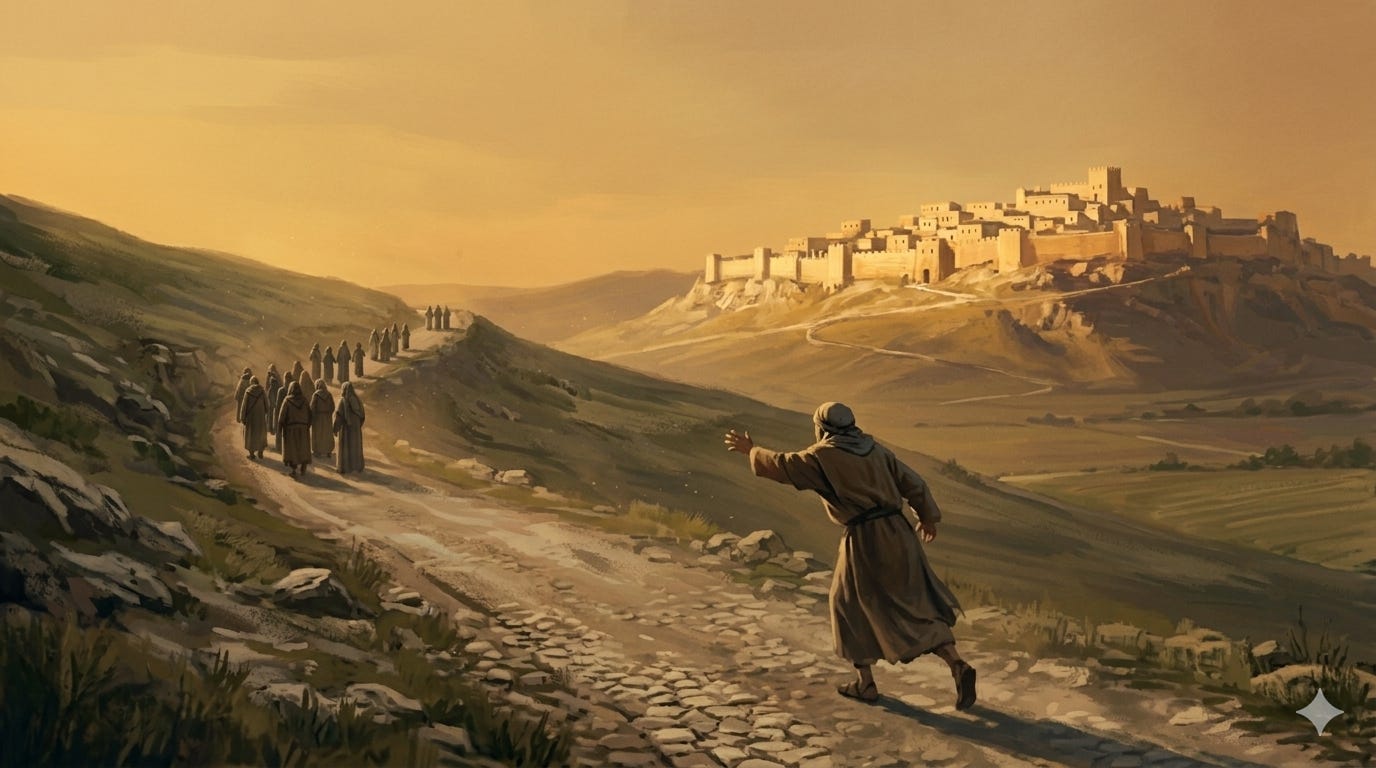
Bartimaeus is sitting beside the road outside Jericho when the crowd passes. He is blind, he is begging, and he knows one thing about what is happening: Jesus of Nazareth is going by. What he does with that information is the entire passage.
He calls out with a title that carries theological weight far beyond what the crowd would have expected from a blind beggar on the roadside. Son of David. This is messianic language drawn from the covenant God made with David in 2 Samuel 7, the promise that a descendant of David’s line would rule forever. By the first century this expectation had become the central hope of Israel’s restoration. Bartimaeus is not making a generic appeal for sympathy. He is making a confession.
The crowd rebukes him. He cries out all the more. The persistence is not stubbornness. It is the logic of someone who understands that this moment may not come again and that the crowd’s opinion is irrelevant compared to the possibility in front of him. He threw aside his cloak. Mark includes this detail quietly. A beggar’s cloak was his most essential possession, his protection, his mat, his collection bowl. He throws it aside to reach Jesus without anything slowing him down.
Jesus stops. What do you want me to do for you? It is the same question He refused to grant automatically to James and John in the previous passage, not because He cannot answer but because requests that come from a different place receive a different response. Bartimaeus asks to see. Jesus grants it and names what made it possible. Your faith has saved you.
The Greek word sōzō, translated as saved, is the same word for salvation throughout the New Testament. Mark is not distinguishing between physical healing and spiritual salvation. He is presenting them as the same event at different depths. The seeing Bartimaeus receives and the salvation Jesus names are two descriptions of what just happened to one man.
What follows is the detail that completes the story. He received his sight and followed Jesus on the way. The road Jesus was on was the road to Jerusalem and the cross. Bartimaeus, who could see nothing an hour earlier, immediately follows the one who gave him sight toward the hardest destination in the Gospel.
If you are in a season where the crowd around you is telling you to be quiet, to be realistic, to stop hoping for something that seems too large, this passage offers a different posture. Bartimaeus had nothing to lose and everything to gain. The crowd could not help him. Jesus could. That clarity cut through everything else.
Reflection Question
What is the crowd in your life telling you to be quiet about, and what would it look like to call out anyway?