

29 Mar 26 | The King Nobody Crowned
The soldiers dressed him as a king to humiliate him, and every detail they got wrong they got exactly right.
The Gospel: Matthew 27:11-54
Jesus stood before the governor, Pontius Pilate, who questioned him,
"Are you the king of the Jews?"
Jesus said, "You say so."
And when he was accused by the chief priests and elders,
he made no answer.
Then Pilate said to him,
"Do you not hear how many things they are testifying against you?"
But he did not answer him one word,
so that the governor was greatly amazed.
Now on the occasion of the feast
the governor was accustomed to release to the crowd
one prisoner whom they wished.
And at that time they had a notorious prisoner called Barabbas.
So when they had assembled, Pilate said to them,
"Which one do you want me to release to you,
Barabbas, or Jesus called Christ?"
For he knew that it was out of envy
that they had handed him over.
While he was still seated on the bench,
his wife sent him a message,
"Have nothing to do with that righteous man.
I suffered much in a dream today because of him."
The chief priests and the elders persuaded the crowds
to ask for Barabbas but to destroy Jesus.
The governor said to them in reply,
"Which of the two do you want me to release to you?"
They answered, "Barabbas!"
Pilate said to them,
"Then what shall I do with Jesus called Christ?"
They all said,
"Let him be crucified!"
But he said,
"Why? What evil has he done?"
They only shouted the louder,
"Let him be crucified!"
When Pilate saw that he was not succeeding at all,
but that a riot was breaking out instead,
he took water and washed his hands in the sight of the crowd,
saying, "I am innocent of this man's blood.
Look to it yourselves."
And the whole people said in reply,
"His blood be upon us and upon our children."
Then he released Barabbas to them,
but after he had Jesus scourged,
he handed him over to be crucified.
Then the soldiers of the governor took Jesus inside the praetorium
and gathered the whole cohort around him.
They stripped off his clothes
and threw a scarlet military cloak about him.
Weaving a crown out of thorns, they placed it on his head,
and a reed in his right hand.
And kneeling before him, they mocked him, saying,
"Hail, King of the Jews!"
They spat upon him and took the reed
and kept striking him on the head.
And when they had mocked him,
they stripped him of the cloak,
dressed him in his own clothes,
and led him off to crucify him.
As they were going out, they met a Cyrenian named Simon;
this man they pressed into service
to carry his cross.
And when they came to a place called Golgotha
— which means Place of the Skull —,
they gave Jesus wine to drink mixed with gall.
But when he had tasted it, he refused to drink.
After they had crucified him,
they divided his garments by casting lots;
then they sat down and kept watch over him there.
And they placed over his head the written charge against him:
This is Jesus, the King of the Jews.
Two revolutionaries were crucified with him,
one on his right and the other on his left.
Those passing by reviled him, shaking their heads and saying,
"You who would destroy the temple and rebuild it in three days,
save yourself, if you are the Son of God,
and come down from the cross!"
Likewise the chief priests with the scribes and elders mocked him and said,
"He saved others; he cannot save himself.
So he is the king of Israel!
Let him come down from the cross now,
and we will believe in him.
He trusted in God;
let him deliver him now if he wants him.
For he said, 'I am the Son of God.'"
The revolutionaries who were crucified with him
also kept abusing him in the same way.
From noon onward, darkness came over the whole land
until three in the afternoon.
And about three o'clock Jesus cried out in a loud voice,
"Eli, Eli, lema sabachthani?"
which means, "My God, my God, why have you forsaken me?"
Some of the bystanders who heard it said,
"This one is calling for Elijah."
Immediately one of them ran to get a sponge;
he soaked it in wine, and putting it on a reed,
gave it to him to drink.
But the rest said,
'Wait, let us see if Elijah comes to save him."
But Jesus cried out again in a loud voice,
and gave up his spirit.
Here all kneel and pause for a short time.
And behold, the veil of the sanctuary
was torn in two from top to bottom.
The earth quaked, rocks were split, tombs were opened,
and the bodies of many saints who had fallen asleep were raised.
And coming forth from their tombs after his resurrection,
they entered the holy city and appeared to many.
The centurion and the men with him who were keeping watch over Jesus
feared greatly when they saw the earthquake
and all that was happening, and they said,
"Truly, this was the Son of God!"
Today’s Focus
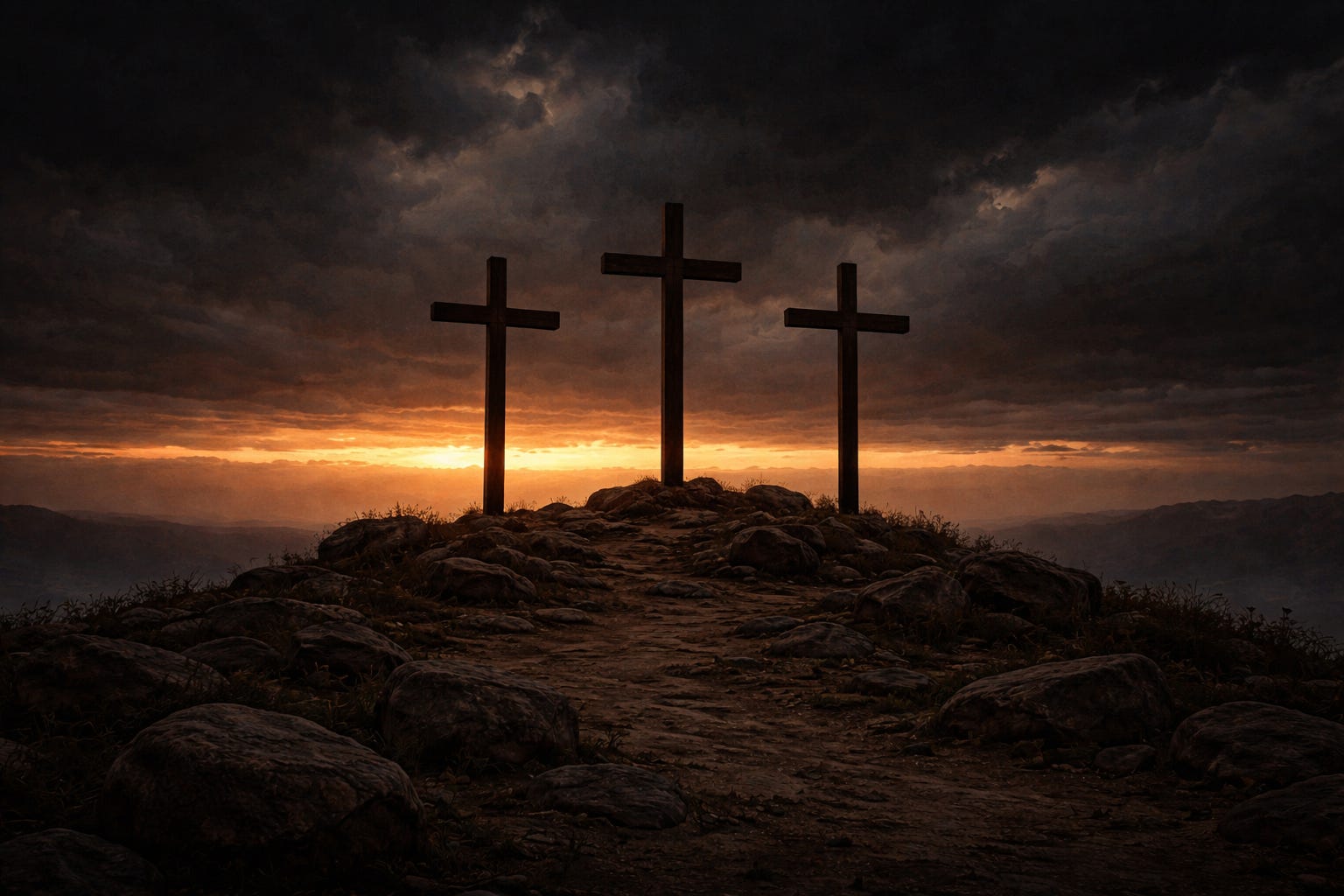
Isaiah described him seven centuries before he arrived. The soldiers mocked him with the truth. A Gentile woman dreamed about him and tried to warn her husband. A Roman soldier watched him die and said what the disciples could not bring themselves to say. The cross looked like the end of the story. It was the story arriving at the moment it had always been moving toward. The veil tore. The earth shook. The barrier between God and humanity that the entire Temple system was built to manage was removed by the death of the one they crowned with thorns.
In the Margins
What Matthew records here is the most consequential sequence of events in human history. Pilate’s question cuts to the heart of everything, asking Jesus if He is the king of the Jews? Jesus answers with a phrase that is neither confirmation nor denial. The chief priests and elders pile accusation upon accusation and He answers nothing. Isaiah 53 described the suffering servant who would be led like a lamb to slaughter, who would not open his mouth. Matthew’s Gospel is showing the fulfillment of a portrait Isaiah drew seven centuries earlier, of a figure who would bear the weight of the nation’s guilt without defense.
Pilate knows what is happening and we Matthew tells us plainly that he recognized envy as the motive behind the handover. His wife’s dream adds another layer. In the Old Testament, dreams carried divine weight. God warned the magi through a dream. He directed Joseph through dreams repeatedly. Now a Gentile woman receives a dream about a righteous man and sends an urgent warning to her husband. The warning goes unheeded. Pilate performs the public handwashing, a gesture drawn from Deuteronomy 21, where elders of a city washed their hands over an unresolved killing to declare their innocence. The crowd absorbs the declaration and answers back with words that carry the full weight of covenantal language. His blood be upon us and upon our children. In Israel’s covenant framework, to take blood upon oneself was to accept moral and legal responsibility for a death. It is important to note that while this is a significant passage in the Bible, Christianity does not read this as a collective curse on the Jewish people.
The mockery in the praetorium is a dark mirror of what Jesus actually is. The soldiers dress Him in scarlet, place a crown on His head, and kneel before Him shouting Hail, King of the Jews. Every element is intended as humiliation. Every element is accidentally true. He is the king. The crown, though made of thorns, sits on the head of the one to whom all authority in heaven and earth belongs.
At Golgotha, which means Place of the Skull, Jesus refuses the wine mixed with gall. Psalm 69 speaks of the righteous sufferer being given gall to drink. His death will be entered into with full consciousness and full will. The garments divided by lot fulfill Psalm 22 precisely, a psalm that opens with the very words Jesus will cry from the cross.
The darkness from noon to three in the afternoon is not incidental atmosphere. In the prophetic tradition, darkness in the middle of the day signaled divine judgment. Amos 8 warned of a day when God would make the sun go down at noon and darken the earth in broad daylight as a sign of judgment on Israel. We do know that scientifically, there was a lunar eclipse on Friday April 3, 33 AD.
Jesus cries out in Aramaic, quoting the opening line of Psalm 22. My God, my God, why have you forsaken me. This is not a moment of lost faith as some have tried to claim. The Psalms were not numbered. The way one would tell someone to look to a Psalm would be to quote the opening line, just as is done here. Psalm 22 is a psalm that moves from desolation to vindication, ending in the declaration that God has not hidden His face from the afflicted one but has heard his cry. Jesus is praying the psalm from inside the suffering it describes.
When He dies, three things happen at once. The Temple veil tears from top to bottom. The earth shakes. Tombs open. The veil separated the Holy of Holies, the innermost chamber where God’s presence dwelt, from the rest of the Temple. Only the high priest could enter it, and only once a year on the Day of Atonement. The barrier between God and humanity that the entire Temple system was built around has been removed by the death of the one the soldiers mocked as king. The earthquake and the opening of tombs signal that what is happening is not contained to one man on one cross.
The first confession of Jesus as Son of God in Matthew’s Passion does not come from a disciple or anyone who had followed Him. It comes from a Roman centurion who has just watched Him die. At the foot of the cross, in the mouth of a Gentile soldier, is the truth the whole narrative has been building toward.
Reflection Question
What would it mean for you to stand at the foot of that cross today and say what the centurion said?
A Small Invitation
If this reflection helped you, consider sharing it with someone who may benefit from hearing this message.