

The Gospel: Mark 4:35-41
On that day, as evening drew on, Jesus said to his disciples:
“Let us cross to the other side.”
Leaving the crowd, they took Jesus with them in the boat just as he was.
And other boats were with him.
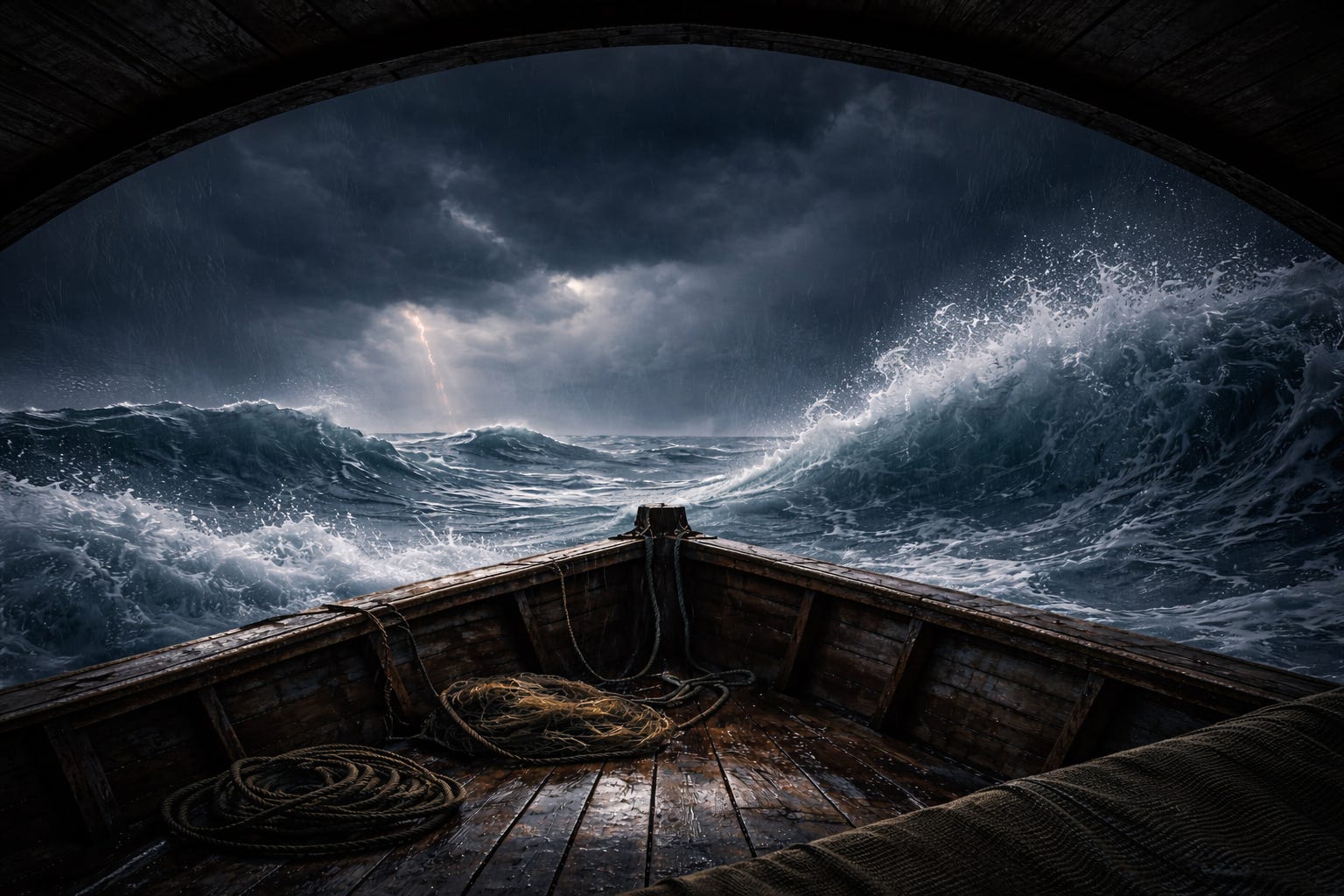
A violent squall came up and waves were breaking over the boat,
so that it was already filling up.
Jesus was in the stern, asleep on a cushion.
They woke him and said to him,
“Teacher, do you not care that we are perishing?”
He woke up,
rebuked the wind,
and said to the sea, “Quiet! Be still!”
The wind ceased and there was great calm.
Then he asked them, “Why are you terrified?
Do you not yet have faith?”
They were filled with great awe and said to one another,
“Who then is this whom even wind and sea obey?”
Today’s Focus
This Gospel shows that obedience to Jesus does not remove uncertainty, but places us directly inside it. The presence of Christ does not eliminate storms, but it does redefine what they mean. Faith is not proven by calm waters, but by who we trust when the boat is filling.
In the Margins
This Gospel begins with a decision, not a miracle. “Let us cross to the other side” is spoken deliberately by Jesus. The movement is His idea. This matters because Scripture consistently presents crossings as moments of transition, testing, and divine encounter. Israel crosses the Red Sea before becoming a free people in Exodus 14. Joshua leads Israel across the Jordan before entering the promised land in Joshua 3. Jonah attempts to flee by sea and is confronted by God’s authority over the waters in Jonah 1. Crossings are never incidental, and this one proves to follow that same notion. These are moments when God reveals who He is and who His people are becoming.
The timing reinforces this. It is evening, visibility is limited, and safety is no longer guaranteed. Jesus does not wait for ideal conditions. Obedience is not scheduled around comfort. The disciples leave the crowd behind, which signals a shift from public ministry to private formation. Crowds witness signs, but disciples are shaped through obedience that leads into uncertainty.
Mark adds a detail that should not be rushed past. “They took Jesus with them in the boat just as he was.” There is no preparation, no repositioning, no attempt to control the circumstances. Jesus is not adjusted to fit the situation. He is received as He is. It is the end of a long period of teaching, and Jesus climbs in the boat and is ready to go. This echoes a larger biblical pattern. God is not domesticated for human plans. Moses encounters God in the wilderness, not in Egypt. Elijah meets God in silence, not in power, in 1 Kings 19. God reveals Himself on His own terms.
The storm is real, though Jesus is sleeping through it. We have covered how quickly the sea conditions change in earlier writings. These are experienced fishermen, not anxious novices. Their fear is understandable. What exposes the deeper issue is their question. “Do you not care that we are perishing?” This is not simply panic. It is a theological accusation. Jesus is present, but they assume His presence should prevent suffering. This reveals an expectation that faith guarantees protection rather than trust.
Jesus sleeping is not a sign of indifference. In the Psalms, God is repeatedly contrasted with anxious humanity. Psalm 4 speaks of resting in peace because the Lord alone makes one dwell in safety. Jesus sleeping during chaos reveals divine authority, not neglect. When He rises, He speaks to the wind and the sea with language of command. This recalls Genesis 1, where God brings order by speaking. Creation responds immediately because it recognizes its Creator.
Only after restoring order does Jesus address the disciples. His questions are revealing. Fear is named first. Faith is addressed second. Faith, in Scripture, is not the absence of danger but trust in the presence of God within it. The disciples end the passage in awe, not relief. Their final question is the most important one. “Who then is this?” The storm has been calmed, but the deeper work has only begun.
We often times expect miracles or a lack of suffering because we are believers. This Gospel is an example of at least two things. The first is that there can still be suffering, even with belief. The second is that sometimes, it is through suffering, that we form our strongest faith.
Reflection Question
Where has following Jesus led you into uncertainty rather than away from it, and what assumptions about His presence does that reveal?
A Small Invitation
If this reflection helped you, consider sharing it with someone who may be carrying more than they were meant to.